
Table of Contents
Ellijah is a distinctive spelling variation of the classic biblical name Elijah, carrying profound religious significance across multiple faith traditions. With roots in ancient Hebrew, this name has resonated through millennia, from the fiery prophet of the Old Testament to modern bearers around the world. Whether spelled as Elijah, Elias, or Ellijah, this name maintains its powerful declaration of faith: ‘My God is Yahweh.’ Discover the rich history, cultural adaptations, and enduring appeal of this timeless name.
Meaning of Ellijah
The name Ellijah derives directly from the Hebrew name אֵלִיָּהוּ (Eliyyahu), which is a compound of two essential Hebrew elements. The first component ‘El’ (אֵל) is one of the primary words for ‘God’ in Hebrew, appearing throughout the Tanakh (Hebrew Bible). The second component ‘Yah’ (יָהּ) is a contraction of Yahweh (יהוה), the personal name of the God of Israel revealed to Moses. Thus, the complete meaning is ‘My God is Yahweh’ or ‘Yahweh is my God’—a powerful statement of monotheistic faith. This name gained prominence through the prophet Elijah, who lived in the 9th century BCE during the reign of King Ahab and Queen Jezebel, famously challenging the worship of Baal on Mount Carmel. The spelling ‘Ellijah’ represents an English phonetic adaptation that preserves the original Hebrew meaning while offering a distinctive orthographic variation.
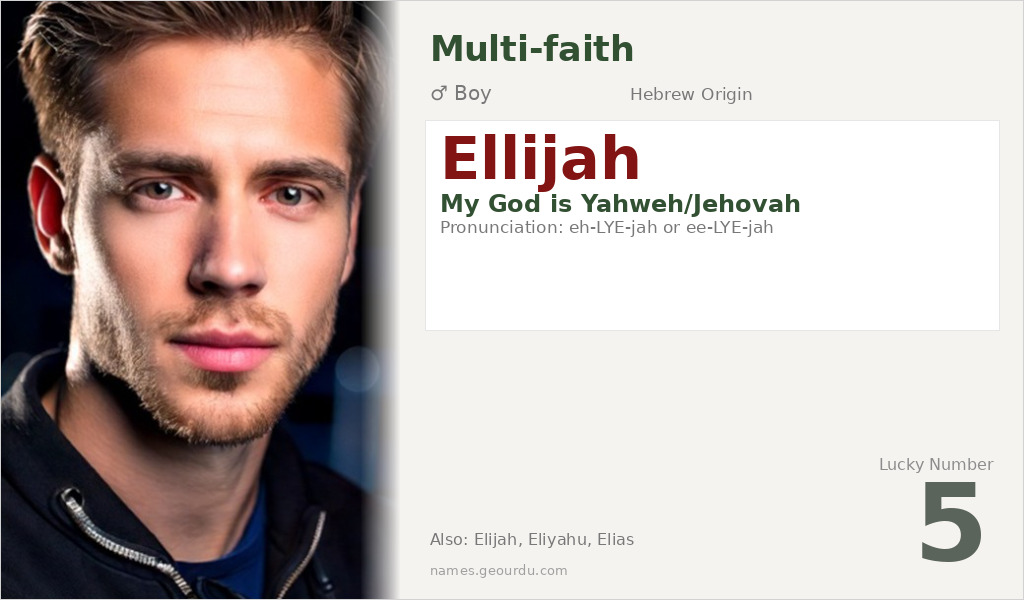
| 📛 Name | Ellijah |
| 💎 Meaning | My God is Yahweh/Jehovah |
| 👤 Gender | Boy |
| 🕌 Religion | Multi-faith |
| 🌍 Origin | Hebrew |
| 🗣 Pronunciation | eh-LYE-jah or ee-LYE-jah |
| ✍️ Urdu | الیاس |
| ✍️ Arabic | إيليا |
| 🔢 Numerology | 5 |
| ✨ Spellings | Elijah, Eliyahu, Elias, Ilyas, Elia, Elija |
Origin & Cultural Significance
Ellijah originates from ancient Hebrew culture and appears in the Tanakh (Hebrew Bible) as the name of one of the most significant prophets in Jewish tradition. The biblical Elijah (Eliyahu) was a Tishbite prophet known for his miracles, confrontation with the prophets of Baal, and eventual ascent to heaven in a chariot of fire. In Christianity, Elijah is revered as a forerunner to John the Baptist and Jesus, mentioned in both Old and New Testaments. In Islam, he is known as Ilyas (إلياس), considered a prophet (nabi) who called people to worship Allah alone. The name has spread globally through religious texts, with variations appearing in numerous languages: Elias in Greek and Latin, Ilyas in Arabic, and Elijah/Ellijah in English. This cross-cultural adoption makes it a truly multi-faith name with deep roots in Abrahamic traditions.
Personality Traits
Names often carry symbolic associations, and Ellijah/Elijah is frequently connected with traits of spiritual strength, conviction, and leadership. Drawing from the biblical prophet’s character, those bearing this name are often perceived as principled individuals with strong moral compasses. They may exhibit determination in facing challenges and a capacity to inspire others through their convictions. While personality varies by individual, the name’s historical and religious associations suggest qualities of faithfulness, courage, and a connection to spiritual matters.
Similar Names
If you like Ellijah, consider: Elisha, Eli, Eliezer, Ezekiel, Isaiah
Famous People Named Ellijah
- Elijah Wood — American actor best known for playing Frodo Baggins in The Lord of the Rings film trilogy
- Elijah Muhammad — American religious leader who led the Nation of Islam from 1934 to 1975
Frequently Asked Questions About Ellijah
What does Ellijah mean?
Ellijah means 'My God is Yahweh' or 'Yahweh is my God.' It originates from the Hebrew name Eliyyahu, composed of 'El' (God) and 'Yah' (short for Yahweh).
Is Ellijah a boy or girl name?
Ellijah is traditionally and predominantly a boy's name, stemming from the male biblical prophet Elijah. While names can evolve, historical and current usage strongly associates it with males.
What is the origin of Ellijah?
Ellijah originates from Hebrew, specifically from the biblical name אֵלִיָּהוּ (Eliyyahu). It has been adopted into Christianity, Islam (as Ilyas), and various cultures worldwide, maintaining its religious significance across Abrahamic faiths.





