
Table of Contents
Elrond is a name that transports us to the epic realms of Middle-earth, crafted by the legendary author J.R.R. Tolkien. Meaning ‘star-dome’ in the fictional Sindarin language, it belongs to one of Tolkien’s most revered characters: Elrond Half-elven, the wise Lord of Rivendell. While not rooted in ancient real-world cultures, this name has captured imaginations worldwide through literature and film. Its celestial meaning and noble associations make it a unique choice for parents seeking a name with literary depth and mythical resonance.
Meaning of Elrond
Elrond derives from J.R.R. Tolkien’s constructed Elvish language, Sindarin, where it is a compound of two elements: ‘el’, meaning ‘star’, and ‘rond’, meaning ‘dome’ or ‘vaulted roof’. Thus, the name translates precisely to ‘star-dome’ or ‘vault of stars’, evoking imagery of the night sky and celestial grandeur. Tolkien, a philologist, designed Sindarin with influences from Welsh and other languages, ensuring linguistic consistency in his legendarium. In his works, Elrond’s name reflects his heritage as a half-elf with ties to both the mortal and immortal realms, symbolizing wisdom and endurance. This meaning is well-documented in Tolkien’s writings, such as ‘The Silmarillion’ and linguistic essays, making it a definitive example of his artistic onomastics.
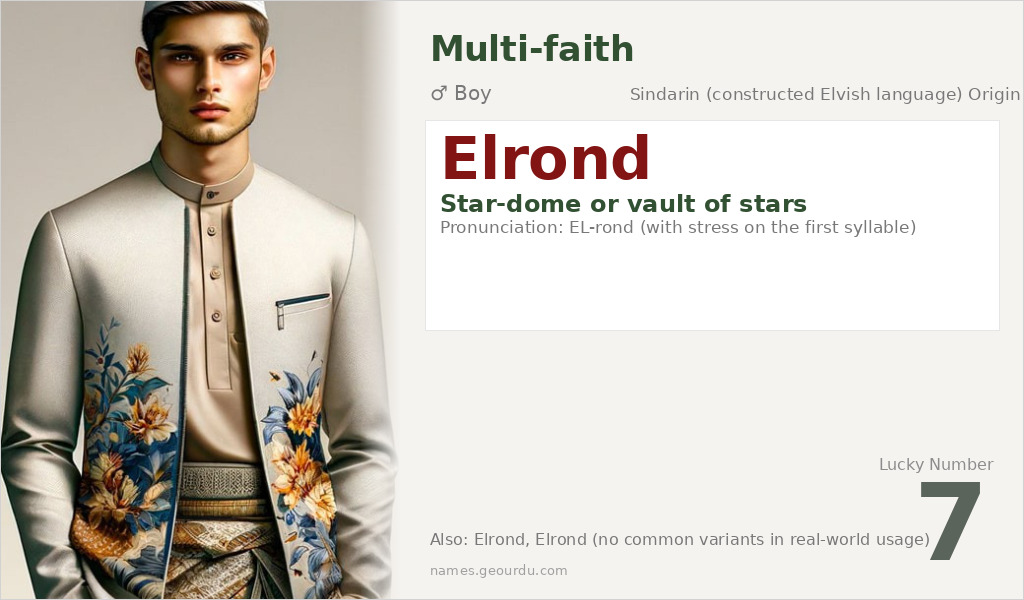
| 📛 Name | Elrond |
| 💎 Meaning | Star-dome or vault of stars |
| 👤 Gender | Boy |
| 🕌 Religion | Multi-faith |
| 🌍 Origin | Sindarin (constructed Elvish language) |
| 🗣 Pronunciation | EL-rond (with stress on the first syllable) |
| ✍️ Urdu | ایلرونڈ |
| ✍️ Arabic | إلروند |
| 🔢 Numerology | 7 |
| ✨ Spellings | Elrond, Elrond (no common variants in real-world usage) |
Origin & Cultural Significance
The origin of Elrond lies entirely within the fictional universe of J.R.R. Tolkien, first appearing in his Middle-earth legendarium in the mid-20th century. Tolkien introduced Elrond as a character in ‘The Hobbit’ (1937) and later expanded his role in ‘The Lord of the Rings’ (1954-1955) and ‘The Silmarillion’ (published posthumously in 1977). As a constructed name from Sindarin, one of Tolkien’s Elvish languages, it has no historical roots in real-world cultures like Arabic, Persian, or Germanic traditions. However, its popularity as a given name in the real world emerged after Tolkien’s works gained global fame, particularly following the film adaptations by Peter Jackson. Today, it is used sporadically, often by fans of fantasy literature, and symbolizes a connection to Tolkien’s rich mythological tapestry.
Personality Traits
Inspired by the character Elrond Half-elven, this name is associated with traits of wisdom, leadership, and serenity. Those named Elrond might be perceived as thoughtful and protective, often taking on roles as advisors or peacemakers in their communities. The name carries an air of ancient knowledge and resilience, hinting at a personality that values tradition and guidance. While these traits are fictional in origin, they influence how the name is viewed in modern contexts, offering a narrative of strength and celestial inspiration.
Similar Names
If you like Elrond, consider: Elros, Elendil, Eärendil, Celeborn, Glorfindel
Famous People Named Elrond
- Elrond Half-elven — Fictional character from J.R.R. Tolkien's 'The Lord of the Rings' and 'The Silmarillion', portrayed by Hugo Weaving in Peter Jackson's film adaptations
- Elrond Hubbard — Occasional reference in pop culture or fan works, but no widely recognized real-world famous person bears this name
Frequently Asked Questions About Elrond
What does Elrond mean?
Elrond means 'star-dome' or 'vault of stars' in Sindarin, the fictional Elvish language created by J.R.R. Tolkien for his Middle-earth legendarium.
Is Elrond a boy or girl name?
Elrond is exclusively a boy's name, as established by its use for the male character Elrond Half-elven in Tolkien's works. It has no traditional usage as a girl's name in any real-world culture.
What is the origin of Elrond?
Elrond originates from J.R.R. Tolkien's fictional universe, specifically from the Sindarin language spoken by Elves in Middle-earth. It has no verified etymology in historical languages like Arabic, Latin, or Sanskrit, being a constructed name for literary purposes.





