
Table of Contents
Emilia is a timeless feminine name with deep historical roots that has captivated parents across cultures for centuries. From ancient Roman nobility to modern celebrity bearers, this name carries an elegant strength that transcends borders and religions. With its melodic sound and meaningful etymology, Emilia continues to be a popular choice for girls worldwide, blending classical appeal with contemporary charm.
Meaning of Emilia
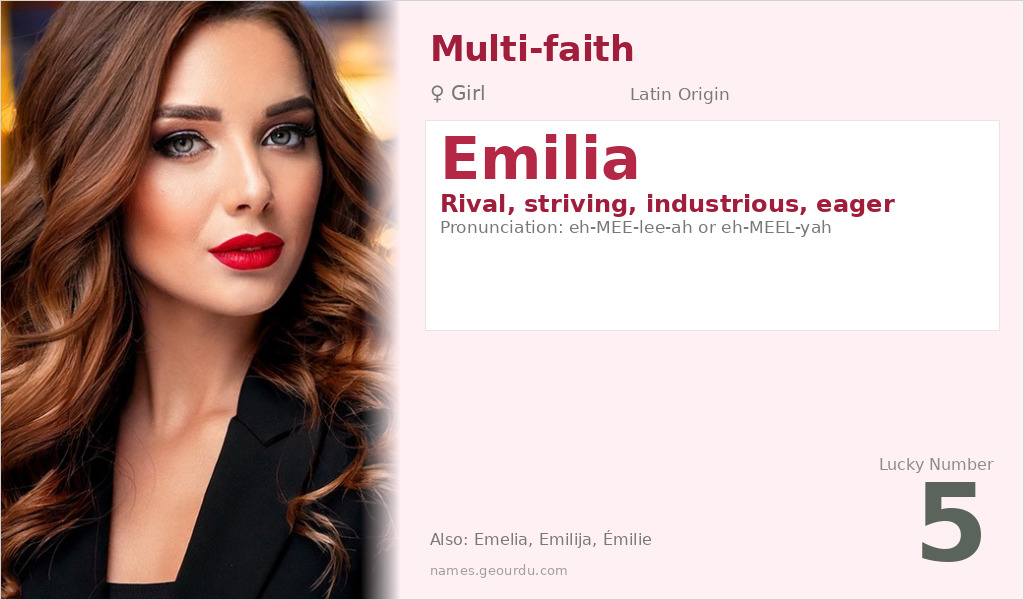
The name Emilia originates from the Latin word ‘aemulus’, which translates to ‘rival’ or ‘striving’. This evolved into the Roman family name Aemilius, with Emilia being its feminine form. The core meaning encompasses concepts of industriousness, eagerness, and healthy competition. Throughout its linguistic journey into Italian, Spanish, Portuguese, English, and other European languages, the name has maintained these essential qualities. The ‘rival’ connotation should be understood in its positive historical context—representing ambition and the drive to excel rather than mere opposition.
| 📛 Name | Emilia |
| 💎 Meaning | Rival, striving, industrious, eager |
| 👤 Gender | Girl |
| 🕌 Religion | Multi-faith |
| 🌍 Origin | Latin |
| 🗣 Pronunciation | eh-MEE-lee-ah or eh-MEEL-yah |
| ✍️ Urdu | ایمیلیا |
| ✍️ Arabic | إميليا |
| 🔢 Numerology | 5 |
| ✨ Spellings | Emelia, Emilija, Émilie, Emília, Emiliya |
Origin & Cultural Significance
Emilia has its roots in ancient Rome, where the gens Aemilia was one of the most prominent patrician families. The name spread throughout Europe during the Roman Empire and was later popularized by Christian saints, most notably Saint Emilia of Caesarea in the 4th century. During the Renaissance, the name gained literary prominence through works like Shakespeare’s ‘Othello’, which featured a character named Emilia. Today, it enjoys widespread usage across Christian, secular, and multi-faith contexts, with particular popularity in Italy, Spain, Portugal, Poland, and English-speaking countries.
Personality Traits
Those named Emilia often exhibit traits of determination, intelligence, and social grace. Drawing from the name’s Latin meaning of ‘striving’, they typically approach life with purpose and ambition. Their natural leadership qualities are often balanced with empathy and strong relational skills. The name’s historical association with nobility and literary characters adds a layer of sophistication to its personality profile.
Similar Names
If you like Emilia, consider: Amelia, Emily, Emma, Emiliana, Emilie
Famous People Named Emilia
- Emilia Clarke — British actress known for Game of Thrones
- Emilia Fox — English actress known for Silent Witness
- Saint Emilia — 4th century Christian saint, mother of Basil the Great
Frequently Asked Questions About Emilia
What does Emilia mean?
Emilia means 'rival', 'striving', or 'industrious' and originates from the Latin word 'aemulus'. It's the feminine form of the Roman family name Aemilius.
Is Emilia a boy or girl name?
Emilia is exclusively a feminine name. The masculine equivalents are Emil, Emilio, or the original Roman Aemilius.
What is the origin of Emilia?
Emilia has Latin origins, deriving from the Roman family name Aemilius. It spread throughout Europe and is now used in many cultures and languages worldwide.





