
Table of Contents
Emily is a timeless feminine name with deep historical roots and enduring popularity across cultures. Derived from ancient Roman origins, this name carries connotations of diligence and aspiration that have resonated for centuries. From literary heroines to modern celebrities, Emily has maintained its elegant appeal while adapting to contemporary naming trends.
Meaning of Emily
The name Emily traces back to the Latin ‘Aemilia’, the feminine form of the Roman family name Aemilius. This originates from the Latin word ‘aemulus’, which means ‘rival’ but carries the positive connotation of ‘striving to equal or excel’. Through French adaptation as Émilie during the Middle Ages, the name entered English usage with the meaning ‘industrious’ or ‘eager’. The semantic evolution reflects a shift from competitive rivalry to diligent effort, making Emily a name associated with ambition and hard work.
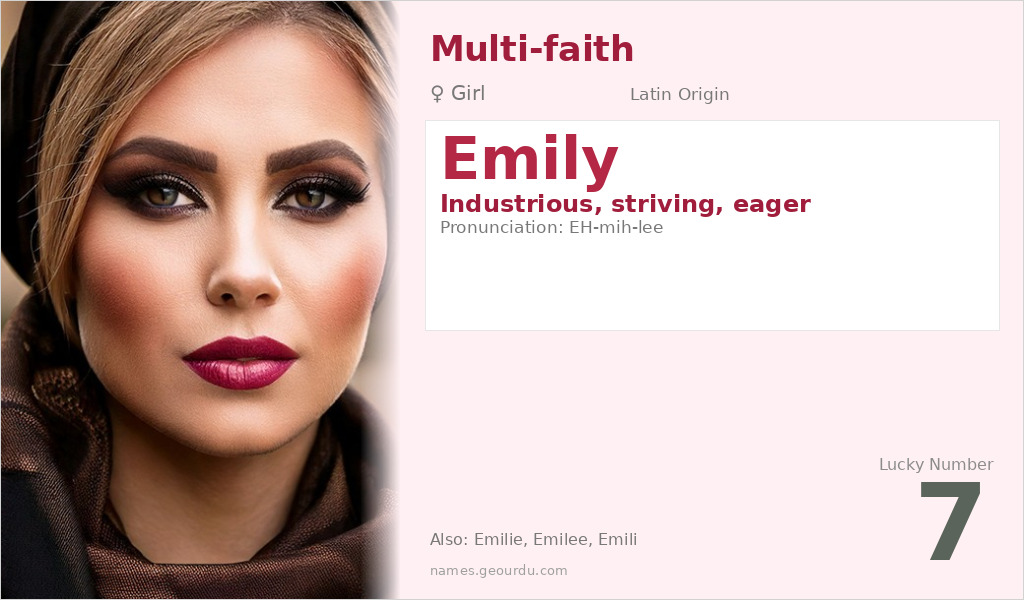
| 📛 Name | Emily |
| 💎 Meaning | Industrious, striving, eager |
| 👤 Gender | Girl |
| 🕌 Religion | Multi-faith |
| 🌍 Origin | Latin |
| 🗣 Pronunciation | EH-mih-lee |
| ✍️ Urdu | ایملی |
| ✍️ Arabic | إيميلي |
| 🔢 Numerology | 7 |
| ✨ Spellings | Emilie, Emilee, Emili, Emely |
Origin & Cultural Significance
Emily has its roots in ancient Rome, where Aemilia was a prominent patrician family name. The name gained popularity in medieval France as Émilie before crossing to England in the 18th century. It was popularized by literary works, particularly Samuel Richardson’s 1740 novel ‘Pamela’, which featured a character named Emily. The name saw a resurgence in the late 20th century, becoming one of the most popular girls’ names in English-speaking countries. While of Latin origin, Emily has been adopted across multiple cultures and religions without specific religious affiliation.
Personality Traits
Those named Emily are often perceived as creative, intelligent, and emotionally aware individuals. They typically possess strong communication skills and a natural curiosity that drives them to explore various interests. With their combination of diligence and compassion, Emilys often excel in fields requiring both analytical thinking and interpersonal sensitivity.
Similar Names
If you like Emily, consider: Amelia, Emma, Emilia, Emmeline, Emery
Famous People Named Emily
- Emily Brontë — English novelist and poet, author of Wuthering Heights
- Emily Dickinson — American poet known for her unique style and reclusive life
Frequently Asked Questions About Emily
What does Emily mean?
Emily means 'industrious', 'striving', or 'eager'. It originates from the Latin word 'aemulus', meaning 'rival' in the sense of striving to equal or excel.
Is Emily a boy or girl name?
Emily is exclusively a feminine name. The masculine equivalent is Emil or Emilio, while Emilia is a closely related feminine variant.
What is the origin of Emily?
Emily originates from Latin, specifically from the Roman family name Aemilius. It entered English through French adaptation as Émilie during the medieval period.





