
Table of Contents
Emmanuel is a timeless name with profound religious significance that has crossed cultural boundaries while maintaining its core meaning. Derived from ancient Hebrew scripture, this name carries a message of divine presence and hope. Popular among Christian communities worldwide, Emmanuel has been borne by leaders, thinkers, and artists throughout history. Its enduring appeal lies in both its beautiful sound and its powerful theological declaration.
Meaning of Emmanuel
The name Emmanuel originates from the Hebrew עִמָּנוּאֵל (Immanu’el), which is a compound of two elements: ‘Immanu’ meaning ‘with us’ and ‘El’ meaning ‘God’. This creates the literal translation ‘God is with us’, a central theological concept in Abrahamic faiths. The name first appears in the Book of Isaiah (7:14) as a prophetic sign, where it foretells the coming of a child who would embody God’s presence among humanity. In Christian tradition, this prophecy is understood to refer to Jesus Christ, making Emmanuel one of the titles for Jesus in the New Testament (Matthew 1:23). The name has been transliterated into various languages including Greek (Ἐμμανουήλ), Latin (Emmanuel), and Arabic (عمانوئيل), while preserving its essential meaning across cultures.
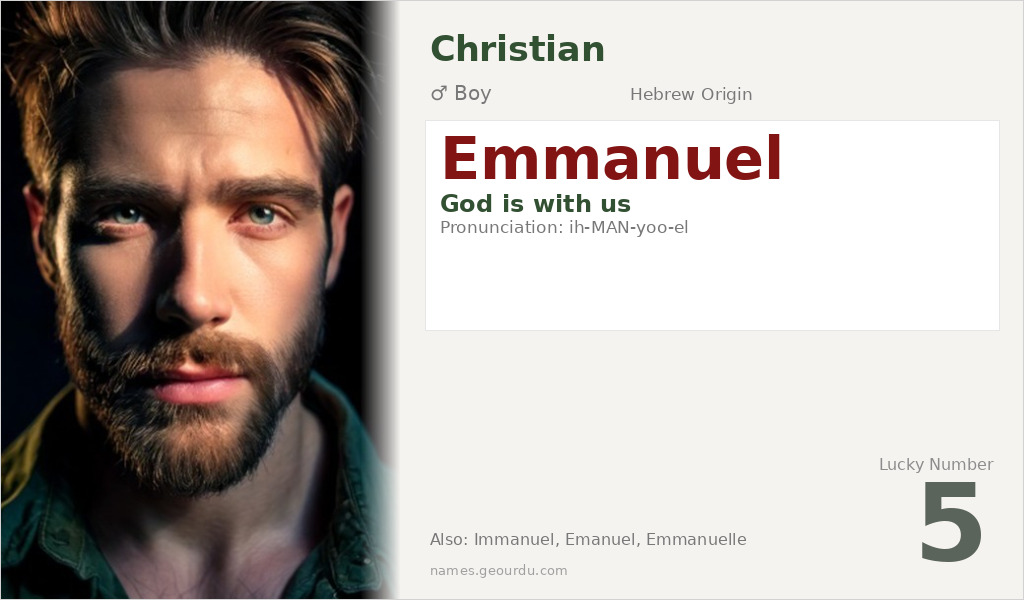
| 📛 Name | Emmanuel |
| 💎 Meaning | God is with us |
| 👤 Gender | Boy |
| 🕌 Religion | Christian |
| 🌍 Origin | Hebrew |
| 🗣 Pronunciation | ih-MAN-yoo-el |
| ✍️ Urdu | ایمانویل |
| ✍️ Arabic | عمانوئيل |
| 🔢 Numerology | 5 |
| ✨ Spellings | Immanuel, Emanuel, Emmanuelle, Manuel, Emmanouel |
Origin & Cultural Significance
Emmanuel has its roots in ancient Hebrew culture and scripture, specifically from the 8th century BCE prophetic writings of Isaiah. The name gained prominence in Christian tradition as a messianic title, appearing in the Gospel of Matthew’s account of Jesus’ birth. Throughout European history, the name spread via Latin translations of the Bible and became popular in Christian communities, particularly in Catholic and Orthodox traditions. While occasionally used by Jewish families, Emmanuel is predominantly associated with Christianity and has been adopted by various cultures including French, Spanish, Portuguese, and English-speaking communities. The name Immanuel Kant represents its philosophical adoption in German culture, though the philosopher himself was not particularly religious.
Personality Traits
People named Emmanuel often exhibit qualities of leadership, empathy, and spiritual depth. They tend to be natural mediators who bring people together, reflecting the name’s meaning of divine presence in human community. Many Emmanuels demonstrate strong communication skills and intellectual curiosity, with a tendency toward philosophical or theological interests. The name’s association with prophecy and messianic figures may contribute to a sense of purpose or destiny in those who bear it.
Similar Names
If you like Emmanuel, consider: Isaiah, Gabriel, Michael, Nathaniel, Daniel
Famous People Named Emmanuel
- Emmanuel Macron — Current President of France
- Emmanuel Kant — Influential German philosopher of the Enlightenment
Frequently Asked Questions About Emmanuel
What does Emmanuel mean?
Emmanuel means 'God is with us' in Hebrew. It's a compound name from 'Immanu' (with us) and 'El' (God), with deep biblical significance in both Jewish and Christian traditions.
Is Emmanuel a boy or girl name?
Emmanuel is traditionally a masculine name. The feminine form is Emmanuelle, which is used primarily in French and other Romance languages.
What is the origin of Emmanuel?
Emmanuel originates from Hebrew (עִמָּנוּאֵל) and appears in the Book of Isaiah in the Hebrew Bible. It was adopted into Greek, Latin, and subsequently various European languages through Christian tradition.





