
Table of Contents
Erling is a powerful Scandinavian name with deep roots in Viking history and Norse mythology. Carrying the meaning ‘descendant of the jarl’ or ‘son of a nobleman’, this name evokes images of medieval chieftains and Nordic warriors. Today, it remains popular in Norway and has gained international recognition through notable modern bearers. With its strong, masculine sound and rich heritage, Erling offers a distinctive choice with historical gravitas.
Meaning of Erling
Erling derives from Old Norse, specifically from the word ‘jarl’ meaning ‘nobleman’, ‘chieftain’, or ‘earl’, combined with the suffix ‘-ing’ which indicates descent or belonging. The ‘-ing’ suffix was commonly used in Germanic languages to form patronymics or to denote membership in a tribe or family. Thus, Erling literally translates to ‘descendant of the jarl’ or ‘son of a nobleman’. This naming convention was typical in medieval Scandinavia where social status and lineage were important identifiers. The name appears in Old Norse sagas and historical records, reflecting its use among the Norse aristocracy and warrior class.
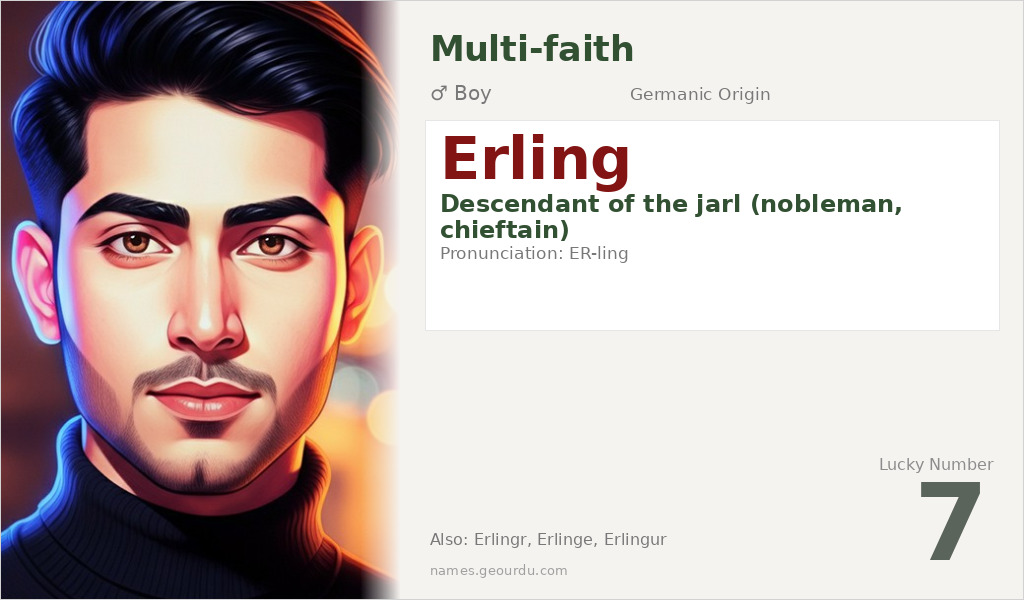
| 📛 Name | Erling |
| 💎 Meaning | Descendant of the jarl (nobleman, chieftain) |
| 👤 Gender | Boy |
| 🕌 Religion | Multi-faith |
| 🌍 Origin | Germanic |
| 🗣 Pronunciation | ER-ling |
| ✍️ Urdu | ارلنگ |
| ✍️ Arabic | إيرلينغ |
| 🔢 Numerology | 7 |
| ✨ Spellings | Erlingr, Erlinge, Erlingur |
Origin & Cultural Significance
Erling originates from Scandinavia, specifically from the Old Norse language spoken by Vikings and medieval Norse peoples. It was particularly common in Norway, where it has been used continuously since the Viking Age (approximately 800-1100 CE). The name appears in several Icelandic sagas, including mentions of historical figures like Erling Skjalgsson, a powerful Norwegian chieftain from the 11th century. While the name predates Christianity in Scandinavia, it was adopted by Christians as Scandinavia converted. Today, it remains most popular in Norway but has spread to other Scandinavian countries and gained international recognition through famous modern Norwegians.
Personality Traits
Those named Erling often embody traits associated with their Norse heritage: strength, independence, and leadership. They tend to be practical problem-solvers with a determined nature, reflecting the resilience needed in harsh Nordic environments. While valuing tradition and family loyalty, many Erlings also demonstrate innovative thinking and adventurous spirits, perhaps echoing the exploratory nature of their Viking ancestors. These individuals often command respect through competence rather than authority alone.
Similar Names
If you like Erling, consider: Earl, Jarl, Harald, Bjorn, Leif
Famous People Named Erling
- Erling Haaland — Norwegian professional footballer considered one of the best strikers in the world
- Erling Kagge — Norwegian explorer, author, and publisher, first person to complete the Three Poles Challenge
Frequently Asked Questions About Erling
What does Erling mean?
Erling means 'descendant of the jarl' or 'son of a nobleman' from Old Norse, where 'jarl' means nobleman/chieftain and '-ing' denotes descent.
Is Erling a boy or girl name?
Erling is exclusively a masculine name with historical usage only for boys/men throughout its Scandinavian history.
What is the origin of Erling?
Erling originates from Old Norse (Germanic language family) and was commonly used in medieval Scandinavia, particularly Norway, during the Viking Age and beyond.





