
Table of Contents
Esfandyar is a name steeped in Persian epic tradition and ancient spirituality. Best known as the heroic prince from Ferdowsi’s Shahnameh, this name carries a rich etymology rooted in Zoroastrian symbolism. Beyond its legendary associations, Esfandyar offers a meaningful choice for parents seeking a name with historical depth and cultural resonance. Let’s explore the origins, meaning, and legacy of this distinctive name.
Meaning of Esfandyar
The name Esfandyar derives from Persian, combining ‘Esfand’ (اسفند), referring to the sacred wild rue plant (Peganum harmala) in Zoroastrianism, with the suffix ‘-yar’ (یار), meaning ‘friend’, ‘companion’, or ‘possessor of’. Thus, Esfandyar literally translates to ‘friend of Esfand’ or ‘one endowed with the glory/protection of Esfand’. In Zoroastrian tradition, Esfand (also called Sepand) is associated with the earth, humility, and protective purification, often used in rituals to ward off evil. The name therefore conveys themes of spiritual safeguarding, nobility, and connection to ancient Persian beliefs. Its most famous bearer, Prince Esfandiyār in the Shahnameh, embodies these qualities as a nearly invincible warrior fated by tragedy.
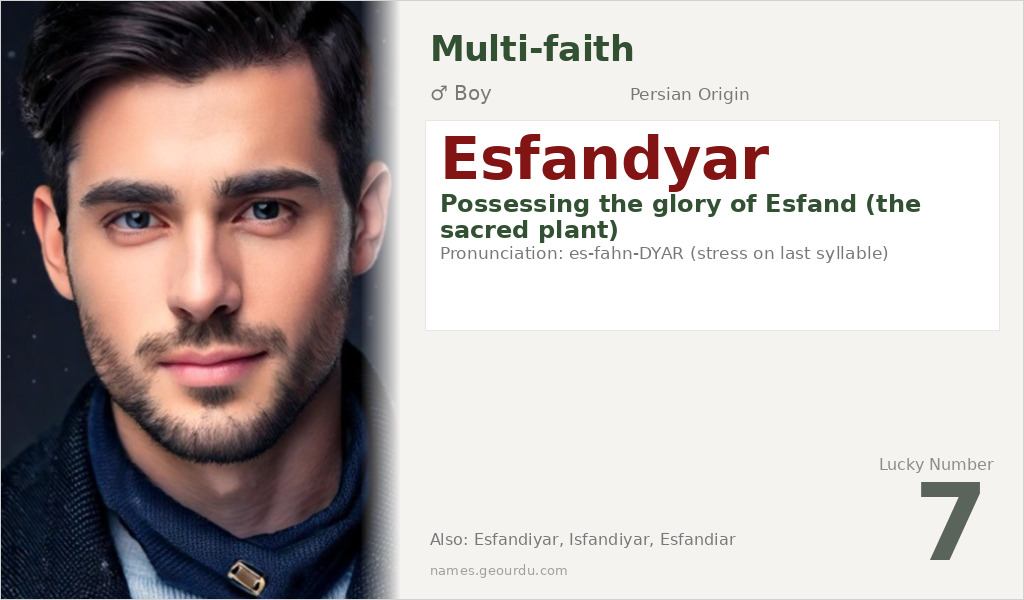
| 📛 Name | Esfandyar |
| 💎 Meaning | Possessing the glory of Esfand (the sacred plant) |
| 👤 Gender | Boy |
| 🕌 Religion | Multi-faith |
| 🌍 Origin | Persian |
| 🗣 Pronunciation | es-fahn-DYAR (stress on last syllable) |
| ✍️ Urdu | اسفندیار |
| ✍️ Arabic | إسفنديار |
| 🔢 Numerology | 7 |
| ✨ Spellings | Esfandiyar, Isfandiyar, Esfandiar, Isfandiar, Esfandyar |
Origin & Cultural Significance
Esfandyar originates from pre-Islamic Persian culture and is deeply embedded in Iranian mythology and literature. It gained prominence through Ferdowsi’s Shahnameh (c. 977–1010 CE), where Esfandiyār is a central tragic hero—the son of King Goshtasp and a champion of Zoroastrianism. The name reflects Zoroastrian symbolism, as Esfand (the plant) is sacred in that faith, used for purification and protection. While the name is used by Muslims in Iran, Afghanistan, Tajikistan, and South Asia (e.g., among Urdu speakers), its roots are not Arabic or exclusively Islamic; it belongs to the broader Persianate cultural sphere. Today, it remains a classic choice in Persian-speaking communities and among diaspora, honoring both literary heritage and spiritual connotations.
Personality Traits
Names like Esfandyar often inspire associations with bravery, protection, and a noble spirit, influenced by the heroic legacy of the Shahnameh. Individuals with this name may be perceived as resilient and principled, with a strong sense of duty or destiny. The connection to the sacred plant Esfand adds a layer of spiritual or purifying quality, suggesting someone who values tradition and moral integrity. However, the tragic arc of the epic hero also hints at potential challenges or a fated aspect, making the name complex and deeply symbolic.
Similar Names
If you like Esfandyar, consider: Rostam, Sohrab, Kaveh, Fereydun, Jamshid
Famous People Named Esfandyar
- Esfandiyār (also spelled Esfandyar) — legendary prince and hero in Ferdowsi's Shahnameh, known for his invulnerability and tragic fate
- Esfandiar Baharmast — Iranian-American former FIFA football referee who officiated in the 1998 World Cup
Frequently Asked Questions About Esfandyar
What does Esfandyar mean?
Esfandyar means 'possessing the glory of Esfand' in Persian, where Esfand refers to the sacred wild rue plant in Zoroastrian tradition, symbolizing protection and purity.
Is Esfandyar a boy or girl name?
Esfandyar is exclusively a boy's name, historically and culturally, as seen in the Shahnameh and Persian naming traditions.
What is the origin of Esfandyar?
Esfandyar originates from Persian language and culture, with roots in Zoroastrian symbolism and the epic Shahnameh, not from Arabic or exclusively Muslim sources.





