
Table of Contents
Essie is a charming, vintage-inspired name that has experienced a resurgence in recent years. With celestial origins meaning ‘star’, this name carries both historical depth and contemporary appeal. Originally a diminutive of Esther and Estelle, Essie now stands confidently as an independent choice for parents seeking a name with both sweetness and substance. Its cross-cultural heritage makes it versatile across different backgrounds and traditions.
Meaning of Essie
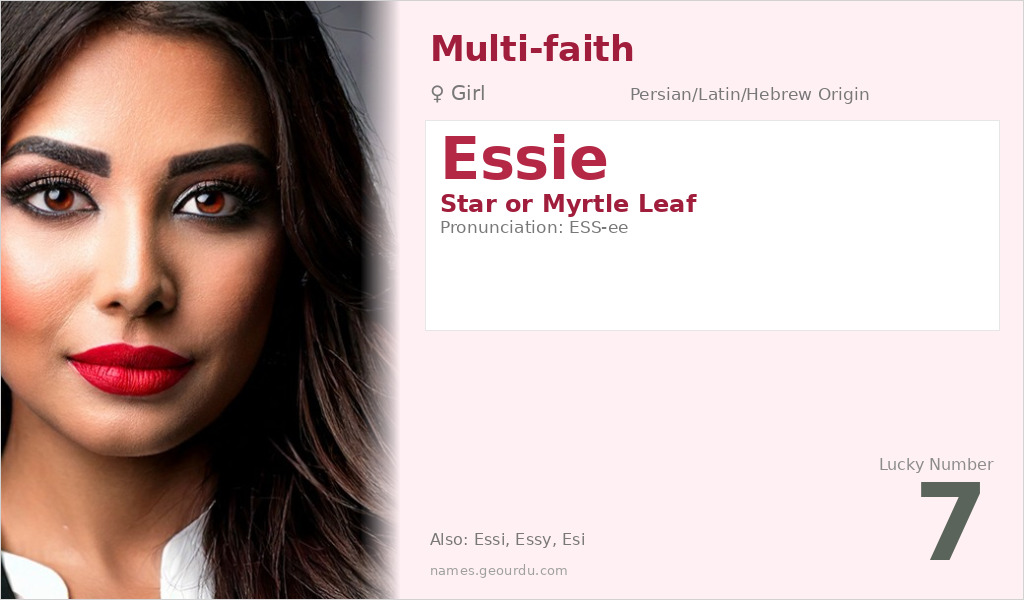
The name Essie derives primarily from two source names: Esther and Estelle. Esther originates from the Persian ‘ستاره’ (Setareh), meaning ‘star’, which was adopted into Hebrew through the biblical Book of Esther. Estelle comes directly from the Latin ‘stella’, also meaning ‘star’. Additionally, through Esther’s Hebrew connection to Hadassah (meaning ‘myrtle tree’), Essie can indirectly carry botanical associations. This dual celestial meaning—from both Persian and Latin roots—gives Essie a rich etymological background that transcends single cultural origins. The name evolved from affectionate nickname to standalone given name in English-speaking countries during the Victorian era.
| 📛 Name | Essie |
| 💎 Meaning | Star or Myrtle Leaf |
| 👤 Gender | Girl |
| 🕌 Religion | Multi-faith |
| 🌍 Origin | Persian/Latin/Hebrew |
| 🗣 Pronunciation | ESS-ee |
| ✍️ Urdu | ایسی |
| ✍️ Arabic | إيسي |
| 🔢 Numerology | 7 |
| ✨ Spellings | Essi, Essy, Esi |
Origin & Cultural Significance
Essie’s origins span multiple cultures and historical periods. The Persian connection dates to ancient times through Queen Esther of the Hebrew Bible, while the Latin connection emerged during the Roman Empire through ‘stella’. The name gained popularity in English-speaking countries during the 19th century, particularly in the United States and United Kingdom, where diminutive forms of longer names became fashionable. Unlike names tied to specific religious traditions, Essie has been adopted across Christian, Jewish, and secular contexts due to its appealing sound and positive meaning. Its multicultural heritage makes it suitable for diverse families seeking a name with historical resonance but contemporary feel.
Personality Traits
Those named Essie often embody qualities associated with their stellar meaning—they may shine in social situations, provide guidance to others, or possess an illuminating intellect. The name suggests someone who is both grounded and aspirational, with the myrtle connection adding an element of natural grace and resilience. While personality traits vary by individual, the name’s etymology hints at potential characteristics of brightness, guidance, and natural beauty that might influence how bearers perceive themselves and are perceived by others.
Similar Names
If you like Essie, consider: Esther, Estelle, Stella, Estrella, Aster
Famous People Named Essie
- Essie Davis — Australian actress known for 'The Babadook' and 'Miss Fisher's Murder Mysteries'
- Essie Mae Washington-Williams — American teacher and author, daughter of Senator Strom Thurmond
Frequently Asked Questions About Essie
What does Essie mean?
Essie means 'star', deriving from either the Persian 'Setareh' (via Esther) or Latin 'stella' (via Estelle). It can also indirectly relate to 'myrtle tree' through Esther's Hebrew origin as Hadassah.
Is Essie a boy or girl name?
Essie is almost exclusively a girl's name, though historically it could occasionally be a nickname for male names like Esteban in some cultures. In contemporary usage, it's firmly established as feminine.
What is the origin of Essie?
Essie has multiple origins: primarily Persian (via Esther meaning 'star'), Latin (via Estelle meaning 'star'), and Hebrew (via the connection to Hadassah meaning 'myrtle'). It became established as a standalone name in English-speaking countries.





