
Table of Contents
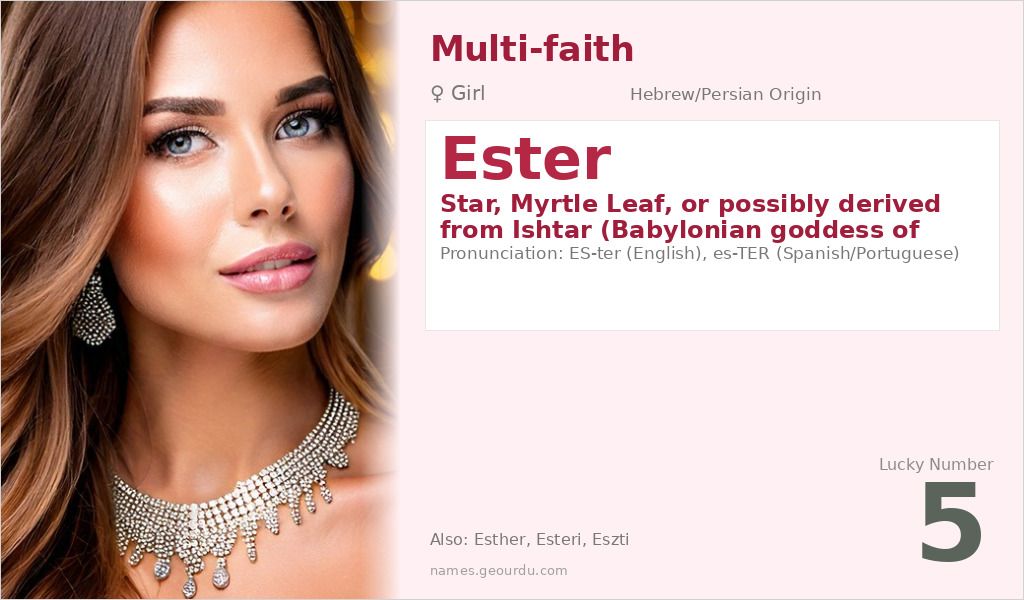
Ester is a beautiful name with celestial origins, meaning ‘star’ in Persian. Used across multiple cultures and religions, this name carries historical significance from the biblical Queen Esther to modern international figures. Discover the rich linguistic journey and cultural adaptations of this timeless name.
Meaning of Ester
The name Ester has a well-documented etymology tracing back to the Persian word ‘ستاره’ (setareh), meaning ‘star’. This Persian origin was adapted into Hebrew as אֶסְתֵּר (Esther), the name of the biblical queen who saved the Jewish people. Some linguistic scholars also connect it to the Babylonian goddess Ishtar, whose name underwent phonetic changes through Hebrew adaptation. The alternative theory links it to the Hebrew ‘hadas’ (myrtle), as Esther’s original Hebrew name was Hadassah. Across languages, the core meaning remains celestial or botanical, with ‘star’ being the most widely accepted interpretation.
| 📛 Name | Ester |
| 💎 Meaning | Star, Myrtle Leaf, or possibly derived from Ishtar (Babylonian goddess of love and war) |
| 👤 Gender | Girl |
| 🕌 Religion | Multi-faith |
| 🌍 Origin | Hebrew/Persian |
| 🗣 Pronunciation | ES-ter (English), es-TER (Spanish/Portuguese) |
| ✍️ Urdu | ایسٹر |
| ✍️ Arabic | إستر |
| 🔢 Numerology | 5 |
| ✨ Spellings | Esther, Esteri, Eszti, Estera, Esther |
Origin & Cultural Significance
Ester originates from the biblical Book of Esther, where Queen Esther’s Persian name was adopted alongside her Hebrew name Hadassah. The name spread through Jewish communities and entered European languages via Latin and Greek translations of the Bible. In Spanish, Portuguese, Italian, and Scandinavian cultures, Ester became a common variant of Esther. The name is used by Christians, Jews, and secular communities worldwide, reflecting its multi-faith appeal. Historical usage shows particular popularity in Spanish-speaking countries and among Jewish communities maintaining biblical naming traditions.
Personality Traits
Those named Ester often exhibit qualities associated with stars—brightness, guidance, and celestial beauty. They tend to be natural leaders with strong communication skills and adaptability to different situations. The name’s historical connection to Queen Esther suggests traits of courage, intelligence, and strategic thinking in challenging circumstances.
Similar Names
If you like Ester, consider: Esther, Estelle, Stella, Aster, Estrella
Famous People Named Ester
- Ester Ledecká — Czech snowboarder and alpine skier, Olympic gold medalist
- Ester Expósito — Spanish actress known for 'Elite'
Frequently Asked Questions About Ester
What does Ester mean?
Ester primarily means 'star' from the Persian word 'setareh', adapted into Hebrew through the biblical Queen Esther. Some interpretations also connect it to the myrtle plant or the Babylonian goddess Ishtar.
Is Ester a boy or girl name?
Ester is exclusively a girl's name across all cultures where it's used, from its biblical origins to modern international usage.
What is the origin of Ester?
Ester originates from Persian/Hebewish sources through the biblical Book of Esther. It entered European languages via Latin and Greek translations, with particular adoption in Spanish, Portuguese, Italian, and Scandinavian naming traditions.





