
Table of Contents
Eswara is a powerful Sanskrit name with deep spiritual resonance in Hindu tradition. Derived from ancient Vedic roots, this name carries the profound meaning of ‘Lord’ or ‘Supreme Being,’ most specifically associated with Lord Shiva. As a name choice, Eswara embodies authority, divinity, and spiritual mastery, making it a significant selection for parents seeking a name with religious and philosophical weight. Its variations appear across South Asian cultures and religious traditions.
Meaning of Eswara
Eswara originates from the Sanskrit word ‘Īśvara,’ which combines the root ‘īś’ (meaning ‘to own, possess, rule, be master of’) with the suffix ‘-vara’ (denoting excellence or superiority). Literally translated, it means ‘the excellent ruler’ or ‘supreme master.’ In Hindu theology, Eswara specifically refers to the personal aspect of the divine, most commonly identified with Lord Shiva as the supreme deity who governs the universe. The term appears in ancient texts like the Upanishads and has been used for millennia across Hindu, Buddhist, and Jain philosophical systems, though with varying theological interpretations. Its linguistic roots connect to Proto-Indo-European language family, showing connections to concepts of power and ownership across related languages.
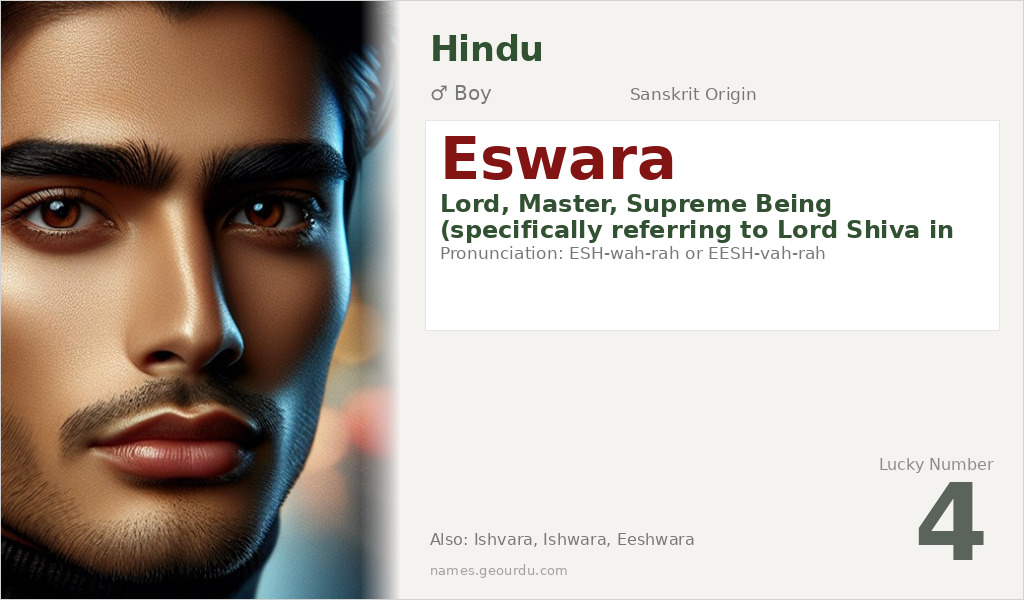
| 📛 Name | Eswara |
| 💎 Meaning | Lord, Master, Supreme Being (specifically referring to Lord Shiva in Hindu context) |
| 👤 Gender | Boy |
| 🕌 Religion | Hindu |
| 🌍 Origin | Sanskrit |
| 🗣 Pronunciation | ESH-wah-rah or EESH-vah-rah |
| ✍️ Urdu | ایشور |
| ✍️ Arabic | إيشوارا |
| 🔢 Numerology | 4 |
| ✨ Spellings | Ishvara, Ishwara, Eeshwara, Īśvara |
Origin & Cultural Significance
Eswara has its origins in ancient Sanskrit, the classical language of India dating back over 3,500 years. The name emerged from Vedic religious and philosophical traditions, where ‘Ishvara’ denoted the supreme personal deity. Throughout Hindu history, the name became particularly associated with Shaivism (worship of Shiva), though it appears across various Hindu traditions. The name spread throughout South Asia via Sanskrit literature and religious texts, influencing naming traditions across India, Nepal, Sri Lanka, and Southeast Asian cultures with Hindu influence. In contemporary usage, Eswara remains primarily a Hindu name, though its philosophical concept has influenced broader Indian spiritual thought.
Personality Traits
Those named Eswara are often associated with leadership qualities, spiritual depth, and protective instincts. The name’s meaning as ‘Lord’ or ‘Master’ suggests individuals who may naturally assume authoritative roles with calm confidence. They tend to be philosophical, introspective, and drawn to matters of spirituality or higher purpose, while also demonstrating practical wisdom in worldly affairs. The connection to Lord Shiva adds associations with transformation, destruction of negativity, and benevolent power.
Similar Names
If you like Eswara, consider: Shiva, Mahadeva, Mahesh, Ishaan, Eshwar
Famous People Named Eswara
- Eswara Reddy — Indian film director known for Telugu cinema
- Eswara Rao — Indian politician from Andhra Pradesh
Frequently Asked Questions About Eswara
What does Eswara mean?
Eswara means 'Lord, Master, or Supreme Being' in Sanskrit, specifically referring to Lord Shiva in Hindu tradition. The name combines the root 'īś' (to rule) with '-vara' (excellence).
Is Eswara a boy or girl name?
Eswara is exclusively a boy's name in Hindu naming tradition, as it refers to masculine divine concepts and specifically to Lord Shiva, a male deity.
What is the origin of Eswara?
Eswara originates from Sanskrit, the ancient classical language of India, with roots in Vedic religious texts dating back thousands of years. It is fundamentally a Hindu name with specific theological significance.





