Table of Contents
Fakhar Ud Dawlah is a distinguished Arabic name that carries centuries of historical and cultural significance. Meaning ‘Pride of the State’ or ‘Glory of the Government’, this name has been borne by rulers and nobility throughout Islamic history. Its compound structure reflects traditional naming conventions that emphasize honor and governance. Today, it remains a meaningful choice for parents seeking a name with both linguistic depth and historical resonance.
Meaning of Fakhar Ud Dawlah
Fakhar Ud Dawlah is composed of three Arabic elements with precise meanings. ‘Fakhar’ (فخر) derives from the root ف-خ-ر (f-kh-r), conveying concepts of pride, honor, and distinction. The middle component ‘Ud’ represents the definite article ‘al-‘ (ال) assimilated before the sun letter ‘dāl’. ‘Dawlah’ (دولة) comes from the root د-و-ل (d-w-l), originally meaning ‘to rotate’ or ‘alternate’, which evolved to mean ‘state’, ‘government’, or ‘dynasty’ in reference to the cyclical nature of political power. The complete name therefore translates literally to ‘Pride of the State’, indicating someone who brings honor to their community or government. This construction follows classical Arabic naming patterns where laudatory titles were often compounded with references to authority or governance.
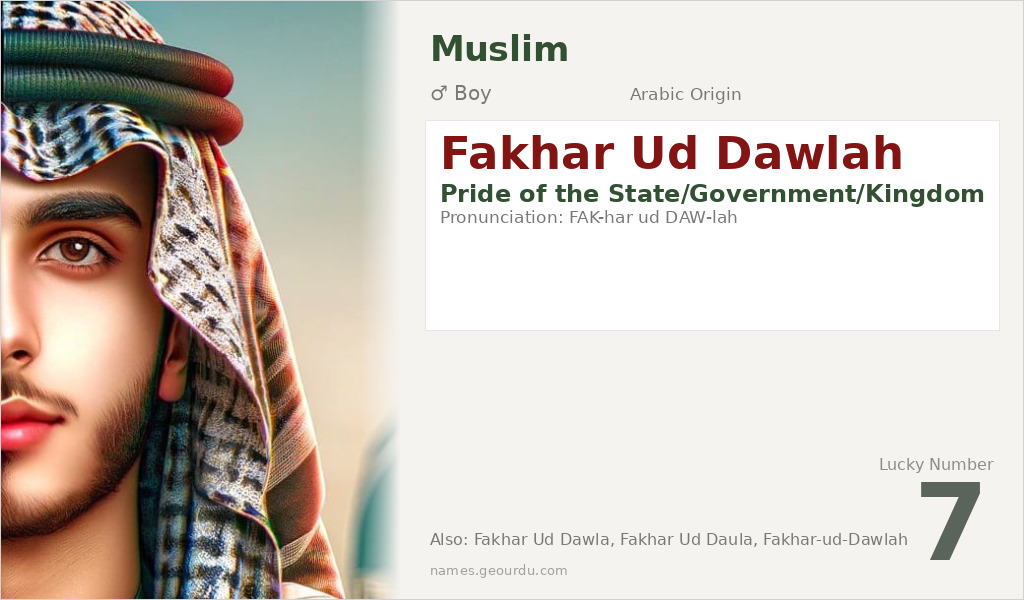
| 📛 Name | Fakhar Ud Dawlah |
| 💎 Meaning | Pride of the State/Government/Kingdom |
| 👤 Gender | Boy |
| 🕌 Religion | Muslim |
| 🌍 Origin | Arabic |
| 🗣 Pronunciation | FAK-har ud DAW-lah |
| ✍️ Urdu | فخر الدولہ |
| ✍️ Arabic | فخر الدولة |
| 🔢 Numerology | 7 |
| ✨ Spellings | Fakhar Ud Dawla, Fakhar Ud Daula, Fakhar-ud-Dawlah, Fakhr Ud Dawlah |
Origin & Cultural Significance
The name Fakhar Ud Dawlah originates from classical Arabic and was particularly popular during medieval Islamic periods. It was commonly used as an honorific title for rulers, governors, and nobility in various Muslim dynasties including the Buyids, Seljuks, and later Mughal and Ottoman courts. The practice of combining ‘Fakhar’ with ‘Dawlah’ reflects the cultural importance placed on both personal honor and political legitimacy in traditional Islamic societies. While the name has historical roots in the Arab world, it spread through Persian and Urdu-speaking regions where similar compound names became fashionable among Muslim communities. Today, it remains in use primarily among Arabic, Persian, and Urdu-speaking populations who value its historical connotations and linguistic elegance.
Personality Traits
Those named Fakhar Ud Dawlah are often perceived as natural leaders with a strong sense of dignity and responsibility. The name’s meaning suggests someone who takes pride in their community or organization and may gravitate toward roles involving governance, management, or public service. Historically associated with nobility, the name carries expectations of honor, integrity, and the ability to uphold traditions while navigating complex social structures. While individual personalities vary, the name’s etymology points toward qualities of distinction, reliability, and a certain gravitas in character.
Similar Names
If you like Fakhar Ud Dawlah, consider: Fakhar, Fakhr, Fakhruddin, Fakhrul Islam, Dawlat
Famous People Named Fakhar Ud Dawlah
- Fakhr-ud-Dawla (11th century) — Buyid amir of Iraq, known for his patronage of learning and architecture
- Fakhr-ud-Din Mubarak Shah (14th century) — Sultan of Bengal who issued coins with his name
Frequently Asked Questions About Fakhar Ud Dawlah
What does Fakhar Ud Dawlah mean?
Fakhar Ud Dawlah means 'Pride of the State' or 'Glory of the Government' in Arabic. It's a compound name where 'Fakhar' means pride/honor, and 'Dawlah' means state/government.
Is Fakhar Ud Dawlah a boy or girl name?
Fakhar Ud Dawlah is exclusively a boy's name in all cultural contexts where it is used. The masculine form 'Fakhar' and the governmental connotations make it traditionally male.
What is the origin of Fakhar Ud Dawlah?
Fakhar Ud Dawlah originates from classical Arabic and was historically used as an honorific title in medieval Islamic courts. It combines Arabic words for 'pride' and 'state/government' following traditional naming conventions.