
Table of Contents
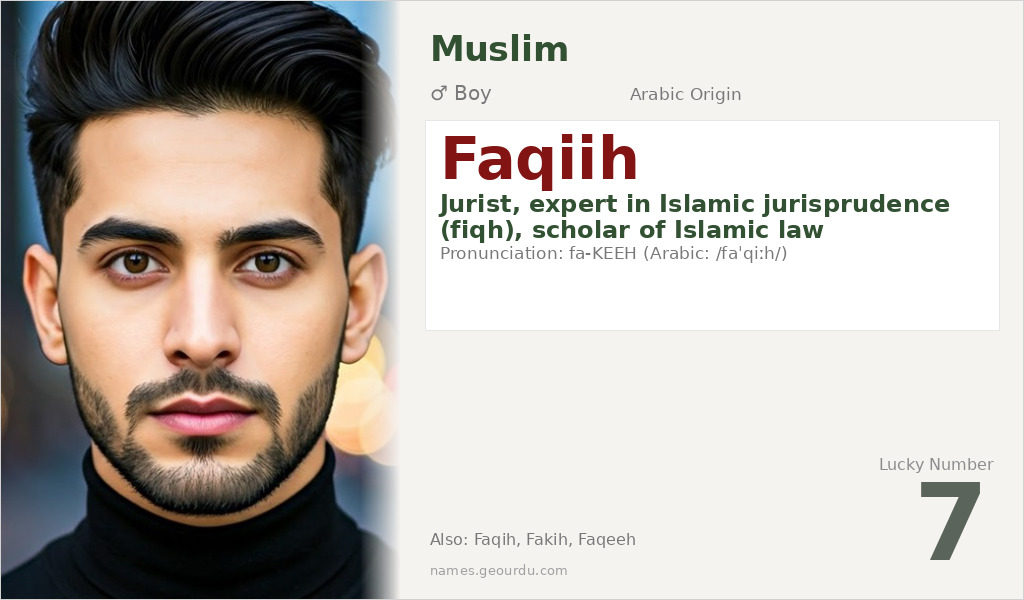
Faqiih is a distinguished Arabic name that carries profound religious and intellectual weight in the Muslim world. Traditionally given to boys, it signifies expertise in Islamic jurisprudence (fiqh) and embodies the Islamic ideal of knowledgeable leadership. This name connects its bearer to a rich tradition of scholarship that has shaped Islamic civilization for centuries. Choosing Faqiih reflects a hope for wisdom, piety, and legal acumen in one’s child.
Meaning of Faqiih
Faqiih (فَقِيه) is derived from the Arabic triliteral root ف-ق-ه (f-q-h), which conveys the core meanings of understanding, comprehension, and deep knowledge. In a technical Islamic context, fiqh refers to the human endeavor of deriving legal rulings from primary sources — the Quran and the Sunnah (traditions of Prophet Muhammad). Thus, a faqiih is not merely a ‘scholar’ in a general sense, but specifically a jurist qualified to interpret and apply Islamic law. The term contrasts with ‘alim’ (scholar of general religious sciences) and ‘mufti’ (one who issues formal legal opinions). Historically, the title ‘Faqih’ was earned through rigorous study in madrasas and under master jurists, making it a name that denotes earned expertise and intellectual authority.
| 📛 Name | Faqiih |
| 💎 Meaning | Jurist, expert in Islamic jurisprudence (fiqh), scholar of Islamic law |
| 👤 Gender | Boy |
| 🕌 Religion | Muslim |
| 🌍 Origin | Arabic |
| 🗣 Pronunciation | fa-KEEH (Arabic: /faˈqiːh/) |
| ✍️ Urdu | فقیہ |
| ✍️ Arabic | فَقِيه |
| 🔢 Numerology | 7 |
| ✨ Spellings | Faqih, Fakih, Faqeeh, Fakīh |
Origin & Cultural Significance
The name Faqiih originates from classical Arabic and is deeply embedded in Islamic culture, particularly within the Arabic-speaking world and among Muslim communities globally. Its usage as a personal name reflects the high societal status accorded to religious scholars (ulema) in Islamic history. During the Abbasid and later periods, the role of the faqiih was central to education, judiciary, and community leadership. While the name is most common in Arab regions, it is also found among Persian, Urdu, Turkish, and other Muslim linguistic groups due to the universal importance of fiqh in Islam. It is not traditionally a tribal or regional name from Pashto, Balochi, or Sindhi, but is used by Muslims of diverse ethnic backgrounds who value its religious connotations.
Personality Traits
A person named Faqiih is often associated with traits of diligence, integrity, and intellectual depth. Parents choosing this name may envision a child who grows into a thoughtful leader, someone who seeks knowledge and applies it with wisdom and fairness. In social contexts, the name can imply a natural inclination toward problem-solving, ethical reasoning, and a calm, measured demeanor. These perceived characteristics align with the name’s literal meaning, suggesting a life guided by principle and understanding.
Similar Names
If you like Faqiih, consider: Fahim, Fahad, Faiz, Farhan, Faruq
Famous People Named Faqiih
- Al-Faqih — title for many classical Islamic jurists like Ibn al-Faqih (10th-century geographer and scholar)
- Modern scholars and religious leaders in Muslim-majority countries often bear 'Faqih' as a surname or honorific
Frequently Asked Questions About Faqiih
What does Faqiih mean?
Faqiih means 'jurist' or 'expert in Islamic jurisprudence (fiqh)' in Arabic. It denotes a deep, specialized understanding of Islamic law derived from the Quran and Sunnah.
Is Faqiih a boy or girl name?
Faqiih is exclusively a masculine name in Arabic and Islamic naming traditions. The grammatical form (فَقِيه) is masculine; the feminine equivalent is Faqiha (فَقِيهَة).
What is the origin of Faqiih?
Faqiih originates from classical Arabic, specifically from the Islamic legal tradition. It is a common name among Muslims, particularly in Arab cultures, due to its religious significance and association with scholarly authority.





