Table of Contents
Farah is a beautiful name that resonates across cultures, carrying a universal message of joy and happiness. With roots in the Arabic language, it has spread through Islamic, Persian, and South Asian traditions, becoming a beloved choice for children worldwide. This name embodies positivity and celebration, making it a timeless selection for parents seeking a meaningful and uplifting name.
Meaning of Farah
Farah originates from the Arabic word ‘farah’ (فَرَح), which means ‘joy,’ ‘happiness,’ or ‘delight.’ It is derived from the triliteral root ف-ر-ح (f-r-ḥ), a core root in Semitic languages associated with gladness and celebration. In linguistic terms, this root appears in various forms across Arabic dialects and related languages like Hebrew (where ‘simcha’ is more common for joy). The name is deeply embedded in Arabic literature and Islamic texts, often cited in contexts of spiritual bliss and earthly contentment. Unlike names denoting physical beauty, Farah emphasizes an emotional state, making it distinct in its semantic focus.
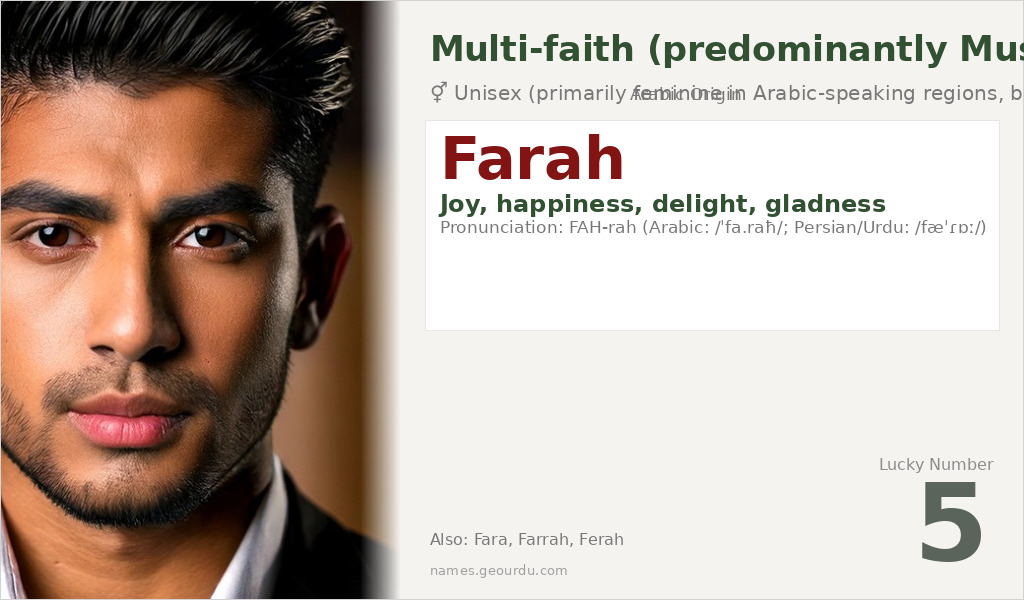
| 📛 Name | Farah |
| 💎 Meaning | Joy, happiness, delight, gladness |
| 👤 Gender | Unisex (primarily feminine in Arabic-speaking regions, but used for both genders in some cultures like Persian and Kurdish) |
| 🕌 Religion | Multi-faith (predominantly Muslim, but also used by Christians, Jews, and others in Middle Eastern and South Asian regions) |
| 🌍 Origin | Arabic |
| 🗣 Pronunciation | FAH-rah (Arabic: /ˈfa.raħ/; Persian/Urdu: /fæˈɾɒː/) |
| ✍️ Urdu | فرح |
| ✍️ Arabic | فَرَح |
| 🔢 Numerology | 5 |
| ✨ Spellings | Fara, Farrah, Ferah, Farha, Farra |
Origin & Cultural Significance
Farah has its primary origin in Classical Arabic, where it has been used since pre-Islamic times. With the spread of Islam, the name traveled to Persian, Turkish, Urdu, and other languages, often retaining its joyful meaning. In Persian, it is used for both genders, while in Arabic-speaking regions it is predominantly feminine. The name is multi-faith, commonly adopted by Muslims, Christians, and Jews in the Middle East, reflecting shared linguistic heritage. Historical figures and modern celebrities have further popularized Farah globally, showcasing its cross-cultural appeal.
Personality Traits
People named Farah are often perceived as joyful, energetic, and compassionate. Their name’s meaning tends to influence expectations of a sunny and approachable personality. They may excel in social settings, using their innate positivity to connect with others and spread happiness. This association makes Farah a name that carries both personal and interpersonal significance.
Similar Names
If you like Farah, consider: Farida, Fariha, Firdaus, Sa'adah, Surur
Famous People Named Farah
- Farah Pahlavi — former Empress of Iran (born 1938)
- Farah Khan — Indian film director and choreographer (born 1965)
Frequently Asked Questions About Farah
What does Farah mean?
Farah means 'joy' or 'happiness' in Arabic, derived from the root ف-ر-ح (f-r-ḥ).
Is Farah a boy or girl name?
Farah is primarily feminine in Arabic-speaking cultures but is unisex in others like Persian and Kurdish, where it can be used for boys.
What is the origin of Farah?
Farah originates from Arabic, with documented usage in pre-Islamic and Islamic traditions, and has spread to Persian, Urdu, and other languages.