Table of Contents
Farangis is a name rich with historical and literary significance, originating from ancient Persian culture. Best known as the noble princess in Ferdowsi’s epic Shahnameh, this name carries meanings that transcend borders and eras. With its melodic sound and deep roots, Farangis remains a distinctive choice that connects modern bearers to a legendary past.
Meaning of Farangis
The name Farangis has a clear etymological foundation in Persian language and history. It combines ‘Frang’ (meaning Frank or European) with the feminine suffix ‘-is,’ literally translating to ‘Frankish woman’ or ‘European woman.’ This reflects historical Persian encounters with Western Europeans during the medieval period, particularly through Arabic intermediaries who used ‘Faranj’ for Crusaders. In linguistic context, the ‘-is’ suffix is a common Persian feminine ending seen in names like ‘Behrouzis’ or ‘Pourandokht.’ The name’s appearance in the 10th-century Shahnameh solidifies its ancient usage, where Princess Farangis symbolizes nobility and cross-cultural connections in Persian-Turanian narratives.
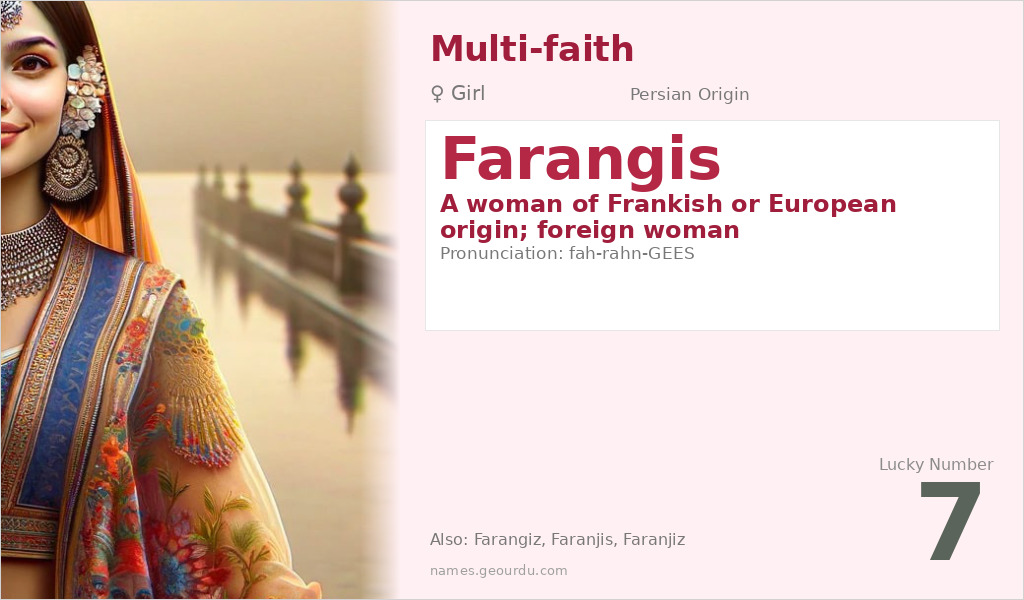
| 📛 Name | Farangis |
| 💎 Meaning | A woman of Frankish or European origin; foreign woman |
| 👤 Gender | Girl |
| 🕌 Religion | Multi-faith |
| 🌍 Origin | Persian |
| 🗣 Pronunciation | fah-rahn-GEES |
| ✍️ Urdu | فرنگیس |
| ✍️ Arabic | فرنگيس |
| 🔢 Numerology | 7 |
| ✨ Spellings | Farangiz, Faranjis, Faranjiz, Farangees |
Origin & Cultural Significance
Farangis originates from pre-Islamic Persian culture, specifically appearing in Ferdowsi’s Shahnameh (Book of Kings) completed in 1010 CE. The name reflects historical Persian geographical awareness, where ‘Frang’ referred to European peoples encountered via trade and conflict. Culturally, it represents the Persian literary tradition of incorporating foreign elements into epic poetry. While used historically in Iran and Persian-influenced regions like Afghanistan and Tajikistan, the name has no exclusive religious affiliation—it appears in Zoroastrian-era literature and is used by Muslims, Zoroastrians, and others. Its survival demonstrates the continuity of Persian linguistic heritage across religious and political changes.
Personality Traits
Those named Farangis are often associated with qualities of cultural sophistication and resilience, inspired by the legendary princess’s story. They may exhibit diplomatic traits, bridging different worlds with grace and intelligence. The name’s historical depth suggests a personality that values tradition while embracing diverse influences, making bearers naturally adaptable in multicultural settings.
Similar Names
If you like Farangis, consider: Farah, Faranak, Gissou, Parisā, Forough
Famous People Named Farangis
- Farangis Shahroudi — Iranian actress known for roles in 'The Snowman' and 'The Blue-Veiled'
- Princess Farangis — Legendary Turanian princess in Ferdowsi's Shahnameh, known for her loyalty and tragic story
Frequently Asked Questions About Farangis
What does Farangis mean?
Farangis means 'a woman of Frankish or European origin' in Persian, derived from 'Frang' (European) and the feminine suffix '-is.'
Is Farangis a boy or girl name?
Farangis is exclusively a feminine name in Persian tradition, with the '-is' suffix indicating female gender.
What is the origin of Farangis?
Farangis originates from Persian language and literature, specifically from Ferdowsi's 10th-century epic Shahnameh, with roots in Middle Persian terms for Europeans.