Table of Contents
Farmand is a powerful and historically rich name that carries connotations of leadership and authority. Rooted in Persian language and culture, this name has traveled across regions and communities, from Iran to Pakistan and India. Whether you’re drawn to its strong meaning or its cultural resonance, Farmand offers a distinctive choice with deep linguistic roots. In this guide, we explore everything from its etymology to its modern usage.
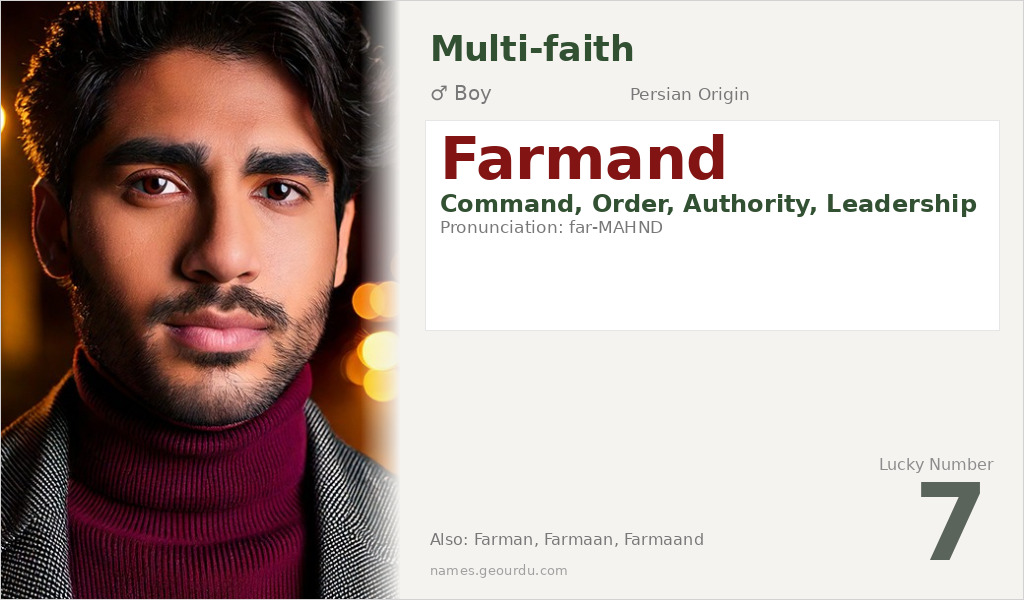
Meaning of Farmand
Farmand derives from the Persian word ‘farmān’ (فرمان), which translates to ‘command, order, decree, or edict.’ The addition of the suffix ‘-and’ creates an agent noun, meaning ‘one who commands’ or ‘commander.’ This construction is common in Persian names, similar to how ‘Rustam’ means ‘hero’ or ‘Rostamand’ implies heroism. Historically, ‘farmān’ was used in royal and administrative contexts across Persian-influenced empires, including the Mughal Empire in India, where farmāns were official decrees issued by the emperor. Thus, the name Farmand inherently carries a sense of authority, governance, and respect.
| 📛 Name | Farmand |
| 💎 Meaning | Command, Order, Authority, Leadership |
| 👤 Gender | Boy |
| 🕌 Religion | Multi-faith |
| 🌍 Origin | Persian |
| 🗣 Pronunciation | far-MAHND |
| ✍️ Urdu | فرماند |
| ✍️ Arabic | فرماند |
| 🔢 Numerology | 7 |
| ✨ Spellings | Farman, Farmaan, Farmaand, Farmanand |
Origin & Cultural Significance
Farmand originates from the Persian language, which has influenced many cultures across West and South Asia. It is particularly prevalent among Persian-speaking communities in Iran, as well as among Pashtun, Baloch, and Kurdish groups who have historical ties to Persian culture. In South Asia, the name is found in Muslim, Sikh, and some Hindu families, especially in regions like Punjab, Sindh, and North India, where Persian was once the court language. Its usage reflects the cross-cultural exchanges along the Silk Road and during the Mughal era, where Persian names and titles were adopted widely. Today, Farmand remains a meaningful choice in diaspora communities worldwide.
Personality Traits
Those named Farmand are often associated with leadership qualities such as decisiveness, integrity, and a natural ability to guide others. They may exhibit a commanding yet calm demeanor, with a focus on structure and achievement. In social settings, they are respected for their wisdom and reliability, often taking on roles that require responsibility and vision.
Similar Names
If you like Farmand, consider: Farman, Farhan, Fardeen, Farzand, Firoz
Famous People Named Farmand
- Farmand Ali — Pakistani cricketer who played for Lahore cricket team
- Farmand Khan — historical figure in Baloch and Pashtun tribal leadership traditions
Frequently Asked Questions About Farmand
What does Farmand mean?
Farmand means 'Command,' 'Order,' or 'Authority' in Persian, derived from the word 'farmān' (فرمان) with the suffix '-and' indicating agency.
Is Farmand a boy or girl name?
Farmand is traditionally a boy's name, reflecting masculine qualities of leadership and command in Persian and related cultures.
What is the origin of Farmand?
Farmand originates from the Persian language and is used in Persian, Pashtun, Baloch, Kurdish, and South Asian communities, with historical ties to administrative and royal contexts.