
Table of Contents
Faryar is a distinctive and meaningful name with deep roots in Persian culture and language. Carrying connotations of bravery and courage, this name has been used for centuries in Persian-speaking regions from Iran to Afghanistan and among diaspora communities worldwide. Unlike many names that have religious exclusivity, Faryar transcends religious boundaries and is appreciated for its strong, positive meaning. Today, it remains a popular choice for parents seeking a name that embodies strength and principled action.
Meaning of Faryar
The name Faryar originates from the Persian language, specifically from the word ‘faryād’ (فریاد), which means ‘cry’, ‘call’, or ‘outcry’. When combined with the Persian suffix ‘-ar’, which denotes ‘one who’ or ‘person of’, it creates the meaning ‘one who cries out’ or ‘one who calls’. In Persian cultural context, this evolved to represent someone who cries out against injustice or calls for what is right, thus symbolizing bravery, courage, and heroism. The name appears in classical Persian literature and historical texts, often associated with characters who demonstrate valor and moral fortitude. Linguistically, it’s a compound name that reflects the Persian tradition of creating meaningful names through word combinations. The metaphorical transformation from literal ‘crier’ to figurative ‘brave hero’ showcases how language evolves within cultural narratives.
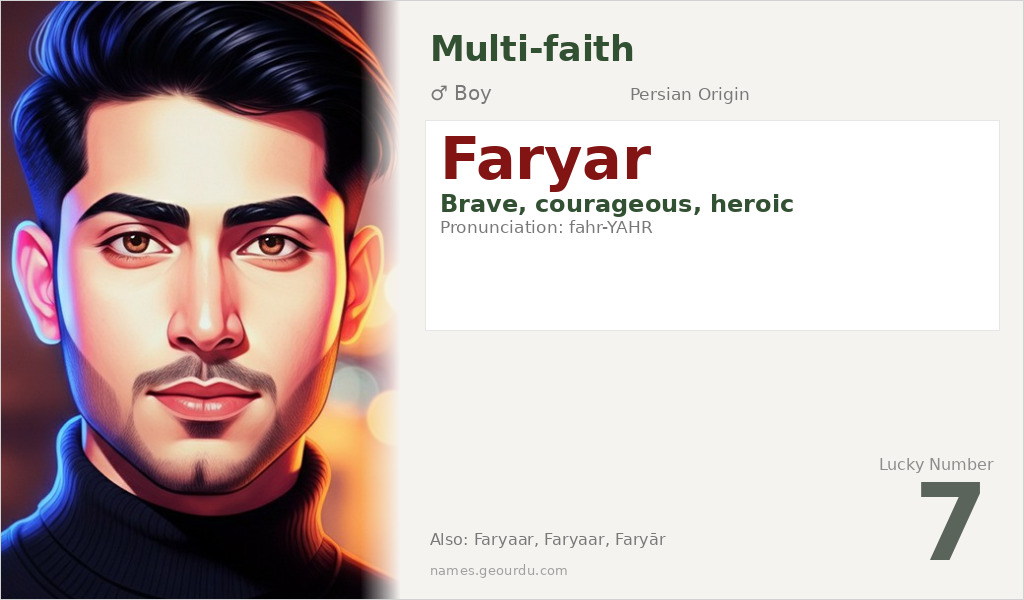
| 📛 Name | Faryar |
| 💎 Meaning | Brave, courageous, heroic |
| 👤 Gender | Boy |
| 🕌 Religion | Multi-faith |
| 🌍 Origin | Persian |
| 🗣 Pronunciation | fahr-YAHR |
| ✍️ Urdu | فریار |
| ✍️ Arabic | فريار |
| 🔢 Numerology | 7 |
| ✨ Spellings | Faryaar, Faryaar, Faryār |
Origin & Cultural Significance
Faryar has its origins in Persian culture and language, with usage documented across Iran, Afghanistan (where it’s also used in Dari), Tajikistan, and Persian-speaking communities worldwide. The name predates Islamic influence in the region and has been used by Zoroastrians, Muslims, and others in Persian cultural spheres, making it a multi-faith name rather than exclusively Muslim. Historically, names ending in ‘-ar’ were common in Persian naming conventions, indicating professions or characteristics. Faryar gained particular prominence through Persian epic poetry and historical narratives where brave characters bore this name. In modern times, it remains popular in Persian-speaking countries and among diaspora communities who value its cultural heritage and strong meaning. The name’s cross-religious appeal demonstrates how cultural names can transcend specific faith traditions while maintaining their linguistic integrity.
Personality Traits
Those named Faryar are often associated with traits of courage, integrity, and vocal advocacy. The name’s meaning suggests someone who is not afraid to speak up for justice or defend what they believe is right. In social settings, Faryars may be perceived as natural leaders who inspire others through their principled stance and determination. While individual personalities vary, the name carries expectations of strength and moral courage that often influence how bearers are perceived in their communities.
Similar Names
If you like Faryar, consider: Farhad, Faramarz, Faryad, Faryan, Faryaz
Famous People Named Faryar
- Faryar Shirzad — Iranian-American former White House official and policy advisor
- Faryar — Character in Persian literature and historical narratives representing bravery
Frequently Asked Questions About Faryar
What does Faryar mean?
Faryar means 'brave, courageous, heroic' in Persian. It comes from the Persian word 'faryād' (meaning cry or call) with the suffix '-ar' (meaning one who), creating the metaphorical meaning of one who cries out for justice or shows bravery.
Is Faryar a boy or girl name?
Faryar is traditionally a boy's name in Persian-speaking cultures. While names can sometimes be adapted across genders in modern contexts, historical and contemporary usage overwhelmingly identifies it as masculine.
What is the origin of Faryar?
Faryar originates from the Persian language and culture, with documented usage across Iran, Afghanistan (Dari), Tajikistan, and Persian diaspora communities. It's a multi-faith name used by Zoroastrians, Muslims, and others within Persian cultural spheres.





