Table of Contents
Feroza is a beautiful feminine name that carries the luminous quality of one of history’s most cherished gemstones. Derived from Persian, this name literally means ‘turquoise’ — referring to the distinctive blue-green mineral prized across civilizations from ancient Persia to Native American cultures. While particularly popular in South Asian Muslim communities, Feroza transcends religious boundaries as a name celebrating natural beauty and protective symbolism. Its melodic pronunciation and rich cultural heritage make it a timeless choice for parents seeking a name with both aesthetic appeal and historical depth.
Meaning of Feroza
The name Feroza has a precise and well-documented meaning: it is the Persian word for ‘turquoise’, the opaque blue-to-green mineral that has been used as a gemstone and ornamental material for over 6,000 years. Etymologically, Feroza comes from the Persian ‘firūza’ (فیروزه), which itself derives from ‘pīrūz’ meaning ‘victorious’ or ‘fortunate’. This connection reflects the ancient belief that turquoise stones brought protection and success to their wearers. In linguistic context, the name is distinctly Persian but was adopted into Urdu, Pashto, and other South Asian languages through centuries of cultural exchange. Unlike generic terms for green stones, Feroza specifically denotes the turquoise gem, known for its unique matrix patterns and cultural significance across Persian, Turkish, and Mughal traditions.
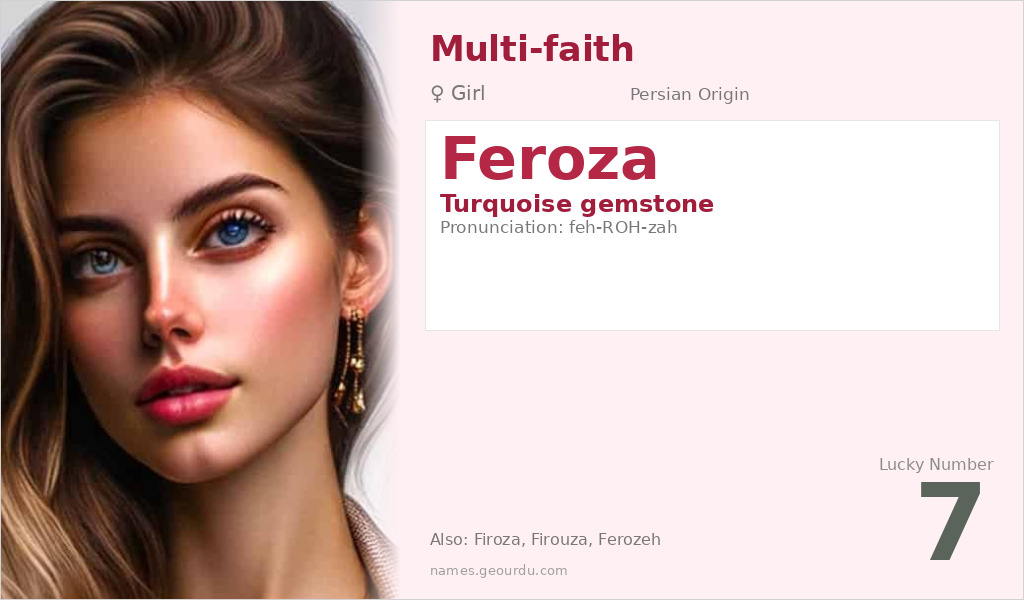
| 📛 Name | Feroza |
| 💎 Meaning | Turquoise gemstone |
| 👤 Gender | Girl |
| 🕌 Religion | Multi-faith |
| 🌍 Origin | Persian |
| 🗣 Pronunciation | feh-ROH-zah |
| ✍️ Urdu | فیروزہ |
| ✍️ Arabic | فيروزة |
| 🔢 Numerology | 7 |
| ✨ Spellings | Firoza, Firouza, Ferozeh, Firozeh |
Origin & Cultural Significance
Feroza originates from Persian culture, where turquoise (firūza) has been mined and valued since antiquity, particularly from the Nishapur mines in Iran that produced the finest specimens. The name entered South Asian naming traditions through Persian influence during the Delhi Sultanate and Mughal periods, when Persian was the court language and cultural lingua franca. While commonly used by Muslims in Pakistan, India, Bangladesh, and Afghanistan, the name also appears among Persian Zoroastrians and has cross-cultural appeal due to the universal appreciation of the turquoise gemstone. Historically, turquoise was believed to protect against evil and bring good fortune, making Feroza a name imbued with protective symbolism. The gem’s association with royalty and spirituality in Persian miniature art and architecture further elevated its status as a namesake.
Personality Traits
Those named Feroza often embody qualities associated with their namesake gemstone: they tend to be calm, intuitive, and spiritually aware individuals. Like turquoise that changes color with light and wear, Ferozas may display adaptability while maintaining core stability. They often possess an artistic sensibility and appreciation for beauty, with a protective nature toward loved ones. The historical belief that turquoise wards off negative energy translates to personalities that often serve as peacemakers or stabilizing forces in their communities.
Similar Names
If you like Feroza, consider: Zumurrud (Emerald in Arabic), Yaqut (Ruby in Arabic), Marjan (Coral in Persian), Durri (Pearl in Arabic), Almas (Diamond in Persian/Urdu)
Famous People Named Feroza
- Feroza Begum — Legendary Bangladeshi Nazrul Sangeet singer known as the 'Bulbul-e-Kashmir'
- Firoza Khatun — Renowned Bangladeshi folk singer specializing in Bhatiali and Bhawaiya genres
Frequently Asked Questions About Feroza
What does Feroza mean?
Feroza means 'turquoise' — specifically referring to the blue-green gemstone. This meaning comes directly from Persian, where 'firūza' is the word for this prized mineral.
Is Feroza a boy or girl name?
Feroza is exclusively a feminine name in all cultures where it is used. There is no masculine equivalent in Persian or related languages.
What is the origin of Feroza?
Feroza originates from Persian language and culture, specifically from the word 'firūza' meaning turquoise. It spread to South Asia through historical Persian influence and is now used across Muslim, Persian, and South Asian communities.