
Table of Contents
Filbert is a distinctive boy’s name with roots stretching back to medieval Europe. Derived from Germanic elements meaning ‘very bright,’ this name carries a luminous quality that has endured for centuries. While relatively uncommon today, Filbert has a rich history and interesting connections to both saints and nature. Discover the fascinating story behind this name that bridges language, culture, and tradition.
Meaning of Filbert
The name Filbert originates from the Old High German name ‘Filibert,’ which is composed of two elements: ‘filu’ meaning ‘very’ or ‘much,’ and ‘beraht’ meaning ‘bright,’ ‘brilliant,’ or ‘shining.’ This combination creates the meaning ‘very bright’ or ‘extremely brilliant.’ The name entered the English language through Norman French after the 1066 Norman Conquest, where it was adapted from the Frankish version. Interestingly, the common nut called ‘filbert’ (a type of hazelnut) derives from this name because these nuts traditionally ripen around St. Philbert’s Day on August 20th. The name has variations across European languages, including Philbert in French and Filiberto in Italian and Spanish.
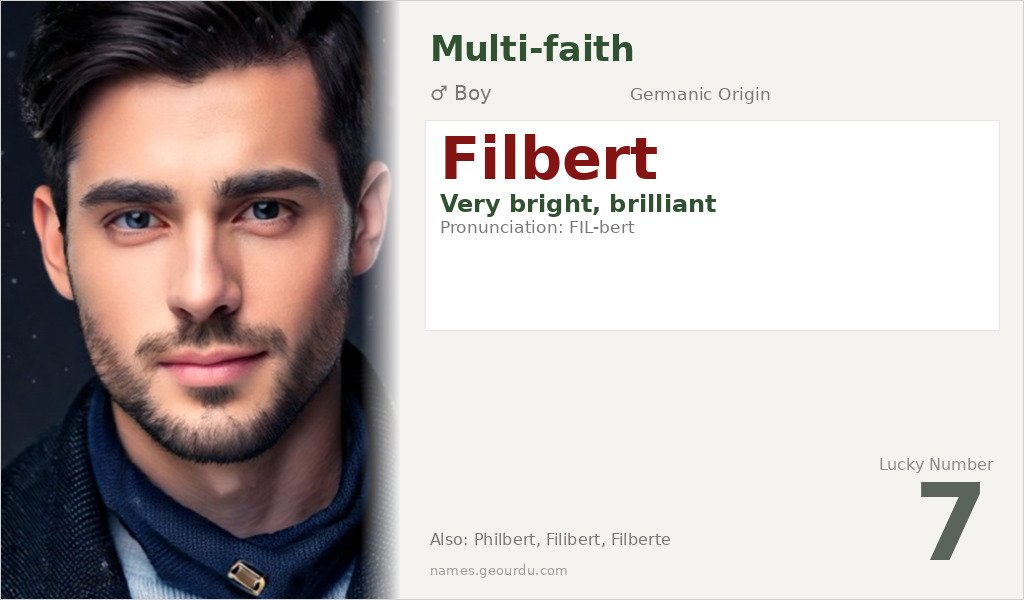
| 📛 Name | Filbert |
| 💎 Meaning | Very bright, brilliant |
| 👤 Gender | Boy |
| 🕌 Religion | Multi-faith |
| 🌍 Origin | Germanic |
| 🗣 Pronunciation | FIL-bert |
| ✍️ Urdu | فلبرٹ |
| ✍️ Arabic | فيلبرت |
| 🔢 Numerology | 7 |
| ✨ Spellings | Philbert, Filibert, Filberte, Philibert |
Origin & Cultural Significance
Filbert has Germanic origins, specifically from the Frankish tribes who spoke Old High German. The name gained prominence through Saint Philbert (c. 608-684), a Frankish abbot who founded Jumièges Abbey in Normandy and several other monasteries. His veneration helped spread the name throughout medieval France and England. While the name appears in Christian contexts due to the saint, its linguistic roots predate Christianity and come from pagan Germanic naming traditions that valued qualities like brightness and brilliance. Today, Filbert remains most common in English-speaking countries and has seen occasional revival as parents seek unique names with historical depth.
Personality Traits
Those named Filbert often exhibit intellectual curiosity and analytical thinking, reflecting the name’s meaning of ‘brightness.’ They tend to be observant, detail-oriented individuals who approach problems methodically. While sometimes reserved in social situations, Filberts typically possess deep insight and perceptiveness that others value. Their thoughtful nature often leads them to careers in research, science, or fields requiring careful analysis.
Similar Names
If you like Filbert, consider: Gilbert, Albert, Herbert, Bertram, Lambert
Famous People Named Filbert
- Saint Philbert — 7th-century Frankish abbot and founder of Jumièges Abbey in Normandy
- Filbert Bayi — Tanzanian middle-distance runner who set world records in the 1500m and mile in the 1970s
Frequently Asked Questions About Filbert
What does Filbert mean?
Filbert means 'very bright' or 'extremely brilliant,' derived from the Old High German elements 'filu' (very) and 'beraht' (bright).
Is Filbert a boy or girl name?
Filbert is traditionally a masculine name, though like many names, it could theoretically be used for any gender in modern contexts.
What is the origin of Filbert?
Filbert originates from Old High German (Germanic language family) and was popularized in medieval Europe through Saint Philbert, a 7th-century Frankish abbot.





