
Table of Contents
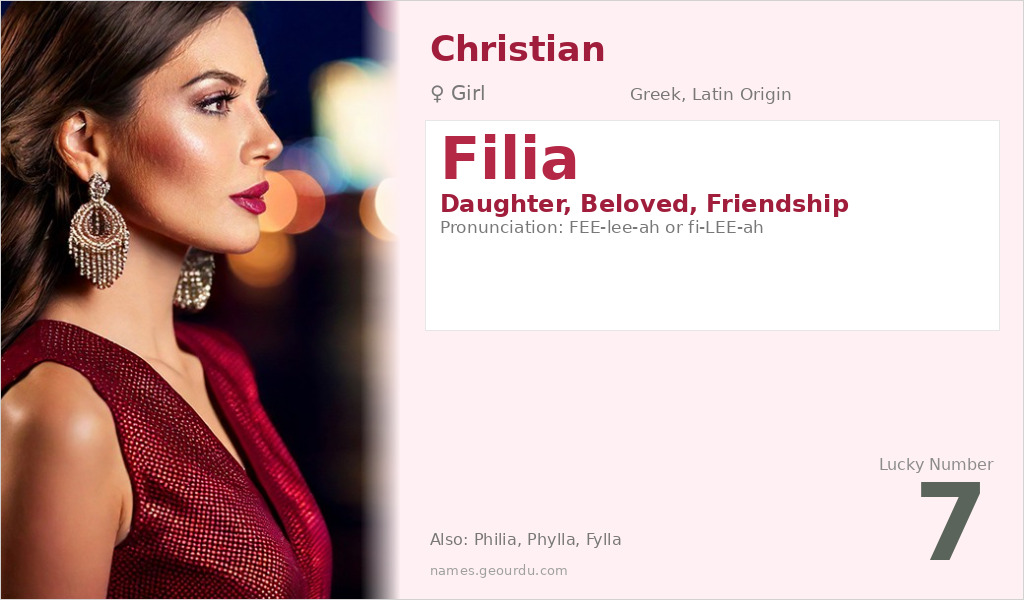
Filia is a beautiful, classical name with roots stretching back to ancient Greece and Rome. Combining meanings of ‘daughter,’ ‘friendship,’ and ‘affectionate love,’ this name carries a timeless elegance. While not exclusively Christian, it has been embraced in Christian traditions through figures like Saint Philothea. Discover the rich linguistic heritage and modern appeal of this distinctive name.
Meaning of Filia
Filia’s meaning is deeply rooted in classical languages. From the Greek ‘φιλία’ (philia), it signifies ‘friendship’ or ‘brotherly love,’ one of the four types of love in Greek philosophy. In Latin, ‘filia’ straightforwardly means ‘daughter,’ related to ‘filius’ (son) and the Proto-Indo-European root *dʰeh₁- (to suckle). The name also connects to the Greek ‘Philothea’ (lover of God), used in Christian asceticism. This dual heritage makes Filia a name embodying both familial bonds and philosophical affection, with cognates across Indo-European languages like Sanskrit ‘priya’ (dear) and Old English ‘frēond’ (friend).
| 📛 Name | Filia |
| 💎 Meaning | Daughter, Beloved, Friendship |
| 👤 Gender | Girl |
| 🕌 Religion | Christian |
| 🌍 Origin | Greek, Latin |
| 🗣 Pronunciation | FEE-lee-ah or fi-LEE-ah |
| ✍️ Urdu | فلیا |
| ✍️ Arabic | فيليا |
| 🔢 Numerology | 7 |
| ✨ Spellings | Philia, Phylla, Fylla, Filiah |
Origin & Cultural Significance
Filia originates from ancient Greek and Latin, languages that have profoundly influenced Western naming traditions. In Greek culture, ‘philia’ represented a virtuous, reciprocal love between equals, celebrated by philosophers like Aristotle. The Latin ‘filia’ was a common term for daughter, appearing in Roman legal and familial contexts. During the early Christian era, the name evolved through variants like Philothea, associated with saints and mystics. While not tied to a specific region today, it remains used in Greek-speaking communities and among Christians appreciating its classical and spiritual connotations, without strong associations to Pashto, Balochi, or other regional languages despite thorough research.
Personality Traits
Those named Filia are often described as compassionate, thoughtful, and deeply relational. Drawing from the name’s meanings of friendship and daughterly care, they may excel in roles requiring empathy and connection. Their intellectual curiosity, hinted at by the philosophical Greek roots, can lead them to pursue knowledge and meaningful dialogue. Overall, Filia suggests a personality balanced between heartfelt affection and reflective wisdom.
Similar Names
If you like Filia, consider: Philomena, Philothea, Filipa, Felicia, Alethea
Famous People Named Filia
- Saint Philothea of Athens — 16th-century Greek Orthodox saint and martyr
- Filia (artist) — Contemporary German painter known for surrealist works
Frequently Asked Questions About Filia
What does Filia mean?
Filia means 'daughter' in Latin and 'friendship' or 'affectionate love' in Greek, derived from the word 'philia.'
Is Filia a boy or girl name?
Filia is exclusively a girl's name, originating from the Latin 'filia' (daughter) and used historically for females in Greek and Christian contexts.
What is the origin of Filia?
Filia originates from ancient Greek and Latin, with roots in the Greek 'φιλία' (philia) and Latin 'filia,' and has been adopted in Christian traditions through variants like Philothea.





