
Table of Contents
Fir’aun is one of the most historically significant names in human civilization, yet it remains controversial as a personal name. Derived from the Ancient Egyptian title for kings, it became immortalized in religious texts as the antagonist to Prophet Moses. While meaning ‘Pharaoh’ or ‘Ruler’, its associations make it an unusual choice for modern naming.
Meaning of Fir'aun
Fir’aun (فرعون) is the Arabic form of ‘Pharaoh’, tracing back through Hebrew ‘Par’oh’ to the Ancient Egyptian ‘pr-ꜥꜣ’, meaning ‘Great House’—originally referring to the royal palace before becoming the title for Egyptian monarchs. In Semitic languages, the term was adopted and adapted, with the Arabic ‘Fir’aun’ specifically referencing the Exodus Pharaoh. Linguistically, it represents one of the oldest cross-cultural borrowings, preserved for millennia through religious texts. The meaning evolved from an institutional reference (‘Great House’) to a personal title (‘Ruler’) to a specific historical figure in Abrahamic traditions.
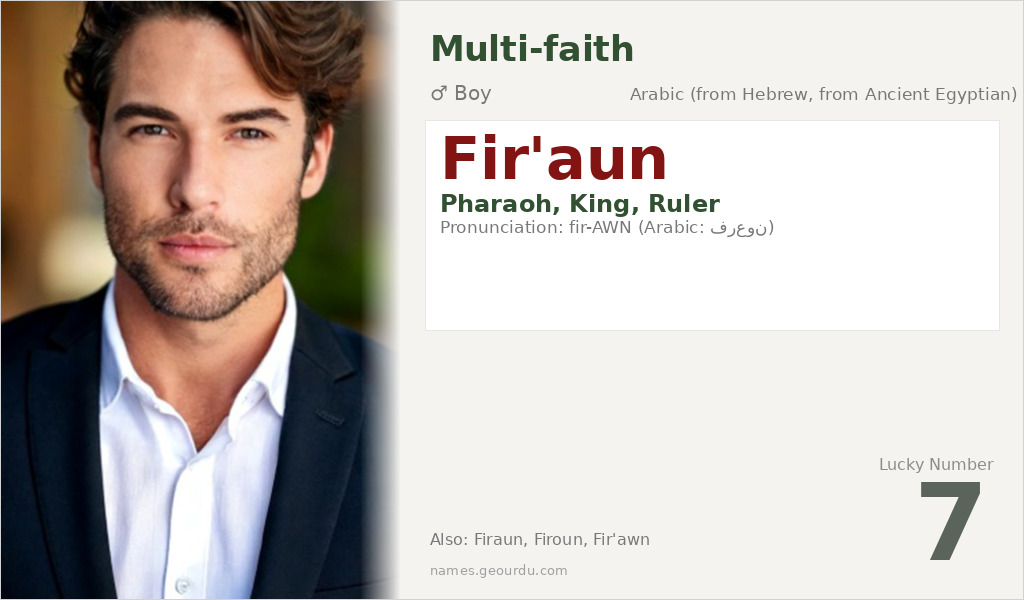
| 📛 Name | Fir'aun |
| 💎 Meaning | Pharaoh, King, Ruler |
| 👤 Gender | Boy |
| 🕌 Religion | Multi-faith |
| 🌍 Origin | Arabic (from Hebrew, from Ancient Egyptian) |
| 🗣 Pronunciation | fir-AWN (Arabic: فرعون) |
| ✍️ Urdu | فرعون |
| ✍️ Arabic | فرعون |
| 🔢 Numerology | 7 |
| ✨ Spellings | Firaun, Firoun, Fir'awn, Pharaoh |
Origin & Cultural Significance
The name originates from Ancient Egypt as a royal title, entering Semitic languages through cultural contact and trade. It appears in the Hebrew Bible as ‘Par’oh’, in the Greek New Testament as ‘Pharaō’, and in the Quran as ‘Fir’aun’. While the term exists across Abrahamic faiths, its usage as a personal name is extremely rare among Muslims due to the Quran’s depiction of Fir’aun as the archetypal tyrant who rejected divine signs. In some regional contexts, particularly South Asia, it might be used ironically or symbolically, but it lacks traditional naming status in Islamic culture. The name represents a fascinating case of a title becoming a proper noun through religious narrative.
Personality Traits
The name Fir’aun carries complex personality associations. Historically, it suggests authority, power, and regal bearing—qualities of leadership and command. However, in religious context, it strongly connotes arrogance, tyranny, and opposition to divine guidance. This duality makes it a name with powerful symbolic weight but challenging practical usage. Those named Fir’aun would likely confront constant religious and historical references rather than positive personal attributes.
Similar Names
If you like Fir'aun, consider: Malik, Sultan, Shah, Qaisar, Badshah
Famous People Named Fir'aun
- Fir'aun (Biblical/Quranic figure) — The Pharaoh who opposed Prophet Moses, mentioned in the Torah, Bible, and Quran
- Firaun (historical reference) — Title for ancient Egyptian rulers, particularly associated with Ramesses II
Frequently Asked Questions About Fir'aun
What does Fir'aun mean?
Fir'aun means 'Pharaoh', 'King', or 'Ruler'. It originates from Ancient Egyptian 'pr-ꜥꜣ' (Great House) through Hebrew into Arabic as the title for Egyptian monarchs.
Is Fir'aun a boy or girl name?
Fir'aun is exclusively a masculine name, as it refers to male Pharaohs in historical and religious contexts. There is no feminine equivalent in traditional usage.
What is the origin of Fir'aun?
The name originates from Ancient Egyptian, entering Semitic languages (Hebrew, then Arabic) as a title for Egyptian rulers. It's most famous from the Exodus narrative in Abrahamic traditions.





