
Table of Contents
Freeman is a distinctive name with deep historical roots in English culture. Originally an occupational surname denoting a free person in medieval society, it has evolved into a meaningful given name celebrating liberty and independence. This name carries the weight of centuries of social history while remaining relevant in modern times. Discover the fascinating journey of this name from feudal England to contemporary usage.
Meaning of Freeman
The name Freeman has a clear and well-documented meaning derived from Old English, the Germanic language spoken in England from the 5th to 12th centuries. It combines ‘freo’ (meaning ‘free, not in bondage’) with ‘mann’ (meaning ‘man, person’). In medieval England, a freeman was someone who was not a serf or slave—a person with legal rights, including the right to own property and participate in local governance. This status name became hereditary as a surname and eventually transitioned to use as a first name, particularly during the surname-as-first-name trend. The meaning reflects fundamental concepts of personal liberty that were crucial in feudal social structures.
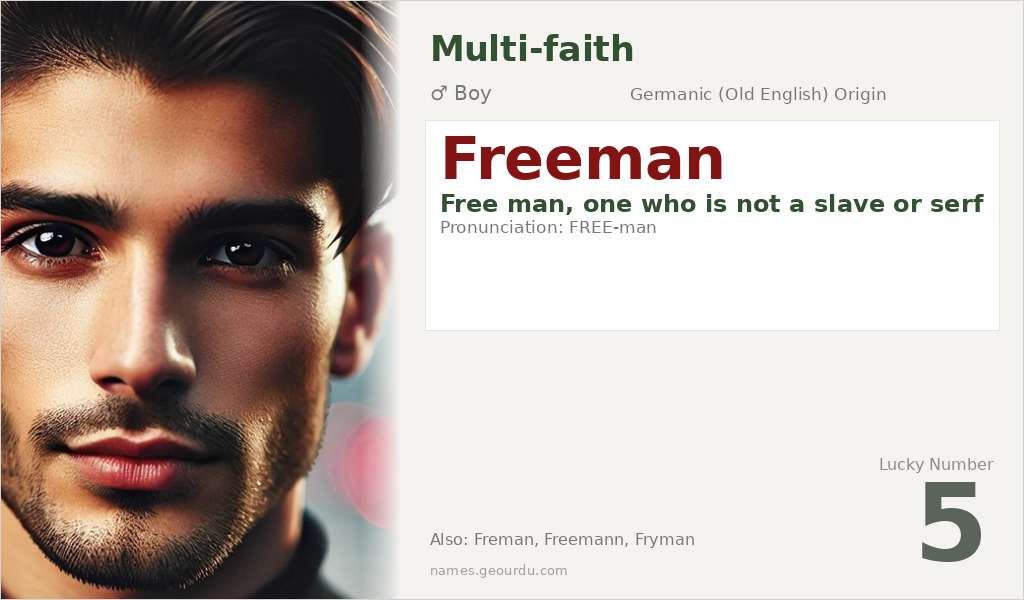
| 📛 Name | Freeman |
| 💎 Meaning | Free man, one who is not a slave or serf |
| 👤 Gender | Boy |
| 🕌 Religion | Multi-faith |
| 🌍 Origin | Germanic (Old English) |
| 🗣 Pronunciation | FREE-man |
| ✍️ Urdu | فری مین |
| ✍️ Arabic | فريمان |
| 🔢 Numerology | 5 |
| ✨ Spellings | Freman, Freemann, Fryman |
Origin & Cultural Significance
Freeman originates from England during the Middle Ages as an occupational or status surname. It emerged from the social hierarchy of feudal England where one’s legal status was paramount. The distinction between freemen and serfs was significant in medieval law and society. As surnames became fixed in the 13th-14th centuries, Freeman became established as a family name. The transition to a given name occurred primarily in English-speaking countries, especially the United States and United Kingdom, where it gained popularity as part of the trend of using surnames as first names. While not tied to any specific religion, it has been used by people of various faiths in English-speaking contexts.
Personality Traits
The name Freeman suggests qualities of independence, self-determination, and strength of character. Those bearing this name are often perceived as natural leaders who value autonomy and personal freedom. The historical connotation of legal and social freedom translates to a personality associated with principled decision-making and resistance to undue constraint. While personality traits vary by individual, the name carries connotations of dignity, self-reliance, and respect for personal boundaries.
Similar Names
If you like Freeman, consider: Franklin, Freedom, Liberty, Freeland
Famous People Named Freeman
- Freeman Dyson — British-American theoretical physicist and mathematician
- Freeman Freeman-Thomas — British politician who served as Governor-General of India
Frequently Asked Questions About Freeman
What does Freeman mean?
Freeman means 'free man' or 'one who is not a slave/serf.' It comes from Old English 'freo' (free) and 'mann' (man), originally denoting a person with legal rights in medieval England.
Is Freeman a boy or girl name?
Freeman is traditionally a masculine name, though theoretically it could be used for any gender. Historically and in contemporary usage, it is overwhelmingly used for boys/men.
What is the origin of Freeman?
Freeman originates from Old English (a Germanic language) as a status surname from medieval England. It described a person who was legally free rather than a serf or slave, and later became used as a given name.





