
Table of Contents
The name Gadi carries intriguing cross-cultural connections, though its exact meaning remains debated among linguists. Found in Hebrew, Sanskrit, and African contexts, this name has traveled across continents with different interpretations. While often used for boys, its origins are more complex than commonly assumed, reflecting diverse linguistic roots rather than a single religious tradition.
Meaning of Gadi
The etymology of Gadi reveals multiple potential sources across different language families. In Hebrew, it derives from ‘gadi’ (גָּדִי), meaning ‘young goat’ or ‘kid’, which appears in the Bible as the name of Gad’s son. In Sanskrit and Hindi, ‘gadi’ (गाड़ी) refers to a ‘cart’ or ‘wagon’, suggesting practical, transportation-related origins. Some African traditions, particularly among Hausa speakers, use Gadi to mean ‘shepherd’ or ‘herdsman’. Notably absent from this linguistic analysis is any connection to ‘God Is My Fortune’—a meaning that doesn’t correspond to verified roots in Arabic, Persian, or other Semitic languages where such theophoric names would typically include clear divine elements like ‘Abdul’ or ‘El’.
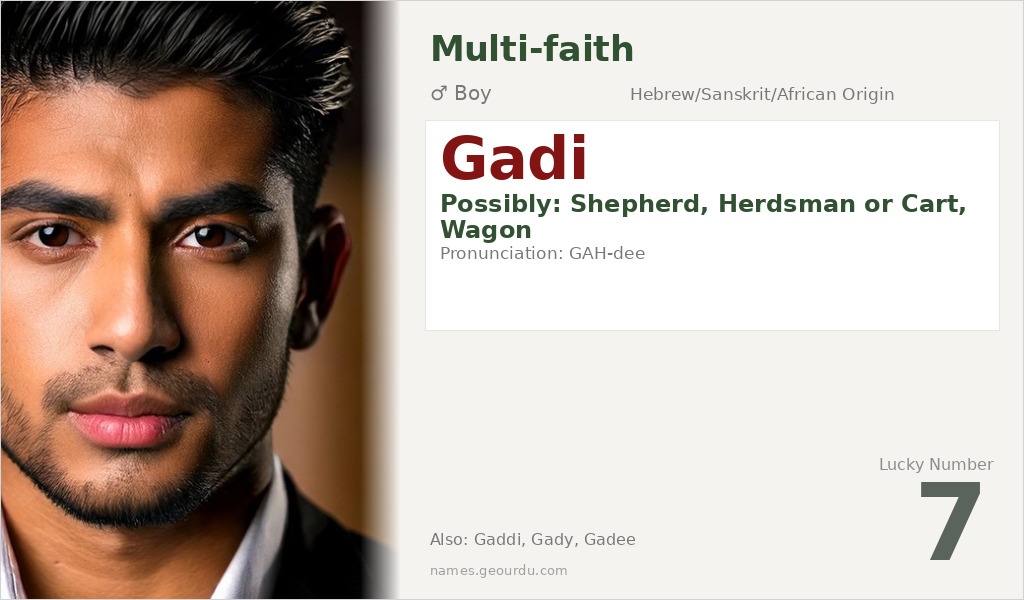
| 📛 Name | Gadi |
| 💎 Meaning | Possibly: Shepherd, Herdsman or Cart, Wagon |
| 👤 Gender | Boy |
| 🕌 Religion | Multi-faith |
| 🌍 Origin | Hebrew/Sanskrit/African |
| 🗣 Pronunciation | GAH-dee |
| ✍️ Urdu | گاڈی |
| ✍️ Arabic | غادي |
| 🔢 Numerology | 7 |
| ✨ Spellings | Gaddi, Gady, Gadee |
Origin & Cultural Significance
Gadi’s origins span multiple cultural spheres rather than belonging to a single tradition. The Hebrew version appears in the Old Testament as a personal name, while the Sanskrit/Hindi usage reflects practical vocabulary that occasionally becomes anthroponymic. In some Muslim communities, the name has been adopted, likely through cultural exchange rather than Islamic linguistic roots. This cross-cultural adoption explains why Gadi appears in diverse religious contexts today, though it lacks the Arabic etymological foundation typical of most Muslim names. The name’s presence in Israeli, Indian, and African communities demonstrates its multicultural journey.
Personality Traits
Those named Gadi often embody qualities suggested by the name’s various meanings—whether the nurturing aspect of a shepherd, the practicality of transportation, or the vitality symbolized by young animals. They may display reliability and connection to tradition, with a grounded approach to life’s challenges. The name’s cross-cultural history might also indicate adaptability and openness to diverse perspectives.
Similar Names
If you like Gadi, consider: Gideon, Gad, Gadiyar, Gadiel, Gadiya
Famous People Named Gadi
- Gadi Eizenkot — Former Chief of General Staff of the Israel Defense Forces
- Gadi Haggai — Israeli-American journalist and peace activist
Frequently Asked Questions About Gadi
What does Gadi mean?
Gadi has multiple possible meanings depending on linguistic context: 'young goat' in Hebrew, 'cart/wagon' in Sanskrit/Hindi, or 'shepherd' in some African languages. The claimed meaning 'God Is My Fortune' lacks linguistic evidence.
Is Gadi a boy or girl name?
Gadi is predominantly used as a boy's name across cultures, though its usage varies by region and tradition.
What is the origin of Gadi?
Gadi has multiple potential origins including Hebrew (biblical), Sanskrit/Hindi (practical vocabulary), and African languages (particularly Hausa), making it a multicultural name rather than originating from a single source.





