Table of Contents
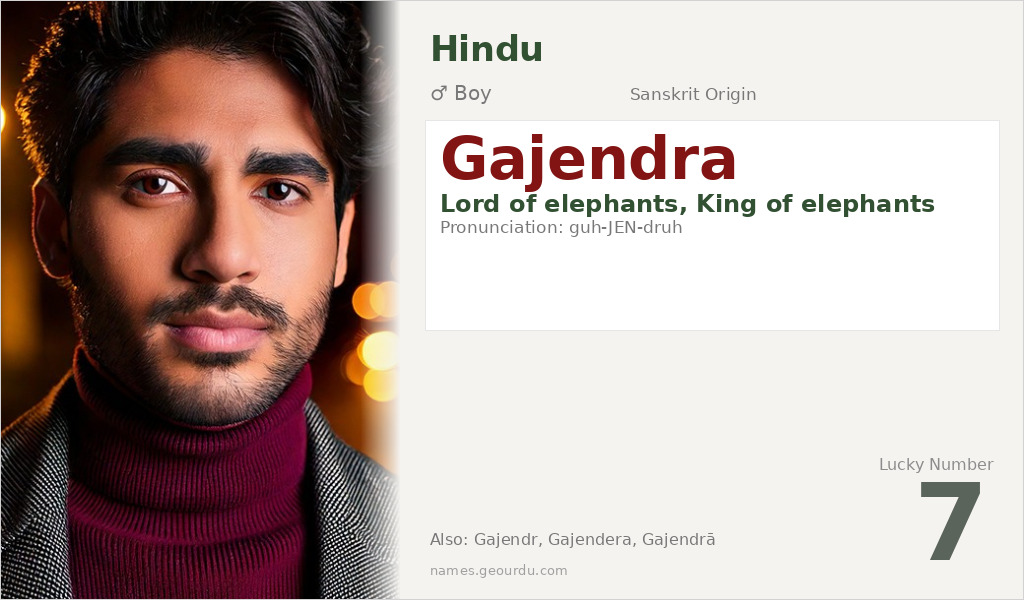
Gajendra is a powerful and regal Sanskrit name that carries deep cultural and spiritual significance in Hindu tradition. Meaning ‘Lord of Elephants’ or ‘King of Elephants’, this name evokes strength, wisdom, and nobility. It’s particularly notable from the Bhagavata Purana story where the elephant king Gajendra is rescued by Lord Vishnu, symbolizing devotion and divine grace. Today, it remains a meaningful choice for parents seeking a name with mythological resonance and majestic connotations.
Meaning of Gajendra
Gajendra derives from classical Sanskrit, combining ‘gaja’ (elephant) and ‘indra’ (lord, king, or ruler). The element ‘indra’ specifically refers to the king of the Devas in Hindu cosmology, but in compound names it functions as an honorific suffix meaning ‘chief of’ or ‘lord of’. Thus, Gajendra literally translates to ‘lord of elephants’ or ‘king of elephants’. This name is deeply embedded in Hindu scriptures, most famously in the Bhagavata Purana’s story of Gajendra Moksha, where the elephant king’s devotion to Vishnu leads to his liberation. The name symbolizes not just physical strength and royal authority, but also spiritual devotion and divine protection.
| 📛 Name | Gajendra |
| 💎 Meaning | Lord of elephants, King of elephants |
| 👤 Gender | Boy |
| 🕌 Religion | Hindu |
| 🌍 Origin | Sanskrit |
| 🗣 Pronunciation | guh-JEN-druh |
| ✍️ Urdu | گجندر |
| ✍️ Arabic | غاجيندرا |
| 🔢 Numerology | 7 |
| ✨ Spellings | Gajendr, Gajendera, Gajendrā |
Origin & Cultural Significance
Gajendra originates from ancient Sanskrit literature and Hindu mythology, with its most prominent appearance in the Bhagavata Purana (circa 8th-10th century CE). The story of Gajendra’s rescue by Vishnu is a central parable in Vaishnavism about surrender and divine grace. While the name is distinctly Hindu in religious association, its linguistic roots are purely Sanskrit, one of the oldest Indo-European languages. The name has been used historically in Indian royal contexts and continues in modern India, particularly among Hindu families. It reflects the cultural reverence for elephants in South Asia as symbols of wisdom, strength, and royal power.
Personality Traits
Those named Gajendra are often associated with qualities of strength, protection, and noble leadership. Like the elephant—revered for its intelligence, memory, and gentle power—they may exhibit wisdom, loyalty, and a calm, commanding presence. In social settings, they might be seen as dependable pillars of their community, combining physical or mental strength with emotional depth. The name suggests someone who carries responsibility well and protects those in their care, embodying both the regal and compassionate aspects of the elephant symbolism.
Similar Names
If you like Gajendra, consider: Gajanan, Gajadhar, Indrajit, Ganesh, Hastin
Famous People Named Gajendra
- Gajendra Singh Shekhawat — Indian politician and current Union Minister of Jal Shakti
- Gajendra Chauhan — Indian actor and former chairman of FTII
Frequently Asked Questions About Gajendra
What does Gajendra mean?
Gajendra means 'Lord of Elephants' or 'King of Elephants'. It comes from Sanskrit: 'gaja' (elephant) + 'indra' (lord, ruler).
Is Gajendra a boy or girl name?
Gajendra is exclusively a masculine name in Hindu naming tradition, derived from masculine Sanskrit grammatical forms and associated with male mythological figures.
What is the origin of Gajendra?
Gajendra originates from Sanskrit and Hindu mythology, most famously from the Bhagavata Purana story of the elephant king Gajendra who is saved by Lord Vishnu.