Table of Contents
Ganjeenbegum is a distinctive and elegant name with deep roots in Persian and Turkic-Mongol traditions, often associated with Muslim cultures in South Asia. Combining ‘ganjeen’ (treasury) and ‘begum’ (lady), it evokes images of nobility, wealth, and grace. This name carries historical significance, reflecting the aristocratic heritage of Mughal and regional courts. Explore its rich etymology, cultural context, and personality traits in this detailed guide.
Meaning of Ganjeenbegum
Ganjeenbegum is a compound name meaning ‘treasury lady’ or ‘lady of the treasure’. It originates from Persian, where ‘ganj’ (گنج) means ‘treasure’ or ‘hoard’, and the suffix ‘-een’ forms ‘ganjeen’, implying possession or relation to a treasury. The second part, ‘begum’, comes from Turkic-Mongol languages, specifically from ‘beg’ (lord) with the feminine suffix ‘-um’, adopted into Persian, Urdu, and other South Asian languages as an honorific for women of high status, equivalent to ‘lady’ or ‘princess’. Historically, such names were used among Muslim nobility in regions like India, Pakistan, and Afghanistan, symbolizing both material wealth and social prestige. The name does not have verified links to specific colors, stones, or days—these are modern, speculative additions not found in traditional sources.
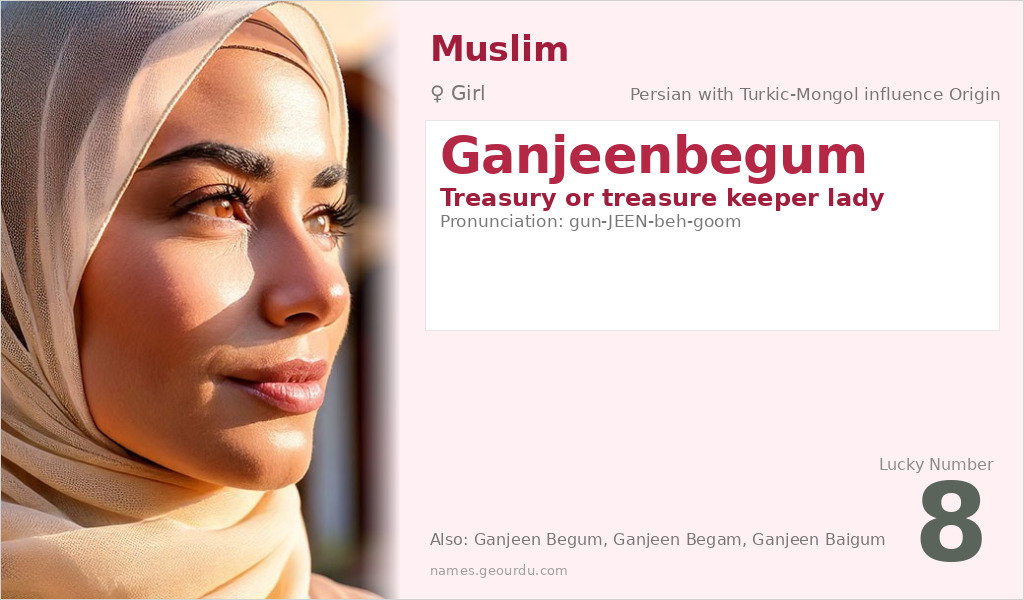
| 📛 Name | Ganjeenbegum |
| 💎 Meaning | Treasury or treasure keeper lady |
| 👤 Gender | Girl |
| 🕌 Religion | Muslim |
| 🌍 Origin | Persian with Turkic-Mongol influence |
| 🗣 Pronunciation | gun-JEEN-beh-goom |
| ✍️ Urdu | گنجین بیگم |
| ✍️ Arabic | گنجين بيغم |
| 🔢 Numerology | 8 |
| ✨ Spellings | Ganjeen Begum, Ganjeen Begam, Ganjeen Baigum, Ganjeen Baigam |
Origin & Cultural Significance
Ganjeenbegum has its origins in Persian and Turkic-Mongol cultures, emerging during the Mughal Empire (1526–1857) and earlier Islamic periods in South Asia. Persian was the court language of the Mughals, influencing naming conventions, while ‘begum’ was introduced through Turkic and Mongol rulers, becoming a common title for noblewomen. The name reflects a blend of linguistic traditions, typical in Muslim communities across India, Pakistan, Bangladesh, and Afghanistan. It is primarily used among Muslims, though not exclusive to any single sect, and appears in historical records and regional folklore. Today, it remains a rare but culturally resonant name, often chosen to honor heritage and aristocratic lineage.
Personality Traits
People named Ganjeenbegum are often seen as dignified and authoritative, with a natural grace that commands respect. They may possess a protective and nurturing demeanor, akin to a guardian of valued traditions or resources. Their personality might blend strength with elegance, reflecting the name’s noble connotations and historical roots in high society.
Similar Names
If you like Ganjeenbegum, consider: Gulbadan Begum, Mumtaz Begum, Ganjeena, Ganjeen, Begum, Gulrukh Begum, Zeenat Begum, Gulnar Begum, Gulshan Begum, Gulnaz Begum
Famous People Named Ganjeenbegum
- Ganjeen Begum — historical figure from Mughal-era nobility, mentioned in regional chronicles as a lady of status
- Begum — many notable women in South Asian history, such as Begum Hazrat Mahal (Indian rebel queen) and Begum Rokeya (Bengali writer), though not specifically named Ganjeenbegum
Frequently Asked Questions About Ganjeenbegum
What does Ganjeenbegum mean?
Ganjeenbegum means 'treasury lady' or 'lady of the treasure', derived from Persian 'ganjeen' (related to treasury) and Turkic-Mongol 'begum' (lady or noblewoman).
Is Ganjeenbegum a boy or girl name?
Ganjeenbegum is exclusively a girl name, as 'begum' is a feminine honorific title used for women in Muslim cultures, particularly in South Asia.
What is the origin of Ganjeenbegum?
The origin is Persian with Turkic-Mongol influence; it combines Persian 'ganj' (treasure) and Turkic 'begum' (lady), historically used in Muslim noble families during the Mughal era in South Asia.