
Table of Contents
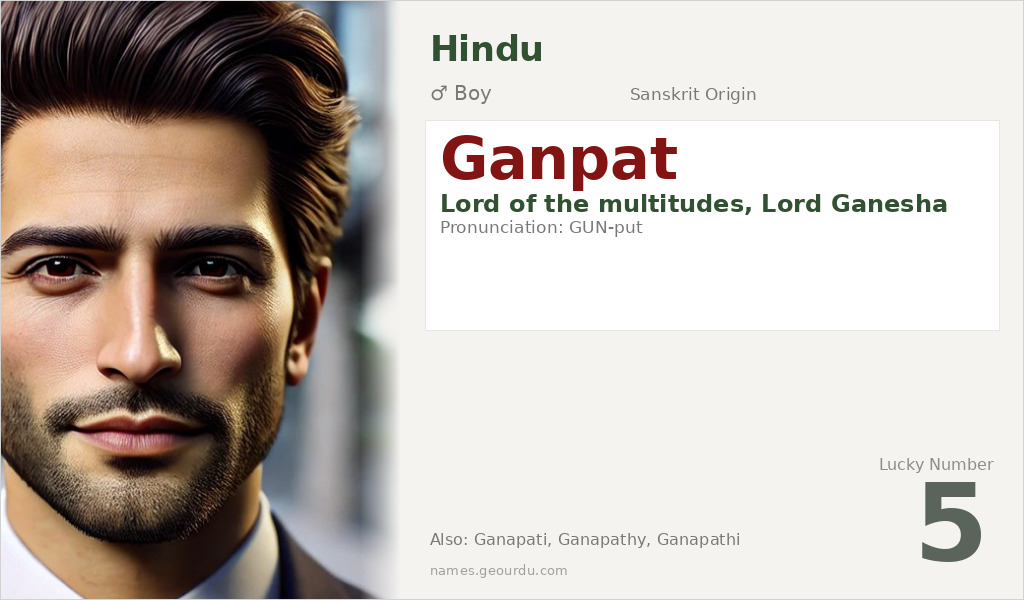
Ganpat is a traditional Hindu name with deep roots in Sanskrit scripture and mythology. Directly meaning ‘Lord of the multitudes,’ it serves as another name for Lord Ganesha, the beloved elephant-headed deity who removes obstacles. This name carries centuries of religious and cultural significance across India and Hindu communities worldwide. Parents choosing Ganpat often seek to invoke the deity’s blessings of wisdom, success, and protection for their child.
Meaning of Ganpat
Ganpat originates from the Sanskrit compound ‘Gaṇapati,’ combining ‘gaṇa’ (multitude, group) and ‘pati’ (lord, master). Literally translating to ‘Lord of the multitudes’ or ‘Leader of the groups,’ this term originally described leaders of celestial troops in Vedic texts. By the post-Vedic period, it became exclusively associated with Lord Ganesha, who is traditionally depicted as the commander of Shiva’s ganas (divine attendants). The name appears in ancient Hindu scriptures including the Rigveda (2.23.1) and extensively in the Mahabharata, where Gaṇapati is invoked at the beginning of the epic. In modern usage, Ganpat retains this specific theophoric meaning while also serving as a given name that honors the deity.
| 📛 Name | Ganpat |
| 💎 Meaning | Lord of the multitudes, Lord Ganesha |
| 👤 Gender | Boy |
| 🕌 Religion | Hindu |
| 🌍 Origin | Sanskrit |
| 🗣 Pronunciation | GUN-put |
| ✍️ Urdu | گنپت |
| ✍️ Arabic | جانباتي |
| 🔢 Numerology | 5 |
| ✨ Spellings | Ganapati, Ganapathy, Ganapathi, Ganapath |
Origin & Cultural Significance
Ganpat has its origins in ancient Sanskrit language and Hindu religious tradition, dating back over 3,000 years to Vedic texts. The name evolved from a general title for leaders of groups to become specifically associated with the deity Ganesha during the Gupta period (4th-6th centuries CE). Culturally, it is most prevalent in India, particularly in Maharashtra, Gujarat, and other regions where Ganesha worship is prominent. The name spread through Hindu diaspora communities to Southeast Asia, Africa, the Caribbean, and Western nations. Regional variations include Ganapati in South India and Ganapathy in Tamil Nadu, while the shortened form Ganpat is common in North India and among Marathi-speaking communities.
Personality Traits
Named after the remover of obstacles, individuals called Ganpat are often perceived as natural problem-solvers who approach challenges with intelligence and perseverance. They tend to exhibit leadership qualities, organizational skills, and a protective nature toward their community or family. Like their namesake deity who is patron of arts and sciences, many Ganpats show creative talents combined with analytical thinking, making them effective in both artistic and practical pursuits.
Similar Names
If you like Ganpat, consider: Ganesh, Ganesha, Vinayak, Vighnesh, Gajanan
Famous People Named Ganpat
- Ganpat Rai — 18th century Indian scholar and author of 'Nigama Parishishta'
- Ganpat Singh — Indian politician and former Member of Legislative Assembly from Rajasthan
Frequently Asked Questions About Ganpat
What does Ganpat mean?
Ganpat means 'Lord of the multitudes' in Sanskrit, specifically referring to the Hindu deity Lord Ganesha, the elephant-headed god who removes obstacles.
Is Ganpat a boy or girl name?
Ganpat is exclusively a boy's name in Hindu tradition, as it refers to the male deity Lord Ganesha and follows masculine Sanskrit grammatical forms.
What is the origin of Ganpat?
Ganpat originates from Sanskrit language and Hindu religion, derived from 'Gaṇapati' appearing in ancient texts like the Rigveda and Mahabharata, specifically associated with Lord Ganesha worship.





