
Table of Contents
Ganpati is a powerful and ancient Hindu name with deep spiritual significance. Derived from Sanskrit, this name literally means ‘Lord of the multitudes’ and serves as one of the primary names for Lord Ganesha, the beloved elephant-headed deity. As a baby name, Ganpati carries the blessings of wisdom, protection, and the ability to overcome obstacles. This name has been cherished for centuries across Hindu communities, particularly in India and Nepal.
Meaning of Ganpati
The name Ganpati originates from the Sanskrit language, combining two essential components: ‘gana’ meaning ‘multitude, group, or celestial hosts’ and ‘pati’ meaning ‘lord, master, or ruler’. This creates the complete meaning ‘Lord of the multitudes’ or ‘Leader of the celestial hosts’. In Hindu mythology, this refers specifically to Lord Ganesha’s role as the commander of Shiva’s ganas (attendant spirits). The name appears in numerous sacred texts including the Rigveda, where it’s used to describe a divine leader. The linguistic roots are well-documented in Sanskrit dictionaries and etymological studies, with the term evolving through Prakrit and modern Indian languages while maintaining its core meaning.
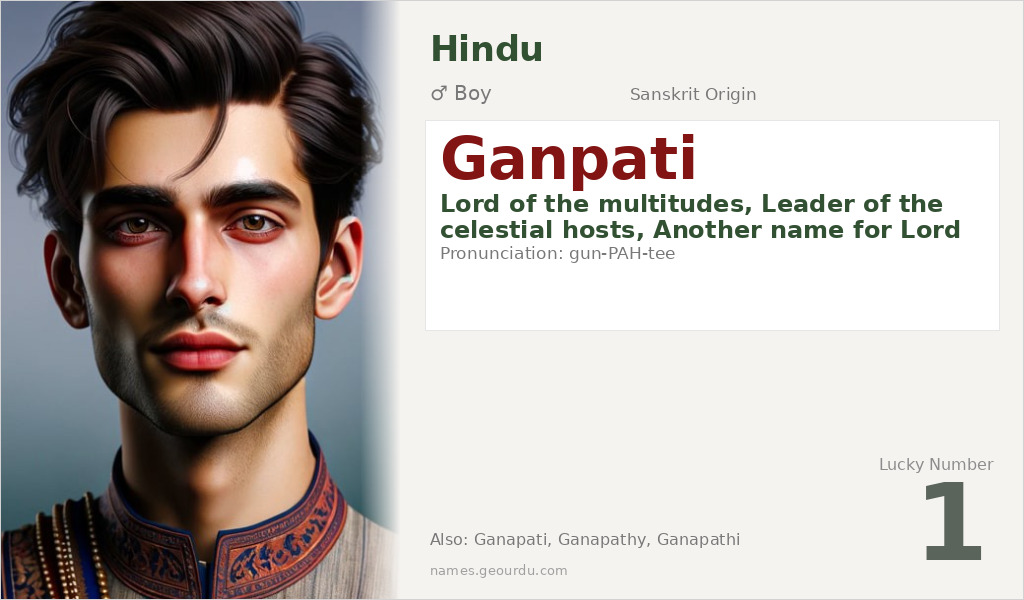
| 📛 Name | Ganpati |
| 💎 Meaning | Lord of the multitudes, Leader of the celestial hosts, Another name for Lord Ganesha |
| 👤 Gender | Boy |
| 🕌 Religion | Hindu |
| 🌍 Origin | Sanskrit |
| 🗣 Pronunciation | gun-PAH-tee |
| ✍️ Urdu | گنپتی |
| ✍️ Arabic | جانباتي |
| 🔢 Numerology | 1 |
| ✨ Spellings | Ganapati, Ganapathy, Ganapathi |
Origin & Cultural Significance
Ganpati has its origins in ancient Sanskrit literature and Hindu religious traditions dating back over 2,000 years. The name first appears in Vedic texts and becomes prominent in the Puranas, particularly the Ganesha Purana and Mudgala Purana. Culturally, Ganpati is especially significant in Maharashtra, India, where the Ganesh Chaturthi festival features the famous chant ‘Ganpati Bappa Morya’. The name spread throughout South Asia with Hindu diaspora communities and remains popular in India, Nepal, Sri Lanka, and Southeast Asian countries with Hindu populations. While primarily a religious name, it has also been adopted as a given name for boys in Hindu families seeking spiritual blessings.
Personality Traits
Those named Ganpati are often associated with leadership qualities, intelligence, and practical wisdom. They tend to be natural problem-solvers who approach obstacles with determination and creativity. The name’s connection to Lord Ganesha suggests personality traits of protection, guidance, and the ability to bring harmony to groups. Individuals with this name may exhibit strong organizational skills and a talent for managing complex situations with grace and intelligence.
Similar Names
If you like Ganpati, consider: Ganesh, Ganesha, Vinayak, Vighnesh, Gajanan
Famous People Named Ganpati
- Ganpati Bappa Morya — Traditional chant and invocation to Lord Ganesha during Ganesh Chaturthi festival
- Ganpati Dada — Historical figure and freedom fighter in Maharashtra, India
Frequently Asked Questions About Ganpati
What does Ganpati mean?
Ganpati means 'Lord of the multitudes' or 'Leader of the celestial hosts' in Sanskrit. It's composed of 'gana' (multitude) and 'pati' (lord), and is one of the primary names for Lord Ganesha in Hindu tradition.
Is Ganpati a boy or girl name?
Ganpati is exclusively a boy's name in Hindu tradition, as it refers to the male deity Lord Ganesha. There are no feminine versions or unisex usage in traditional contexts.
What is the origin of Ganpati?
Ganpati originates from Sanskrit, the ancient language of India. It has been used for over two millennia in Hindu religious texts and traditions, particularly associated with the worship of Lord Ganesha.





