
Table of Contents
Gar is a concise, powerful name with roots stretching across continents and cultures. While often considered a modern shortened form of names like Gareth, its true origins are far more ancient and meaningful. This name carries the strength of weapons in Germanic tradition and the solidity of mountains in South Asian languages, making it a name of substantial character and history.
Meaning of Gar
The name Gar derives from multiple linguistic sources, each with distinct meanings. In Old English and Germanic languages, ‘gar’ directly translates to ‘spear’ or ‘javelin,’ referring to a throwing weapon used in warfare and hunting. This root appears in words like ‘garfish’ (spear-shaped fish) and survives in modern English ‘gore.’ In Pashto and Balochi languages spoken in Afghanistan, Pakistan, and Iran, ‘gar’ (گر/ګر) means ‘mountain’ or ‘rock,’ often appearing in compound names like Garshasp (having mountain horses) or place names. The Sanskrit/Hindi ‘gar’ (गर) means ‘swallowing’ or ‘consuming,’ though this is rarely used as a standalone name. While Gar is sometimes used as a nickname for Gareth (Welsh for ‘gentle’), this represents a modern adaptation rather than the name’s primary etymology.
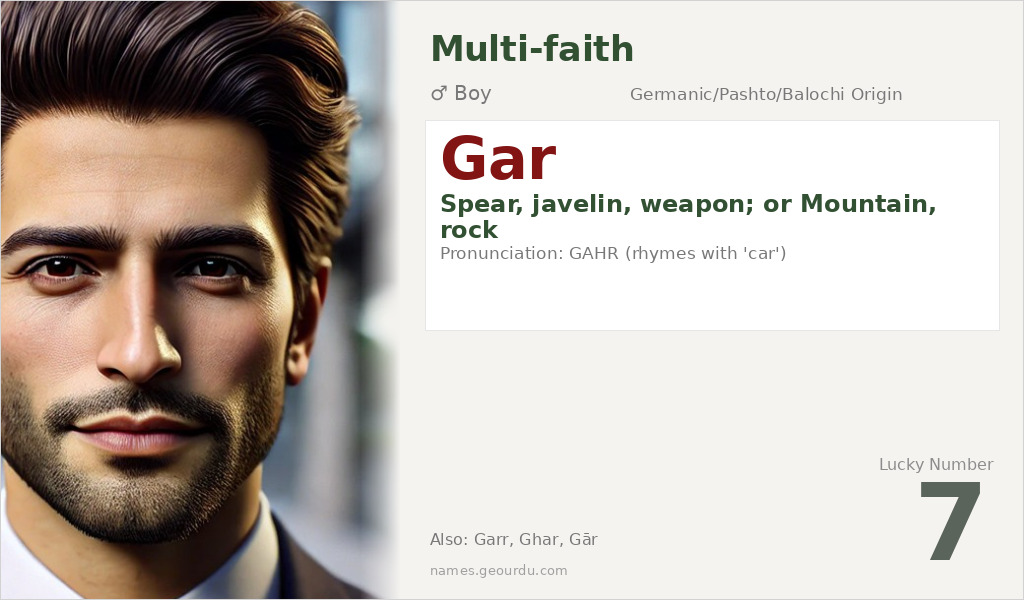
| 📛 Name | Gar |
| 💎 Meaning | Spear, javelin, weapon; or Mountain, rock |
| 👤 Gender | Boy |
| 🕌 Religion | Multi-faith |
| 🌍 Origin | Germanic/Pashto/Balochi |
| 🗣 Pronunciation | GAHR (rhymes with 'car') |
| ✍️ Urdu | گر |
| ✍️ Arabic | غار |
| 🔢 Numerology | 7 |
| ✨ Spellings | Garr, Ghar, Gār |
Origin & Cultural Significance
Gar has diverse cultural origins that reflect its multiple meanings. The Germanic/Old English version dates back to the early medieval period, where weapon-related names were common among warrior cultures. This tradition spread through Anglo-Saxon and Norse influences. Simultaneously, in South and Central Asia, the Pashto and Balochi version has been used for centuries among tribal communities, often describing geographical features or incorporated into longer names. The name appears in various forms across regions: as a standalone name in English-speaking countries, as an element in compound names in Afghanistan and Pakistan, and occasionally in literary contexts. Unlike many names tied to specific religions, Gar transcends religious boundaries, appearing in Christian, Muslim, and secular contexts depending on regional usage.
Personality Traits
Those named Gar are often associated with strength, stability, and resilience—qualities reflected in both the ‘spear’ and ‘mountain’ meanings. They tend to be practical, grounded individuals who approach challenges with determination. While they may appear reserved initially, they typically demonstrate loyalty and protectiveness toward those they care about. The name suggests someone who provides solid foundation in relationships and endeavors.
Similar Names
If you like Gar, consider: Gareth, Garrett, Gard, Garth, Garvan
Famous People Named Gar
- Gar Wood — American inventor and boat racer who held the world water speed record
- Gar Smith — American environmental activist and journalist
Frequently Asked Questions About Gar
What does Gar mean?
Gar has two primary meanings: 'spear' or 'javelin' in Germanic/Old English languages, and 'mountain' or 'rock' in Pashto and Balochi languages spoken in Afghanistan, Pakistan, and Iran.
Is Gar a boy or girl name?
Gar is predominantly used as a boy's name across all cultures where it appears, though it could theoretically be used as a unisex name in modern contexts.
What is the origin of Gar?
Gar has dual origins: from Old English/Germanic languages meaning 'spear,' and from Pashto/Balochi languages meaning 'mountain.' It is not exclusively Christian and appears in multiple cultural traditions.





