
Table of Contents
Ghaa’ib is a profound Arabic name for boys that carries rich spiritual and linguistic heritage. Rooted in Islamic theology, it evokes concepts of the unseen and the divine mysteries beyond human perception. This name connects its bearer to a tradition of faith in what lies beyond the visible world. Explore the meaning, origin, and cultural significance of this distinctive name.
Meaning of Ghaa'ib
Ghaa’ib (غائب) is derived from the Arabic root غ-ي-ب (gh-y-b), which encompasses meanings related to absence, concealment, and the imperceptible. As a masculine active participle, it literally means ‘one who is absent’ or ‘that which is hidden.’ In Islamic context, the related term ‘al-ghayb’ (الغيب) is central to faith, referring to all that is unseen and known only to God—including the afterlife, angels, destiny, and divine decrees. The name thus embodies a theological concept emphasizing belief beyond sensory evidence. Linguistically, it appears in classical Arabic literature and the Quran, where faith in the unseen is praised (e.g., Quran 2:3).
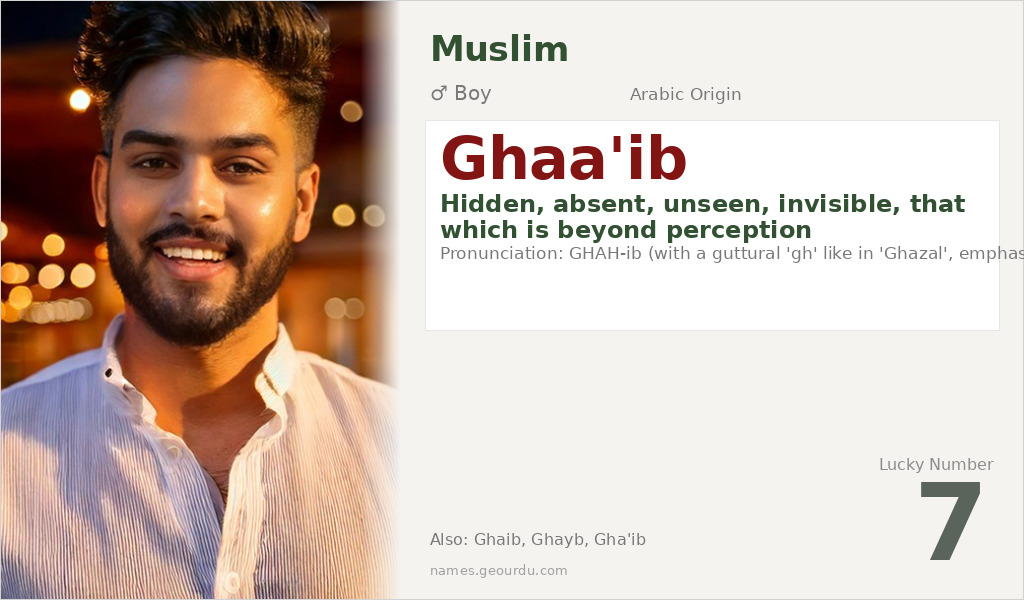
| 📛 Name | Ghaa'ib |
| 💎 Meaning | Hidden, absent, unseen, invisible, that which is beyond perception |
| 👤 Gender | Boy |
| 🕌 Religion | Muslim |
| 🌍 Origin | Arabic |
| 🗣 Pronunciation | GHAH-ib (with a guttural 'gh' like in 'Ghazal', emphasis on first syllable) |
| ✍️ Urdu | غائب |
| ✍️ Arabic | غائب |
| 🔢 Numerology | 7 |
| ✨ Spellings | Ghaib, Ghayb, Gha'ib, Ghaeb |
Origin & Cultural Significance
Ghaa’ib originates from classical Arabic and is deeply embedded in Islamic culture due to its theological significance. It is primarily used in Muslim communities across the Arab world, South Asia, and beyond, though it is less common as a personal name compared to other Arabic names. Historically, the concept of ‘ghayb’ has been discussed extensively in Islamic philosophy, mysticism (Sufism), and theology, shaping spiritual thought. While the name is authentically Arabic, it is not typical in Pashto, Balochi, or other regional languages as a native name—those cultures may adopt it due to Islamic influence. Its usage reflects a desire to instill spiritual values, emphasizing trust in divine wisdom beyond human sight.
Personality Traits
A person named Ghaa’ib is often associated with depth, introspection, and a spiritual outlook. They may be perceived as reserved or thoughtful, with a strong inner life and an interest in metaphysical questions. This name suggests a personality that values privacy, wisdom, and faith in the unseen, potentially leading to careers in theology, philosophy, or creative arts. While not deterministic, the name’s meaning can inspire a lifelong curiosity about life’s hidden dimensions.
Similar Names
If you like Ghaa'ib, consider: Ghani (wealthy, rich), Ghalib (victorious, dominant), Ghassan (youth), Ghazwan (warrior), Ghiyath (succor, aid)
Famous People Named Ghaa'ib
- No widely known contemporary public figures with this exact name were found in verified sources. It is more commonly used as a theological term than as a personal name in modern times.
Frequently Asked Questions About Ghaa'ib
What does Ghaa'ib mean?
Ghaa'ib means 'hidden,' 'absent,' 'unseen,' or 'invisible' in Arabic. It comes from the root غ-ي-ب (gh-y-b) and carries spiritual connotations in Islam, referring to matters beyond human perception.
Is Ghaa'ib a boy or girl name?
Ghaa'ib is exclusively a boy's name in Arabic grammar, as it is a masculine active participle. It is not used for girls in traditional Arabic or Islamic naming practices.
What is the origin of Ghaa'ib?
Ghaa'ib originates from classical Arabic language and Islamic culture. It is not derived from Pashto, Balochi, or other regional languages—its roots are firmly in Arabic linguistics and theology, widely used in Muslim communities.





