
Table of Contents
Ghanendra is a powerful Sanskrit name steeped in Hindu mythology and natural symbolism. Meaning ‘Lord of Clouds’, this name directly references Indra, the king of gods in Hindu tradition who commands rain, thunder, and atmospheric phenomena. With its rich linguistic heritage and majestic connotations, Ghanendra carries both cultural depth and poetic imagery. This name continues to be chosen by parents seeking a name with mythological resonance and natural elements.
Meaning of Ghanendra
Ghanendra derives from classical Sanskrit, combining ‘ghana’ (cloud) and ‘indra’ (lord/ruler) to create the literal meaning ‘Lord of Clouds’. In Hindu cosmology, clouds represent both life-giving rain and divine power, making this name particularly significant. The ‘ghana’ component also carries connotations of density, thickness, and abundance, while ‘indra’ specifically refers to the supreme Vedic deity. This compound structure is characteristic of Sanskrit names that describe divine attributes or natural phenomena. The name appears in various Hindu texts as an epithet for Indra, emphasizing his role as controller of weather and atmospheric elements.
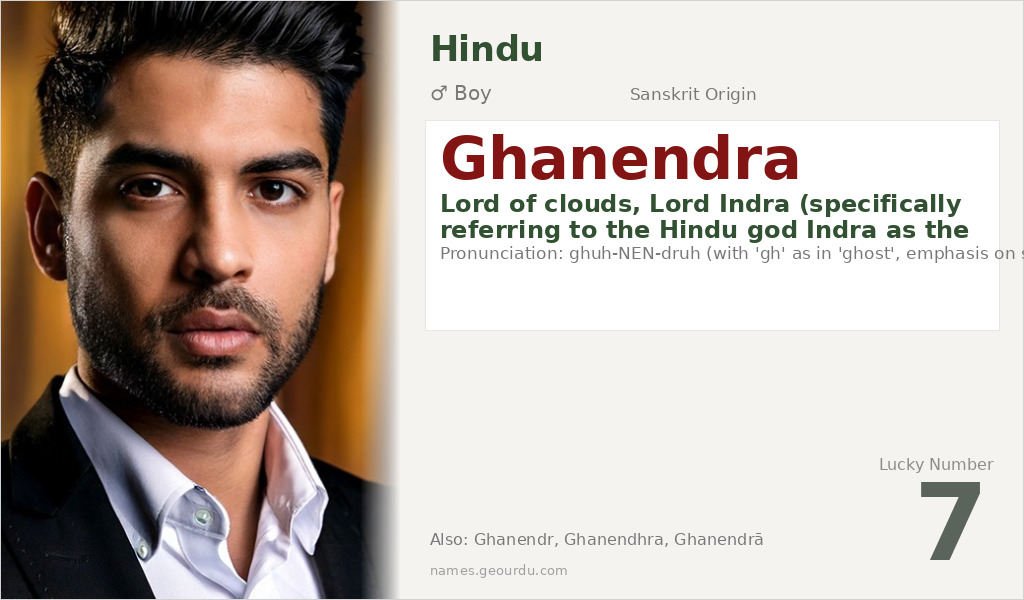
| 📛 Name | Ghanendra |
| 💎 Meaning | Lord of clouds, Lord Indra (specifically referring to the Hindu god Indra as the ruler of clouds and rain) |
| 👤 Gender | Boy |
| 🕌 Religion | Hindu |
| 🌍 Origin | Sanskrit |
| 🗣 Pronunciation | ghuh-NEN-druh (with 'gh' as in 'ghost', emphasis on second syllable) |
| ✍️ Urdu | گھنندر |
| ✍️ Arabic | غانيندرا |
| 🔢 Numerology | 7 |
| ✨ Spellings | Ghanendr, Ghanendhra, Ghanendrā |
Origin & Cultural Significance
Ghanendra originates from ancient Sanskrit language and Hindu religious tradition, specifically from the Vedic period when Indra was worshipped as the chief deity. The name reflects the importance of rain and agriculture in ancient Indian civilization, where cloud deities held crucial roles in mythology. While primarily used in Hindu communities across India and Nepal, the name has also been adopted by some Buddhist communities in regions influenced by Sanskrit culture. The name’s usage spans centuries, appearing in classical literature, religious texts, and continuing in modern times among families valuing traditional Sanskrit names with mythological connections.
Personality Traits
Those named Ghanendra often embody leadership qualities and protective instincts, mirroring Indra’s role as king of gods. They may demonstrate resilience during challenges and possess natural authority in social situations. The cloud symbolism suggests both strength and adaptability—able to be firm yet flexible according to circumstances. Their connection to rain imagery often correlates with emotional expressiveness and nurturing tendencies toward others.
Similar Names
If you like Ghanendra, consider: Indra, Meghnad, Varun, Parjanya, Vayu
Famous People Named Ghanendra
- Ghanendra Shumsher Rana — Nepalese politician and former Minister of Foreign Affairs
- Ghanendra Malla — Nepalese cricketer who played for the national team
Frequently Asked Questions About Ghanendra
What does Ghanendra mean?
Ghanendra means 'Lord of Clouds' in Sanskrit, specifically referring to the Hindu god Indra who rules over clouds, rain, and atmospheric phenomena.
Is Ghanendra a boy or girl name?
Ghanendra is exclusively a masculine name in Hindu naming tradition, derived from the male deity Indra and using masculine Sanskrit grammatical forms.
What is the origin of Ghanendra?
Ghanendra originates from Sanskrit language and Hindu religious tradition, combining 'ghana' (cloud) and 'indra' (lord) to create a name for the rain god Indra.





