
Table of Contents
Ghareeb is a profound name with roots deep in Arabic language and culture, evoking themes of uniqueness and journey. Often chosen for boys, it carries a rich history beyond its surface meaning, connecting to spiritual and literary traditions. This name resonates across regions, from the Middle East to South Asia, where it symbolizes distinction and resilience. Discover the true essence of Ghareeb and why it remains a meaningful choice for parents today.
Meaning of Ghareeb
Ghareeb originates from the Arabic root غ-ر-ب (gh-r-b), which conveys ideas of strangeness, foreignness, and being away from one’s homeland. In its literal sense, it means ‘stranger’ or ‘foreigner,’ but it has evolved to also signify ‘rare,’ ‘unique,’ or ‘unfamiliar.’ This duality reflects in Islamic texts, where it is used to describe those who adhere to faith in times of moral decline, emphasizing spiritual uniqueness. In Persian, Urdu, and other languages, it retains these meanings, with additional nuances like ‘humble’ or ‘poor’ in a metaphorical sense of detachment from materialism. The name’s depth makes it a popular choice for conveying individuality and depth of character.
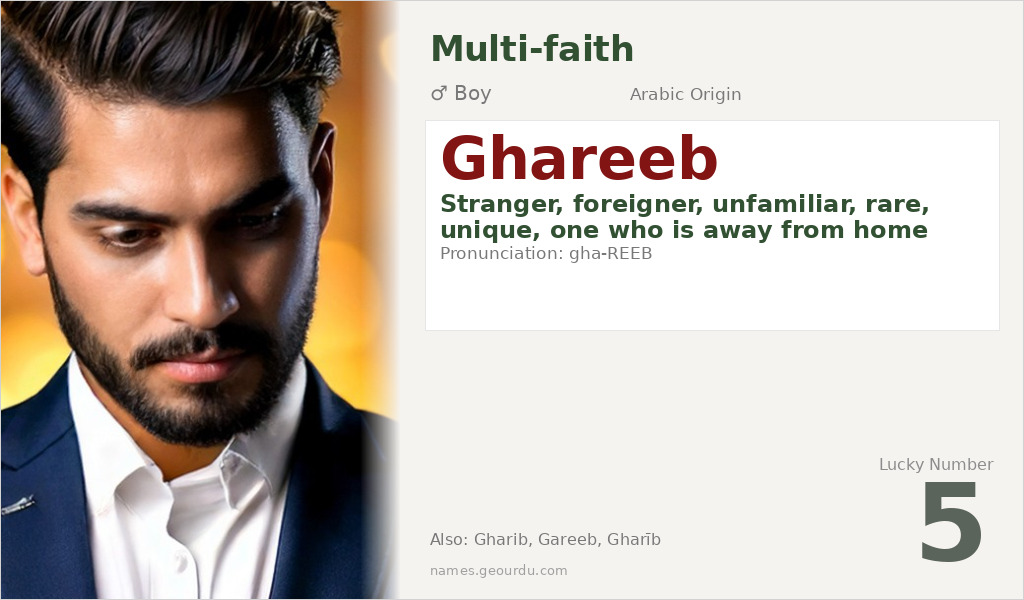
| 📛 Name | Ghareeb |
| 💎 Meaning | Stranger, foreigner, unfamiliar, rare, unique, one who is away from home |
| 👤 Gender | Boy |
| 🕌 Religion | Multi-faith |
| 🌍 Origin | Arabic |
| 🗣 Pronunciation | gha-REEB |
| ✍️ Urdu | غریب |
| ✍️ Arabic | غريب |
| 🔢 Numerology | 5 |
| ✨ Spellings | Gharib, Gareeb, Gharīb, غريب |
Origin & Cultural Significance
The name Ghareeb has its origins in classical Arabic, dating back to pre-Islamic and early Islamic periods. It is widely used in Muslim-majority cultures, including Arab, Persian, Turkish, and South Asian communities, but it is not exclusive to Islam—it appears in multi-faith contexts due to its linguistic appeal. Historically, it has been borne by scholars, poets, and saints, such as the Sufi figure Gharib Nawaz, highlighting its spiritual connotations. In modern times, it remains common in countries like Pakistan, India, Iran, and Arab nations, often chosen for its meaningful resonance and cultural heritage.
Personality Traits
People named Ghareeb are often perceived as distinctive and thoughtful, with a natural inclination towards introspection and authenticity. Their name suggests a person who may feel like an outsider at times, but this fosters resilience, creativity, and a unique perspective on life. They tend to value genuine connections and may excel in fields that require innovation or deep understanding, embodying the rarity their name implies.
Similar Names
If you like Ghareeb, consider: Ajeeb (عجيب – wonderful, strange), Nadeem (نديم – companion, friend), Aqeel (عقيل – wise, intelligent), Saleem (سليم – safe, sound), Kareem (كريم – generous, noble)
Famous People Named Ghareeb
- Gharib Nawaz (غریب نواز) – title of Sufi saint Moinuddin Chishti, meaning 'benefactor of the poor'
- Gharib (غریب) – common surname in Arabic-speaking regions, e.g., Egyptian poet Ahmed Fouad Negm used the pseudonym 'el-Fagoumi' (the poor one) in a similar vein
Frequently Asked Questions About Ghareeb
What does Ghareeb mean?
Ghareeb primarily means 'stranger,' 'foreigner,' or 'unique' in Arabic, with additional connotations of rarity and humility in various cultural contexts.
Is Ghareeb a boy or girl name?
Ghareeb is traditionally a boy's name in Arabic and related cultures, though it is rarely used for girls in some modern settings.
What is the origin of Ghareeb?
Ghareeb originates from Arabic, with roots in the غ-ر-ب (gh-r-b) triliteral root, and it is used across Muslim and other cultures in regions like the Middle East and South Asia.





