Table of Contents
Ghitbah is a distinctive Arabic name with deep roots in early Islamic history. Unlike many names with general meanings, Ghitbah specifically commemorates a notable woman from the Prophet Muhammad’s family. This name carries the weight of tradition and scholarship, making it a meaningful choice for parents seeking a name with historical and religious significance. Discover the fascinating story behind this unique name and its place in Muslim naming traditions.
Meaning of Ghitbah
Ghitbah (غِثْبَة) is an Arabic feminine name that derives from the root غ-ث-ب (gh-th-b), which relates to narrating or transmitting information. Unlike abstract names, Ghitbah specifically refers to Ghitbah bint ‘Abd al-Muttalib, a paternal aunt of Prophet Muhammad who was recognized as a narrator of Hadith—the recorded sayings and traditions of the Prophet. In classical Islamic sources, her name appears among early female transmitters of religious knowledge, giving the name a commemorative rather than lexical meaning. The name thus represents a direct link to the foundational period of Islam and honors women’s contributions to preserving Islamic tradition. This makes Ghitbah a historically significant name rather than one with a general descriptive meaning.
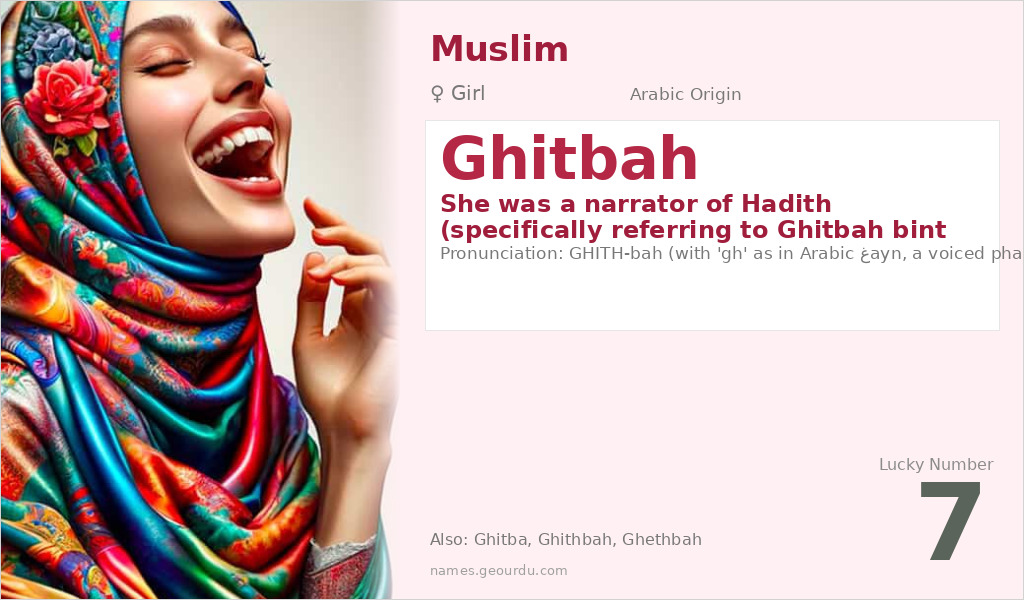
| 📛 Name | Ghitbah |
| 💎 Meaning | She was a narrator of Hadith (specifically referring to Ghitbah bint 'Abd al-Muttalib, an early Muslim woman) |
| 👤 Gender | Girl |
| 🕌 Religion | Muslim |
| 🌍 Origin | Arabic |
| 🗣 Pronunciation | GHITH-bah (with 'gh' as in Arabic غayn, a voiced pharyngeal fricative) |
| ✍️ Urdu | غثبہ |
| ✍️ Arabic | غِثْبَة |
| 🔢 Numerology | 7 |
| ✨ Spellings | Ghitba, Ghithbah, Ghethbah, Ghitbat |
Origin & Cultural Significance
Ghitbah originates from classical Arabic and specifically from 7th-century Arabia during the early Islamic period. The name is documented in historical records and biographical dictionaries (like Ibn Sa’d’s ‘Kitab al-Tabaqat al-Kabir’) as belonging to Ghitbah bint ‘Abd al-Muttalib, making it one of the rare names that refer to a specific historical figure rather than having a general meaning. As a name from the Quraysh tribe of Mecca, it reflects the naming practices of early Arab Muslims who sometimes used names commemorating relatives known for piety or knowledge. While uncommon today, the name preserves an important connection to women’s roles in early Islamic scholarship and remains part of the rich tapestry of Arabic Islamic names with historical references.
Personality Traits
The name Ghitbah suggests personality traits associated with wisdom, tradition, and spiritual depth. Given its connection to early Islamic scholarship and Hadith narration, individuals with this name might be perceived as knowledge-seekers with respect for heritage and religious tradition. They may exhibit thoughtful, reliable characteristics with an appreciation for historical continuity. The name carries an air of dignity and connection to Islamic history that could influence how bearers perceive their identity and values.
Similar Names
If you like Ghitbah, consider: Ghazala, Ghufran, Ghayda, Ghania, Ghadir
Famous People Named Ghitbah
- Ghitbah bint 'Abd al-Muttalib — Early Muslim woman, paternal aunt of Prophet Muhammad, and narrator of Hadith
- No other widely documented famous individuals with this name in modern times
Frequently Asked Questions About Ghitbah
What does Ghitbah mean?
Ghitbah specifically means 'she was a narrator of Hadith,' referring to Ghitbah bint 'Abd al-Muttalib, an early Muslim woman and paternal aunt of Prophet Muhammad. The name commemorates this historical figure rather than having a general lexical meaning.
Is Ghitbah a boy or girl name?
Ghitbah is exclusively a girl's name in Arabic and Islamic tradition. It is the feminine form and specifically refers to a female historical figure, with no masculine equivalent in usage.
What is the origin of Ghitbah?
Ghitbah originates from classical Arabic and specifically from 7th-century Arabia. It is documented in early Islamic historical records as the name of Ghitbah bint 'Abd al-Muttalib, making it a name with direct historical and religious significance in Muslim culture.