
Table of Contents
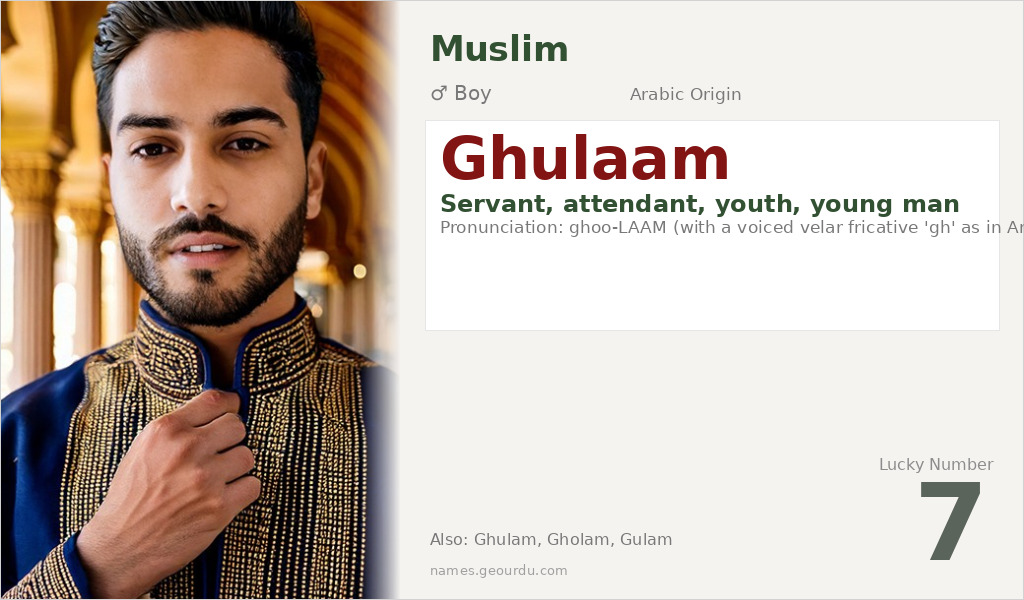
Ghulaam is a classic Arabic name with deep cultural and linguistic roots, commonly used in Muslim communities across South Asia, the Middle East, and beyond. Meaning ‘servant’ or ‘young man’, it reflects values of humility, devotion, and service. This name has been borne by notable figures in music, politics, and history, showcasing its enduring appeal. In this guide, we explore its etymology, usage, and significance in detail.
Meaning of Ghulaam
Ghulaam (غلام) originates from the Arabic root غ-ل-م (gh-l-m), which conveys concepts related to youth and servitude. In classical Arabic, it specifically denotes a ‘servant’, ‘attendant’, or ‘young man’, often used historically for male servants in royal or noble households. The term is linguistically distinct from ‘abd’ (عبد), another Arabic word for servant, with ‘ghulaam’ emphasizing youthfulness and attendant roles. In Islamic naming traditions, it frequently appears in compound forms like Ghulam Ahmad or Ghulam Hussain, symbolizing devotion through servitude to religious figures. Its usage spans various languages influenced by Arabic, including Persian, Urdu, and Punjabi, where it retains similar meanings.
| 📛 Name | Ghulaam |
| 💎 Meaning | Servant, attendant, youth, young man |
| 👤 Gender | Boy |
| 🕌 Religion | Muslim |
| 🌍 Origin | Arabic |
| 🗣 Pronunciation | ghoo-LAAM (with a voiced velar fricative 'gh' as in Arabic غ) |
| ✍️ Urdu | غلام |
| ✍️ Arabic | غلام |
| 🔢 Numerology | 7 |
| ✨ Spellings | Ghulam, Gholam, Gulam, Gholaam |
Origin & Cultural Significance
The name Ghulaam has its origins in pre-Islamic and early Islamic Arabic culture, where it was used to describe young male servants or attendants. With the spread of Islam, it was adopted into Persian, Turkish, and South Asian languages like Urdu, Punjabi, and Sindhi, becoming a common given name in Muslim communities. Historically, it was often part of titles or names denoting loyalty, such as in Mughal and Ottoman courts. In modern times, it remains popular in countries like Pakistan, India, Afghanistan, and Iran, reflecting both religious devotion and cultural heritage. Its usage is primarily within Muslim contexts, though it may appear in multi-faith regions due to linguistic overlap.
Personality Traits
People named Ghulaam are often associated with traits of loyalty, humility, and diligence, inspired by the name’s meaning of service. They may exhibit a strong sense of responsibility and respect for traditions, making them dependable and earnest in their endeavors. In social settings, they are typically seen as courteous and supportive, valuing relationships built on trust and mutual respect.
Similar Names
If you like Ghulaam, consider: Abdul, Khadim, Fida, Ata, Mansoor
Famous People Named Ghulaam
- Ghulam Ali — legendary Pakistani ghazal singer known for his soulful voice and classical music contributions
- Ghulam Nabi Azad — Indian politician who served as Chief Minister of Jammu and Kashmir and held various ministerial positions
Frequently Asked Questions About Ghulaam
What does Ghulaam mean?
Ghulaam means 'servant', 'attendant', or 'young man' in Arabic, derived from the root غ-ل-م (gh-l-m) related to youth and servitude.
Is Ghulaam a boy or girl name?
Ghulaam is exclusively a boy's name in Arabic and Islamic naming traditions, reflecting its masculine grammatical form and historical usage for males.
What is the origin of Ghulaam?
Ghulaam originates from Arabic and has been adopted into various languages like Persian, Urdu, and Punjabi through Islamic cultural diffusion, primarily used in Muslim communities.





