
Table of Contents
Girivara is a powerful Sanskrit name with deep roots in Hindu tradition and mythology. Meaning ‘Lord of mountains’ or ‘King of mountains’, this name carries connotations of strength, stability, and natural majesty. Often chosen for boys in Hindu families, Girivara reflects the cultural reverence for mountains in Indian spirituality. The name’s compound structure reveals its precise linguistic meaning beyond simple translation.
Meaning of Girivara
Girivara derives from classical Sanskrit, combining ‘giri’ (mountain) with ‘vara’ (lord, best, excellent). This compound formation follows standard Sanskrit naming conventions where ‘vara’ serves as a suffix denoting superiority or mastery. The name literally means ‘lord of mountains’ or ‘supreme among mountains’, not merely ‘great mountain’ as sometimes mistranslated. In Hindu cosmology, mountains are sacred entities—abodes of gods and symbols of stability. Girivara appears in religious texts as an epithet for deities, particularly Shiva who resides on Mount Kailash. The name’s precise etymology is well-documented in Sanskrit lexicons and grammatical texts.
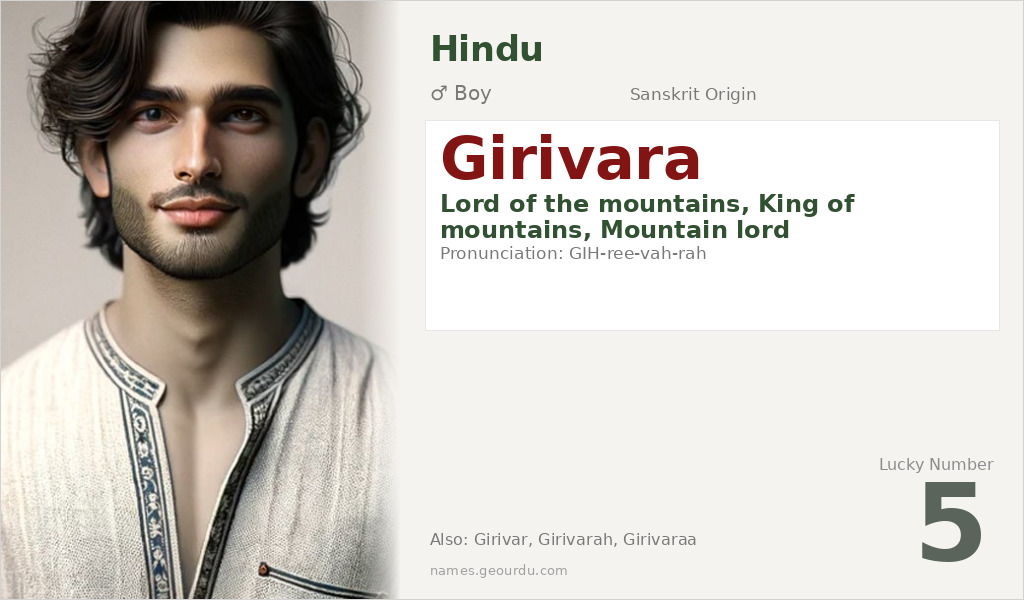
| 📛 Name | Girivara |
| 💎 Meaning | Lord of the mountains, King of mountains, Mountain lord |
| 👤 Gender | Boy |
| 🕌 Religion | Hindu |
| 🌍 Origin | Sanskrit |
| 🗣 Pronunciation | GIH-ree-vah-rah |
| ✍️ Urdu | گیری ورا |
| ✍️ Arabic | غيريفارا |
| 🔢 Numerology | 5 |
| ✨ Spellings | Girivar, Girivarah, Girivaraa |
Origin & Cultural Significance
Girivara originates from Sanskrit, the ancient liturgical language of Hinduism. As a compound name, it reflects the sophisticated word-formation techniques of classical Sanskrit literature. The name appears in Hindu scriptures and mythology, where mountains are revered as divine entities and dwelling places of gods. In cultural context, names containing ‘giri’ (mountain) are common in Hindu communities, reflecting the spiritual significance of mountains in Indian tradition. While primarily used in Hindu families, the name’s Sanskrit origin gives it pan-Indian recognition across various linguistic regions. Historical usage shows it as both a given name and an epithet for mountain-associated deities.
Personality Traits
Named after the lord of mountains, individuals called Girivara are often associated with qualities of strength, stability, and protection. Like mountains that stand firm through seasons, they may exhibit resilience and steadfastness in character. The name suggests natural leadership abilities and a protective nature toward family and community. These individuals might be perceived as reliable anchors in relationships, embodying the enduring qualities their name represents.
Similar Names
If you like Girivara, consider: Girish, Girindra, Giridhar, Parvateshwar, Girija
Famous People Named Girivara
- Girivara — A name used in Hindu mythology for deities associated with mountains, particularly Shiva who is sometimes called Girivara as lord of Mount Kailash
- Girivara — Occasionally appears as a given name in Hindu communities, particularly in India and Nepal
Frequently Asked Questions About Girivara
What does Girivara mean?
Girivara means 'Lord of mountains' or 'King of mountains' in Sanskrit. It's a compound name from 'giri' (mountain) and 'vara' (lord, best).
Is Girivara a boy or girl name?
Girivara is exclusively a boy's name in Hindu naming tradition. Sanskrit compound names ending in 'vara' are typically masculine.
What is the origin of Girivara?
Girivara originates from Sanskrit, the classical language of Hinduism. It has mythological connections as an epithet for mountain-associated deities in Hindu tradition.





