Table of Contents
Gita is a beautiful Sanskrit name that carries centuries of cultural and spiritual significance. Meaning ‘song’ or ‘sacred hymn’, this name evokes musicality, wisdom, and divine connection. Popular across South Asia and among Hindu communities worldwide, Gita represents both artistic expression and spiritual depth. Its most famous association is with the Bhagavad Gita, one of Hinduism’s most important philosophical texts.
Meaning of Gita
The name Gita originates from the Sanskrit word ‘gītā’ (गीता), which directly translates to ‘song’, ‘sung’, or ‘poetic composition’. In classical Sanskrit literature, gita refers to any metrical composition or hymn, particularly those of spiritual or philosophical nature. The most renowned example is the Bhagavad Gita (‘Song of the Lord’), part of the Mahabharata epic, where Lord Krishna imparts spiritual wisdom to Arjuna. This connection elevates the name beyond mere musical reference to encompass sacred knowledge and divine discourse. The feminine grammatical gender of the Sanskrit word naturally led to its adoption as a female name across Hindu communities.
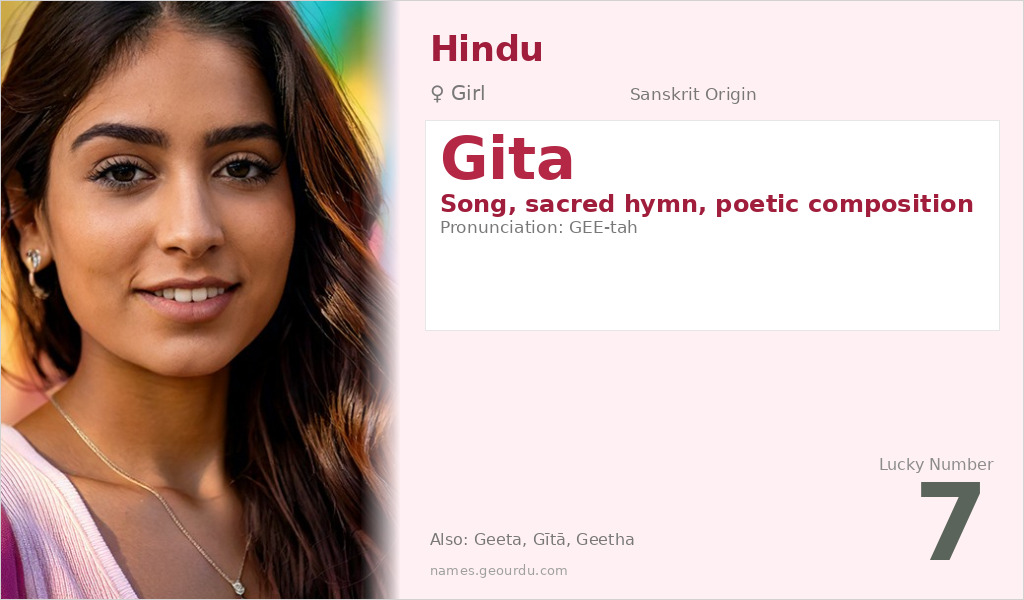
| 📛 Name | Gita |
| 💎 Meaning | Song, sacred hymn, poetic composition |
| 👤 Gender | Girl |
| 🕌 Religion | Hindu |
| 🌍 Origin | Sanskrit |
| 🗣 Pronunciation | GEE-tah |
| ✍️ Urdu | گیتا |
| ✍️ Arabic | جيتا |
| 🔢 Numerology | 7 |
| ✨ Spellings | Geeta, Gītā, Geetha |
Origin & Cultural Significance
Gita has its roots in ancient Sanskrit, the classical language of India that dates back over 3,500 years. As a name, it gained prominence through Hindu religious texts and philosophical traditions, particularly through the Bhagavad Gita’s enduring influence. The name spread throughout South Asia with Sanskrit’s cultural reach, appearing in various regional languages including Hindi, Bengali, Marathi, and Gujarati. While primarily associated with Hindu tradition, the name has also been adopted by some Jains and Buddhists due to shared cultural-linguistic heritage. In modern times, it remains popular in India, Nepal, and among diaspora communities worldwide.
Personality Traits
Those named Gita often embody qualities of creativity, spirituality, and eloquence. Their name’s musical meaning frequently reflects in their appreciation for arts, poetry, and meaningful conversation. Many Gitas demonstrate strong intuitive abilities and a thoughtful approach to life’s challenges. The name’s association with sacred wisdom sometimes manifests in their personality as philosophical depth and guidance-oriented behavior toward others.
Similar Names
If you like Gita, consider: Gayatri, Veda, Shruti, Stuti, Kavita
Famous People Named Gita
- Geeta Phogat — Indian freestyle wrestler and Commonwealth Games gold medalist
- Geeta Bali — Indian actress in Hindi cinema during the 1940s-50s
Frequently Asked Questions About Gita
What does Gita mean?
Gita means 'song' or 'sacred hymn' in Sanskrit, the classical language of India. It specifically refers to poetic compositions, most famously the Bhagavad Gita ('Song of the Lord').
Is Gita a boy or girl name?
Gita is exclusively a girl's name. In Sanskrit grammar, 'gītā' is a feminine noun, and this grammatical gender has carried through to its use as a personal name across Hindu cultures.
What is the origin of Gita?
Gita originates from Sanskrit, an ancient Indo-Aryan language of India. It has been used for centuries in Hindu religious texts and philosophical traditions, particularly through the Bhagavad Gita's influence.