Table of Contents
Gobind is a profound traditional name with deep roots in Indian spirituality and culture. Derived from ancient Sanskrit, this name carries the beautiful meaning ‘protector of cows’ and has been borne by revered religious figures. Whether in Hinduism or Sikhism, Gobind represents divine protection, nurturing care, and spiritual leadership. Discover the rich etymology, cultural significance, and modern relevance of this timeless name.
Meaning of Gobind
The name Gobind originates from the Sanskrit language, combining two meaningful elements: ‘go’ (गो) and ‘vind’ (विन्द्). ‘Go’ has multiple layers of meaning in Sanskrit—primarily referring to cows, but also extending to earth, senses, and rays of light, reflecting the sacred status of cows in Vedic culture. ‘Vind’ means to find, protect, tend, or care for. Thus, Gobind literally translates to ‘one who finds/protects/tends cattle’. This isn’t merely about animal husbandry—in Hindu mythology, Lord Krishna as Gobind represents the divine protector of all living beings. In Sikh tradition, Guru Gobind Singh embodied this protective role for his followers. The name’s etymology reflects values of guardianship, nourishment, and spiritual stewardship.
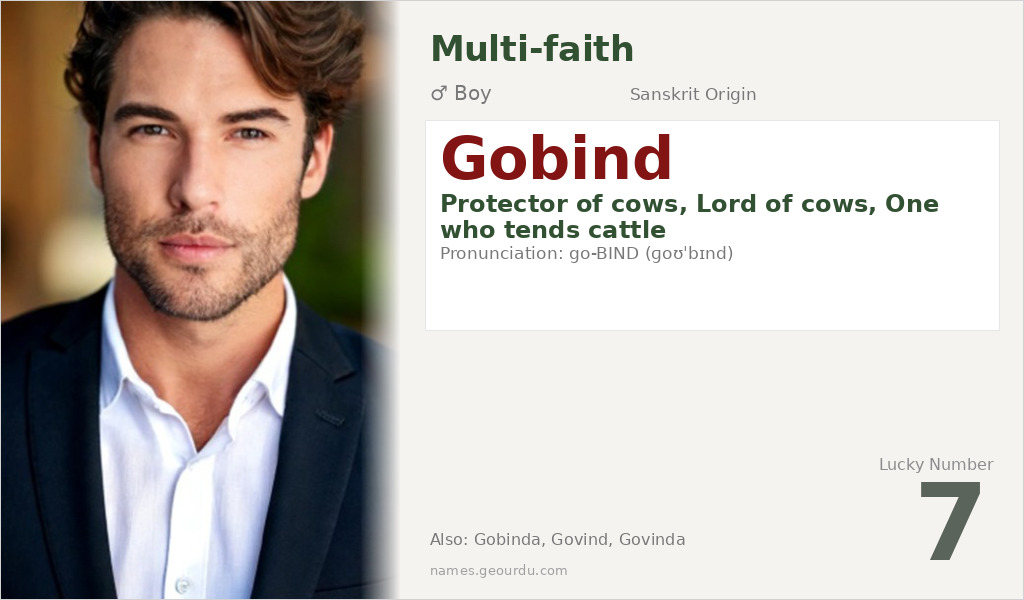
| 📛 Name | Gobind |
| 💎 Meaning | Protector of cows, Lord of cows, One who tends cattle |
| 👤 Gender | Boy |
| 🕌 Religion | Multi-faith |
| 🌍 Origin | Sanskrit |
| 🗣 Pronunciation | go-BIND (ɡoʊˈbɪnd) |
| ✍️ Urdu | گووند |
| ✍️ Arabic | جوبيند |
| 🔢 Numerology | 7 |
| ✨ Spellings | Gobinda, Govind, Govinda, Gobindh |
Origin & Cultural Significance
Gobind has its origins in ancient Sanskrit texts and Hindu religious traditions, where it appears as an epithet for Lord Krishna, particularly referencing his childhood as a cowherd in Vrindavan. The name gained significant prominence in Sikhism when Guru Gobind Singh (1666-1708), the tenth Sikh Guru, adopted it, making it central to Sikh identity and history. While primarily associated with Indian religions, the name has Sanskrit roots that predate religious divisions. It’s used across Hindu, Sikh, and sometimes Jain communities, though with different cultural emphases. The name remains popular in India, Nepal, and among diaspora communities worldwide, maintaining its traditional and spiritual resonance.
Personality Traits
Those named Gobind often exhibit qualities of protection, responsibility, and spiritual depth. They tend to be natural caregivers with a strong sense of duty toward family and community. Their connection to this historically significant name often inspires leadership qualities, compassion, and a grounded approach to life’s challenges. While individual personalities vary, the name’s meaning suggests someone who values tradition while actively safeguarding what they cherish.
Similar Names
If you like Gobind, consider: Krishna, Gopal, Giridhar, Madhav, Hari
Famous People Named Gobind
- Guru Gobind Singh — Tenth Sikh Guru, founder of Khalsa, warrior-poet
- Gobind Behari Lal — Indian-American journalist, Pulitzer Prize winner
Frequently Asked Questions About Gobind
What does Gobind mean?
Gobind means 'Protector of cows' or 'Lord of cows' in Sanskrit. It combines 'go' (cow/earth) and 'vind' (to protect/find), with deep spiritual significance in Hindu and Sikh traditions.
Is Gobind a boy or girl name?
Gobind is exclusively a boy's name in all cultural contexts where it's used. It has masculine grammatical forms in Sanskrit and is traditionally given only to males.
What is the origin of Gobind?
Gobind originates from Sanskrit, an ancient Indian language. It's primarily associated with Hindu mythology (as an epithet of Lord Krishna) and Sikh history (through Guru Gobind Singh).