Table of Contents
Golestana is a beautifully poetic Persian name that evokes images of blooming gardens and natural beauty. Meaning ‘land of flowers’ or ‘rose garden’, this feminine name carries centuries of literary and cultural significance from Persian-speaking regions. While popular in Muslim communities, its origins are specifically Persian/Iranian rather than exclusively religious. Let’s explore the rich etymology and cultural context of this floral-inspired name.
Meaning of Golestana
Golestana derives from the Persian words ‘gol’ (گل), meaning ‘flower’ or specifically ‘rose’, and the suffix ‘-estan’ (ـستان), meaning ‘land of’ or ‘place of’. The combination creates the meaning ‘land of flowers’ or ‘flower garden’. The additional feminine suffix ‘-a’ makes it specifically a female name, translating to ‘belonging to the flower garden’. This construction follows standard Persian naming patterns where ‘-estan’ indicates a place (like Afghanistan – land of Afghans, or Pakistan – land of the pure). The name shares its root with the famous Persian literary work ‘Gulistan’ (The Rose Garden) by 13th-century poet Saadi, giving it deep cultural and literary resonance in Persian-speaking cultures.
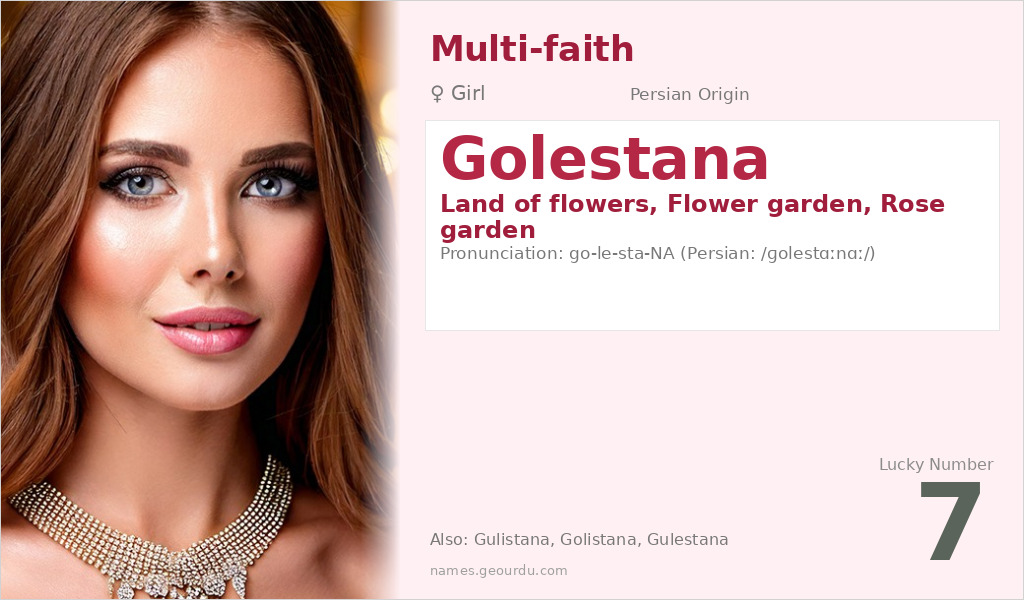
| 📛 Name | Golestana |
| 💎 Meaning | Land of flowers, Flower garden, Rose garden |
| 👤 Gender | Girl |
| 🕌 Religion | Multi-faith |
| 🌍 Origin | Persian |
| 🗣 Pronunciation | go-le-sta-NA (Persian: /ɡolestɑːnɑː/) |
| ✍️ Urdu | گلستانہ |
| ✍️ Arabic | جولستانا |
| 🔢 Numerology | 7 |
| ✨ Spellings | Gulistana, Golistana, Gulestana |
Origin & Cultural Significance
Golestana originates from Persian (Farsi) language and culture, with roots in ancient Persian civilization. The name reflects the Persian cultural appreciation for gardens and nature, evident in traditional Persian garden design (chahar bagh) and literature. While commonly used in Muslim communities across Iran, Afghanistan, Tajikistan, and South Asia, the name is cultural rather than religious in origin. It appears in historical records, including a 19th-century Persian poet and calligrapher named Golestana from the Qajar era. The name has spread to Urdu-speaking regions (as گلستانہ) and other cultures influenced by Persian language and literature, maintaining its floral meaning across regions.
Personality Traits
Those named Golestana are often associated with qualities of beauty, growth, and nurturing. Like a well-tended garden, they may exhibit patience, creativity, and the ability to cultivate beauty in their surroundings. The name suggests someone with artistic sensibilities who appreciates nature and aesthetics, while also possessing the resilience and cyclical renewal symbolized by flowering gardens. These associations stem from the literal meaning and cultural connotations of the name in Persian tradition.
Similar Names
If you like Golestana, consider: Golshan, Gulnar, Gulbahar, Gulrukh, Gulrang
Famous People Named Golestana
- Golestana (historical figure) — A 19th-century Persian poet and calligrapher from the Qajar era, known for her literary works
- Golestan (place) — Not a person but the famous 'Gulistan' (Rose Garden) by Persian poet Saadi, one of the most influential works in Persian literature
Frequently Asked Questions About Golestana
What does Golestana mean?
Golestana means 'land of flowers', 'flower garden', or 'rose garden' in Persian. It comes from 'gol' (flower) and '-estan' (land of), with a feminine suffix.
Is Golestana a boy or girl name?
Golestana is exclusively a girl's name. The '-a' ending makes it specifically feminine in Persian naming conventions, while the root 'Golestan' can be unisex or masculine.
What is the origin of Golestana?
Golestana originates from Persian (Farsi) language and culture. It's a compound name meaning 'land of flowers' and has been used in Persian-speaking regions for centuries, with literary connections to Saadi's 'Gulistan'.