Table of Contents
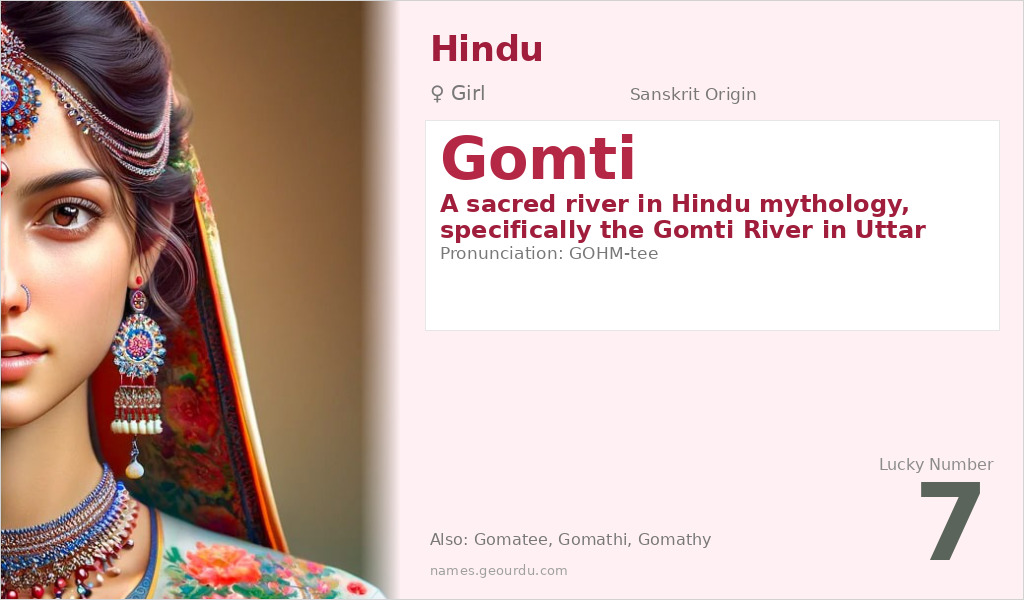
Gomti is a beautiful and meaningful Hindu girl name with deep roots in Indian mythology and Sanskrit tradition. Unlike many modern names, Gomti carries specific geographical and religious significance as it refers to one of India’s sacred rivers. This name connects the bearer to ancient Hindu texts and cultural heritage, making it a choice rich with spiritual meaning. Parents seeking a name with historical depth and natural symbolism often find Gomti appealing.
Meaning of Gomti
The name Gomti originates from Sanskrit, combining two elements: ‘Go’ meaning ‘cow’ and ‘mati’ meaning ‘having’ or ‘possessing’. Thus, the literal translation is ‘having cows’ or ‘abounding in cows’, reflecting the agricultural and pastoral significance in ancient Indian society. In Hindu mythology, the Gomti River is believed to have emerged from the sweat of the divine cow Kamadhenu or from sage Vashishta’s cow, giving it purifying properties. The river is mentioned in both the Ramayana and Mahabharata as a sacred water body where rituals were performed. This connection to bovine symbolism is important as cows represent nourishment, purity, and divinity in Hindu tradition. The name therefore carries connotations of abundance, sanctity, and natural flow.
| 📛 Name | Gomti |
| 💎 Meaning | A sacred river in Hindu mythology, specifically the Gomti River in Uttar Pradesh, India |
| 👤 Gender | Girl |
| 🕌 Religion | Hindu |
| 🌍 Origin | Sanskrit |
| 🗣 Pronunciation | GOHM-tee |
| ✍️ Urdu | گومتی |
| ✍️ Arabic | جومتي |
| 🔢 Numerology | 7 |
| ✨ Spellings | Gomatee, Gomathi, Gomathy |
Origin & Cultural Significance
Gomti has its origins firmly in Sanskrit language and Hindu religious tradition. The name specifically refers to the Gomti River, a tributary of the Ganges that flows through Uttar Pradesh in northern India. This river has been considered sacred for millennia, with numerous temples and pilgrimage sites along its banks. In Hindu cosmology, rivers are personified as goddesses, and Gomti is no exception—she is revered as a divine entity. The name’s usage as a personal name likely developed from this geographical and religious significance, allowing parents to bestow the river’s sacred qualities upon their daughters. Unlike names from Abrahamic traditions or modern coinages, Gomti maintains a direct, unbroken connection to its mythological source.
Personality Traits
Those named Gomti are often associated with the qualities of the sacred river they’re named after: constant flow, purification, and life-giving nourishment. They may exhibit adaptability to changing circumstances while maintaining core values, much like a river adjusting its course while remaining true to its source. The connection to cows in the etymology suggests nurturing, gentle, and protective traits. These individuals often value tradition, spirituality, and natural harmony in their approach to life.
Similar Names
If you like Gomti, consider: Ganga, Yamuna, Saraswati, Godavari, Narmada
Famous People Named Gomti
- Gomti — A character in Indian mythology associated with the sacred river
- Gomti Narang — Indian literary scholar and critic
Frequently Asked Questions About Gomti
What does Gomti mean?
Gomti means 'abounding in cows' or 'having cows' in Sanskrit, specifically referring to the sacred Gomti River in Hindu mythology that is believed to have originated from a divine cow.
Is Gomti a boy or girl name?
Gomti is exclusively a girl's name in Hindu naming tradition, as it refers to a sacred river that is personified as a goddess in Hindu mythology.
What is the origin of Gomti?
Gomti originates from Sanskrit language and Hindu religious tradition, specifically from the name of the sacred Gomti River mentioned in ancient Indian texts like the Ramayana and Mahabharata.