
Table of Contents
Gul Yar is a beautiful compound name that evokes imagery of nature and friendship. Primarily used for boys in Persian and Pashto-speaking communities, this name carries poetic significance that reflects cultural values. With roots in languages spoken across Afghanistan, Iran, Pakistan, and parts of Central Asia, Gul Yar represents more than just a name—it’s a connection to floral symbolism and interpersonal bonds.
Meaning of Gul Yar
Gul Yar is a compound name composed of two distinct elements from Persian and Pashto languages. The first component, ‘Gul’ (گل), is a common Persian word meaning ‘flower’ or specifically ‘rose’, appearing in countless names and poetic expressions across Persianate cultures. The second component, ‘Yar’ (یار), means ‘friend’, ‘companion’, or ‘beloved’ in both Persian and Pashto. When combined, the name literally translates to ‘friend of flowers’ or ‘beloved of flowers’, suggesting someone who cherishes natural beauty and delicate things. This construction follows a common naming pattern in these languages where ‘Gul’ is paired with another word to create meaningful compounds. The name appears in historical texts and poetry, particularly in Pashto literature where floral metaphors are abundant.
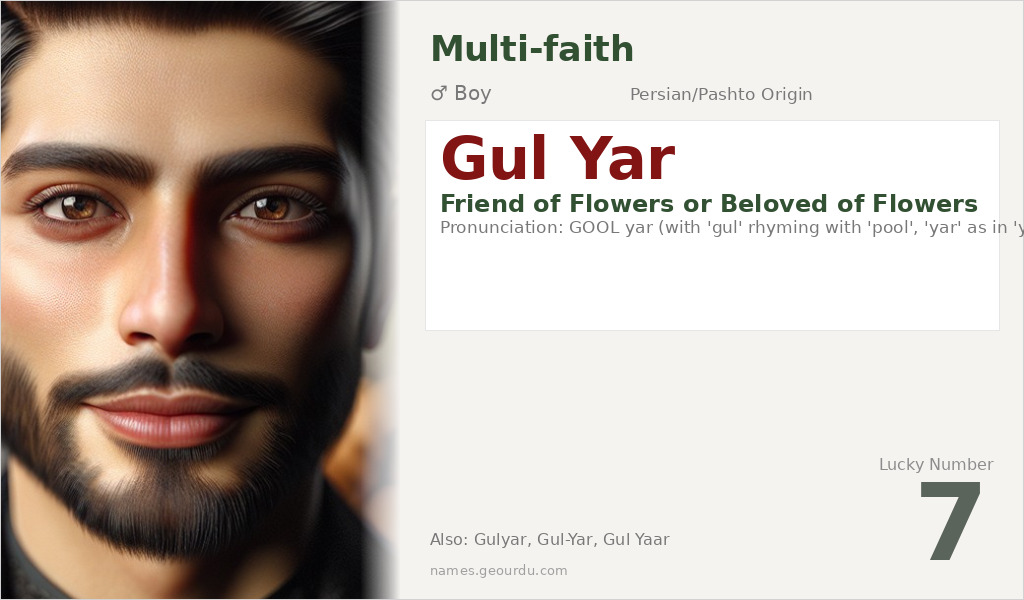
| 📛 Name | Gul Yar |
| 💎 Meaning | Friend of Flowers or Beloved of Flowers |
| 👤 Gender | Boy |
| 🕌 Religion | Multi-faith |
| 🌍 Origin | Persian/Pashto |
| 🗣 Pronunciation | GOOL yar (with 'gul' rhyming with 'pool', 'yar' as in 'yard' without the 'd') |
| ✍️ Urdu | گل یار |
| ✍️ Arabic | گل يار (typically written in Persian script, not classical Arabic) |
| 🔢 Numerology | 7 |
| ✨ Spellings | Gulyar, Gul-Yar, Gul Yaar |
Origin & Cultural Significance
Gul Yar originates from Persian and Pashto linguistic traditions, with strongest usage among Pashtun communities in Afghanistan and Pakistan, as well as Persian speakers in Iran and Tajikistan. The name reflects the importance of nature imagery in these cultures, where flowers symbolize beauty, transience, and spiritual concepts. Historically, such compound names became popular during periods when Persian was the lingua franca of administration and literature across much of Central and South Asia. While commonly used by Muslims today due to the spread of Persianate culture with Islam, the name itself predates Islamic influence and continues to be appreciated across religious boundaries in regions where these languages are spoken. It represents a cultural heritage shared by multiple ethnic groups rather than being tied exclusively to one religion.
Personality Traits
Those named Gul Yar are often associated with qualities of gentleness, appreciation for beauty, and strong interpersonal connections. The floral element suggests a personality that values aesthetics, nature, and delicate balance, while the ‘friend’ component indicates loyalty and sociability. In cultural contexts, such names are believed to influence character development, with Gul Yar typically describing someone who approaches life with poetic sensitivity and values meaningful relationships above superficial interactions.
Similar Names
If you like Gul Yar, consider: Gulzar, Gulshan, Yar Gul, Gul Bahar, Gul Rang
Famous People Named Gul Yar
- Gul Yar Khan — Pashtun tribal leader and historical figure from Pakistan's tribal regions
- Gul Yar — Afghan poet known for works in Pashto and Persian during the 20th century
Frequently Asked Questions About Gul Yar
What does Gul Yar mean?
Gul Yar means 'Friend of Flowers' or 'Beloved of Flowers' in Persian and Pashto. It's a compound name where 'Gul' means flower and 'Yar' means friend or beloved.
Is Gul Yar a boy or girl name?
Gul Yar is primarily a boy's name in Persian and Pashto naming traditions. While names can sometimes be used across genders, historical and cultural records show overwhelming masculine usage.
What is the origin of Gul Yar?
Gul Yar originates from Persian and Pashto languages, with strong cultural roots among Pashtun communities in Afghanistan and Pakistan, as well as Persian speakers in Iran. It reflects the floral symbolism prevalent in these cultures' poetry and naming conventions.





