
Table of Contents
Gursan is a powerful masculine name with deep roots in Pashto and Persian cultures. Meaning ‘lion’s son’ or ‘lion cub’, this name carries connotations of bravery, strength, and noble lineage. Used primarily among Pashtun, Baloch, and Persian-speaking communities, Gursan represents both cultural heritage and aspirational qualities. Its compound structure reveals fascinating insights into naming traditions of Central and South Asia.
Meaning of Gursan
Gursan derives from the Pashto/Persian elements ‘Gur’ (گور) meaning ‘lion’ and the suffix ‘-san’ (سان) meaning ‘son of’ or ‘like’. In linguistic context, ‘Gur’ specifically refers to the Asiatic lion, historically native to regions from the Middle East to India, making it a potent symbol in these cultures. The ‘-san’ suffix functions similarly to patronymic elements in other languages, indicating descent or characteristic. This combination creates a name that literally means ‘son of lion’, metaphorically suggesting someone with lion-like qualities—courage, leadership, and protective instincts. The name appears in various forms across Pashto, Dari, and Balochi dialects, maintaining consistent lion symbolism.
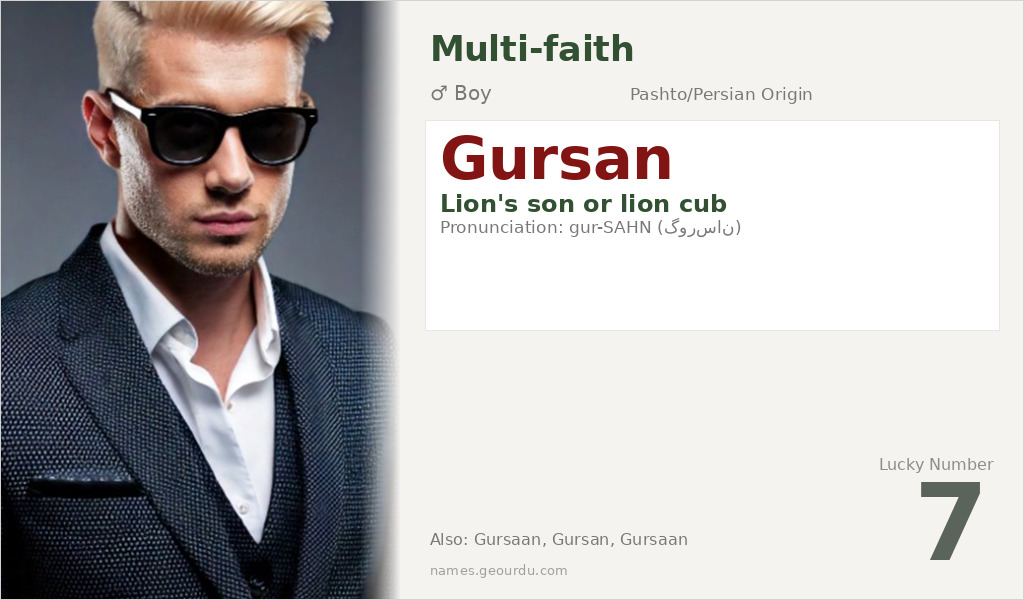
| 📛 Name | Gursan |
| 💎 Meaning | Lion's son or lion cub |
| 👤 Gender | Boy |
| 🕌 Religion | Multi-faith |
| 🌍 Origin | Pashto/Persian |
| 🗣 Pronunciation | gur-SAHN (گورسان) |
| ✍️ Urdu | گورسان |
| ✍️ Arabic | غورسان |
| 🔢 Numerology | 7 |
| ✨ Spellings | Gursaan, Gursan, Gursaan |
Origin & Cultural Significance
Gursan originates from Pashto and Persian naming traditions, particularly among Pashtun tribes in Afghanistan and Pakistan, as well as Baloch and Persian-speaking communities. Historically, lion names have been prestigious in these cultures, associated with warriors, leaders, and nobility. The name reflects the importance of animal symbolism in Central Asian and South Asian naming conventions, where lions represent royal authority and martial prowess. While primarily used by Muslims, the name has cross-cultural appeal and appears among Sikhs and others in the region with Pashtun influence. Its usage spans several centuries, particularly in tribal contexts where lineage and heroic qualities are emphasized.
Personality Traits
Those named Gursan are often expected to embody lion-like characteristics: courage in adversity, protective instincts toward family and community, and natural leadership abilities. The name suggests someone with strong principles, dignity, and the ability to command respect. These individuals may display both fierceness when necessary and noble restraint, balancing strength with wisdom. The ‘son of’ element adds a dimension of heritage pride and responsibility to uphold family honor.
Similar Names
If you like Gursan, consider: Sherzad, Aslan, Arslan, Singh, Haider
Famous People Named Gursan
- Gursan — Common among Pashtun and Baloch tribal leaders and warriors in Afghanistan and Pakistan
- Gursan Singh — Sikh individuals with Pashtun heritage or influence
Frequently Asked Questions About Gursan
What does Gursan mean?
Gursan means 'lion's son' or 'lion cub', originating from Pashto/Persian where 'Gur' means lion and '-san' means son of.
Is Gursan a boy or girl name?
Gursan is exclusively a masculine name in its cultural contexts, reflecting lion symbolism traditionally associated with male attributes in Pashtun and Persian cultures.
What is the origin of Gursan?
Gursan originates from Pashto and Persian languages, primarily used among Pashtun, Baloch, and Persian-speaking communities in Afghanistan, Pakistan, and Iran.





