Table of Contents
Gushtasp is a powerful and historic name with deep roots in Persian culture and mythology. Often associated with nobility and strength, it carries the meaning ‘owner of horses’ or ‘horse-keeper’. This name is celebrated in classical Persian literature, particularly in Ferdowsi’s epic Shahnameh, where Gushtasp is a legendary king. Whether you’re drawn to its rich heritage or its evocative meaning, Gushtasp offers a unique and meaningful choice for a boy’s name.
Meaning of Gushtasp
Gushtasp is a Persian name composed of two elements: ‘gusht’ and ‘asp’, both meaning ‘horse’ in Old Persian. Thus, it translates to ‘owner of horses’, ‘possessor of horses’, or ‘horse-keeper’. This reflects the high status of horses in ancient Persian society, where they were essential for warfare, travel, and prestige. The name appears in Zoroastrian and Persian traditions, with Gushtasp (or Vishtaspa) historically noted as a patron of the prophet Zoroaster. In Ferdowsi’s Shahnameh, Gushtasp is a key figure—a king of Iran and father of the hero Esfandiyar—symbolizing royal lineage and martial valor. The duplication of ‘horse’ in the name emphasizes abundance and mastery, making it a name of power and nobility.
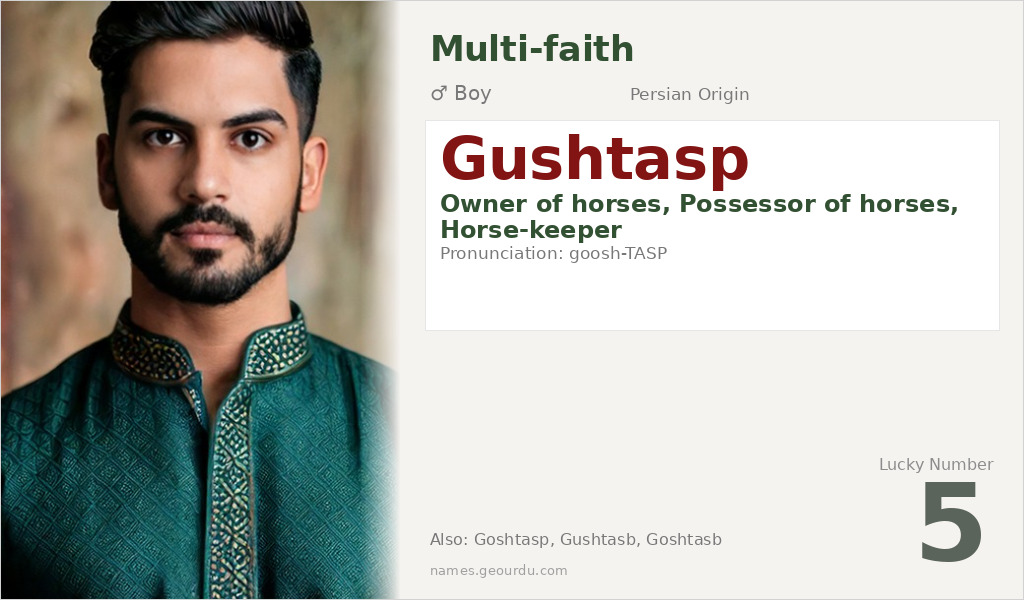
| 📛 Name | Gushtasp |
| 💎 Meaning | Owner of horses, Possessor of horses, Horse-keeper |
| 👤 Gender | Boy |
| 🕌 Religion | Multi-faith |
| 🌍 Origin | Persian |
| 🗣 Pronunciation | goosh-TASP |
| ✍️ Urdu | گشتاسپ |
| ✍️ Arabic | گشتاسب |
| 🔢 Numerology | 5 |
| ✨ Spellings | Goshtasp, Gushtasb, Goshtasb, Gushtasf |
Origin & Cultural Significance
Gushtasp originates from Persian (Farsi) culture, with roots in Old Persian and Avestan languages. It is closely linked to the historical and mythological figure Vishtaspa (or Hystaspes), who is revered in Zoroastrianism as an early supporter of Zoroaster. Over time, the name evolved into Gushtasp in Persian literature, most famously in the 10th-century epic Shahnameh by Ferdowsi, where Gushtasp is depicted as a wise and just king. The name is used across Persian-speaking regions, including Iran, Afghanistan, and Tajikistan, and among diaspora communities. While it appears in Muslim contexts due to Persian cultural influence, it is not exclusively Islamic and is also valued in Zoroastrian and secular traditions, highlighting its multi-faith appeal.
Personality Traits
People named Gushtasp are often perceived as leaders with a strong sense of duty and heritage. Inspired by the name’s equine symbolism, they may exhibit qualities like stamina, grace, and a desire for exploration. Their connection to Persian legend can foster a deep appreciation for history and storytelling, making them thoughtful and resilient individuals. In social settings, they might be protective and loyal, embodying the noble traits associated with their namesake.
Similar Names
If you like Gushtasp, consider: Esfandiyar, Kay Khosrow, Fereydun, Rostam, Sohrab
Famous People Named Gushtasp
- Gushtasp (Kay Gushtasp) — Legendary king in Persian mythology, father of Esfandiyar, featured in Ferdowsi's Shahnameh
- Gushtasp — Historical figure in some Persian and Zoroastrian traditions, sometimes identified with Vishtaspa, patron of Zoroaster
Frequently Asked Questions About Gushtasp
What does Gushtasp mean?
Gushtasp means 'owner of horses' or 'horse-keeper' in Persian, derived from the Old Persian words 'gusht' and 'asp', both meaning horse.
Is Gushtasp a boy or girl name?
Gushtasp is traditionally a boy's name, rooted in Persian mythology where it belongs to male figures like the king in Shahnameh.
What is the origin of Gushtasp?
Gushtasp originates from Persian (Farsi) culture, with historical ties to Zoroastrianism and classical Persian literature, especially Ferdowsi's Shahnameh.