
Table of Contents
Gyanendra is a distinguished Sanskrit name that carries profound intellectual and spiritual significance. Meaning ‘Lord of Knowledge’ or ‘Master of Wisdom’, this name embodies the Hindu ideal of enlightened leadership. Historically associated with learned sages and royalty, Gyanendra continues to be a popular choice for boys in Hindu families across South Asia. Its rich etymology and cultural resonance make it a name that commands respect and admiration.
Meaning of Gyanendra
Gyanendra is a classical Sanskrit compound name with deep philosophical roots. The first component ‘Gyan’ (ज्ञान) derives from the Sanskrit root ‘jñā’, meaning ‘to know, to perceive, to understand’, and represents the highest form of spiritual knowledge in Hindu philosophy. The second component ‘Indra’ (इन्द्र) refers to the king of the gods in Hindu mythology, symbolizing sovereignty, power, and leadership. When combined, Gyanendra literally means ‘Lord of Knowledge’ or ‘Master of Wisdom’, suggesting someone who has mastered both worldly and spiritual understanding. This name appears in various Hindu texts as an epithet for sages and deities associated with wisdom, particularly in contexts emphasizing the importance of knowledge as the ultimate power.
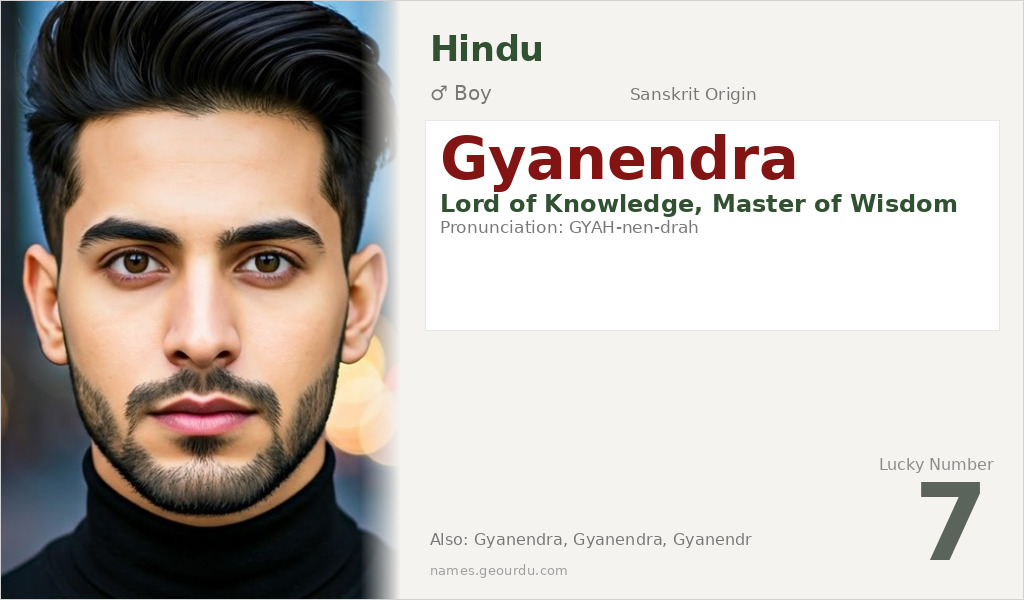
| 📛 Name | Gyanendra |
| 💎 Meaning | Lord of Knowledge, Master of Wisdom |
| 👤 Gender | Boy |
| 🕌 Religion | Hindu |
| 🌍 Origin | Sanskrit |
| 🗣 Pronunciation | GYAH-nen-drah |
| ✍️ Urdu | گیانندر |
| ✍️ Arabic | جيانيندرا |
| 🔢 Numerology | 7 |
| ✨ Spellings | Gyanendra, Gyanendra, Gyanendr, Gyanendera |
Origin & Cultural Significance
Gyanendra originates from classical Sanskrit, the ancient liturgical language of Hinduism that has influenced numerous South Asian languages. As a compound name, it follows the traditional Sanskrit pattern of combining meaningful elements to create names with specific virtues. The name has been used historically in Hindu royal families and among learned communities, particularly in Nepal and northern India. The most prominent modern bearer is Gyanendra Bir Bikram Shah Dev, the last monarch of Nepal, which has contributed to the name’s continued recognition. While primarily Hindu in association, the name’s Sanskrit roots give it cultural significance across South Asia beyond strictly religious boundaries.
Personality Traits
Those named Gyanendra are often characterized by their intellectual curiosity and natural authority. They tend to approach life with a philosophical mindset, seeking deeper meaning and understanding in their experiences. Their combination of wisdom and leadership qualities makes them effective in roles that require both knowledge and decision-making. While they may appear serious or contemplative, they typically possess a calm confidence that inspires trust in others.
Similar Names
If you like Gyanendra, consider: Gyanesh, Gyanprakash, Gyaneshwar, Indrajit, Vidyanand
Famous People Named Gyanendra
- Gyanendra Bir Bikram Shah Dev — Former King of Nepal (reigned 2001-2008)
- Gyanendra Malla — Nepalese cricketer who played for the national team
Frequently Asked Questions About Gyanendra
What does Gyanendra mean?
Gyanendra means 'Lord of Knowledge' or 'Master of Wisdom'. It is a Sanskrit compound name combining 'Gyan' (knowledge) and 'Indra' (lord/master).
Is Gyanendra a boy or girl name?
Gyanendra is exclusively a masculine name in Hindu naming traditions. The '-endra' suffix is typically masculine in Sanskrit grammar and naming conventions.
What is the origin of Gyanendra?
Gyanendra originates from Sanskrit, the ancient language of Hindu scriptures. It is a traditional Hindu name with historical usage in South Asia, particularly in Nepal and northern India.





