
Table of Contents
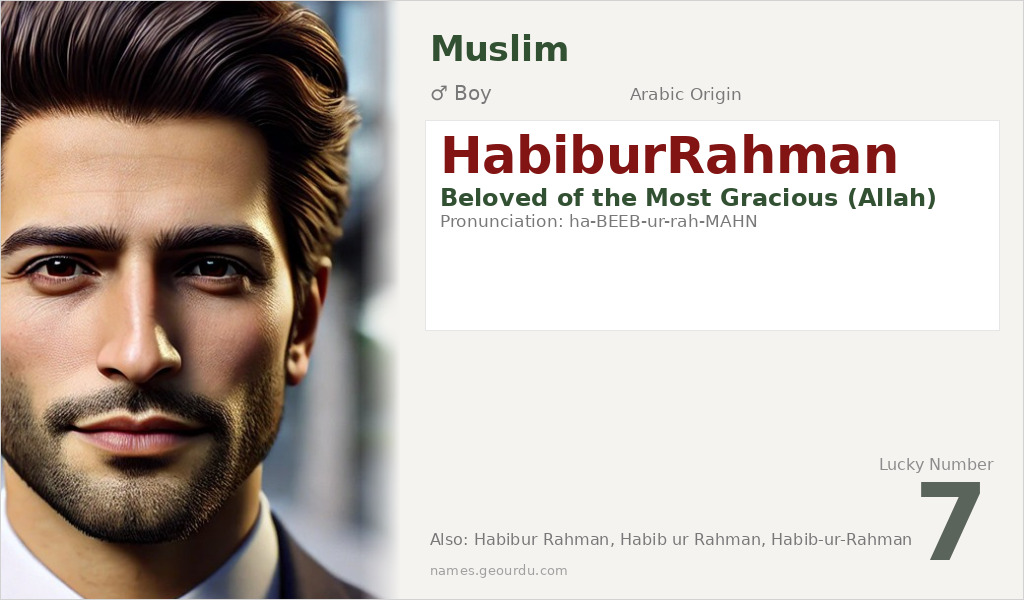
HabiburRahman is a beautiful and meaningful Arabic name that carries deep spiritual significance in the Muslim world. Combining ‘Habib’ (beloved) with ‘Rahman’ (the Most Gracious), this name embodies a profound connection to divine mercy and love. Popular across regions from the Middle East to South Asia, it reflects Islamic values of devotion and compassion. In this guide, we explore the rich etymology, cultural context, and personality traits associated with HabiburRahman.
Meaning of HabiburRahman
HabiburRahman is a compound Arabic name with two distinct components, each rooted in classical Arabic linguistics. The first part, ‘Habib,’ derives from the root Ḥ-B-B (ح ب ب), which conveys concepts of love, affection, and friendship. The second part, ‘Rahman,’ comes from the root R-Ḥ-M (ر ح م), meaning mercy or compassion, and is specifically used as one of the primary names of Allah in the Quran, translated as ‘the Most Gracious.’ Together, the name means ‘Beloved of the Most Gracious,’ emphasizing a personal, cherished relationship with the divine. This theophoric construction is common in Islamic naming traditions, where names like Abdur Rahman (Servant of the Most Gracious) also appear. The name is phonetically harmonious and carries a poetic resonance in Arabic, often chosen for its spiritual depth and melodic quality.
| 📛 Name | HabiburRahman |
| 💎 Meaning | Beloved of the Most Gracious (Allah) |
| 👤 Gender | Boy |
| 🕌 Religion | Muslim |
| 🌍 Origin | Arabic |
| 🗣 Pronunciation | ha-BEEB-ur-rah-MAHN |
| ✍️ Urdu | حبیب الرحمن |
| ✍️ Arabic | حبيب الرحمن |
| 🔢 Numerology | 7 |
| ✨ Spellings | Habibur Rahman, Habib ur Rahman, Habib-ur-Rahman, Habeebur Rahman |
Origin & Cultural Significance
HabiburRahman originates from Arabic, the liturgical language of Islam, and has been used for centuries across the Muslim world. It gained particular prominence in South Asia during the Mughal era and later through Islamic scholarship and literature. The name is prevalent in countries like Bangladesh, Pakistan, India, and Indonesia, often among families with religious or scholarly backgrounds. While its core remains Arabic, it has been adapted into various scripts, including Urdu, Persian, and Bengali, maintaining its original meaning. Unlike some names that may have pre-Islamic or regional tribal origins, HabiburRahman is firmly rooted in Islamic theology, with ‘Rahman’ being a central attribute of Allah mentioned frequently in the Quran. Its usage transcends ethnic boundaries, appearing among Arab, Persian, Turkic, and South Asian Muslim communities.
Personality Traits
Those named HabiburRahman are often seen as embodying the qualities of their name—graciousness, empathy, and a strong spiritual foundation. They may be drawn to helping others and fostering peaceful environments, reflecting the merciful aspect of ‘Rahman.’ Their ‘Habib’ component suggests they value close, loving relationships and may be cherished by their community. While personality varies individually, the name’s meaning can inspire a life oriented toward compassion and divine connection.
Similar Names
If you like HabiburRahman, consider: Abdur Rahman, Habibullah, Rahman, Habib, Karimur Rahman, Nurur Rahman, Mahbubur Rahman
Famous People Named HabiburRahman
- Habibur Rahman (1913–1976) — Bangladeshi Islamic scholar and politician, served as Acting President of Bangladesh
- Habibur Rahman (1920–2014) — Indian-born British physician and community leader in the UK Muslim community
Frequently Asked Questions About HabiburRahman
What does HabiburRahman mean?
HabiburRahman means 'Beloved of the Most Gracious' in Arabic, combining 'Habib' (beloved) and 'Rahman' (the Most Gracious, a name of Allah).
Is HabiburRahman a boy or girl name?
HabiburRahman is exclusively a boy's name in Muslim naming traditions, as it is a masculine Arabic compound name.
What is the origin of HabiburRahman?
HabiburRahman originates from Arabic, specifically from Islamic religious vocabulary, and is used widely in Muslim cultures across the Middle East, South Asia, and Southeast Asia.





