
Table of Contents
Habis is a distinguished Arabic name with deep roots in Islamic scholarly tradition. Primarily used for boys, this name carries significant religious and cultural weight within Muslim communities. Unlike many modern names, Habis has a specific occupational meaning connected to the preservation of Islamic knowledge. Understanding its etymology reveals why this name has maintained relevance for centuries.
Meaning of Habis
The name Habis originates from the Arabic root ‘ḥ-b-s’ (ح ب س), which fundamentally means ‘to restrain, detain, or confine.’ In the context of Islamic scholarship, Habis specifically refers to a narrator or transmitter of Hadith—the recorded sayings, actions, and approvals of Prophet Muhammad. This specialized meaning developed because Hadith narrators were responsible for ‘restraining’ or preserving authentic traditions through meticulous transmission chains. The name appears in classical biographical works like Ibn Hajar’s ‘Tahdhib al-Tahdhib’ and al-Dhahabi’s ‘Siyar A’lam al-Nubala’, where individuals named Habis are documented as reliable transmitters. This linguistic connection between restraint and knowledge preservation makes Habis a meaningful choice for families valuing Islamic scholarship.
| 📛 Name | Habis |
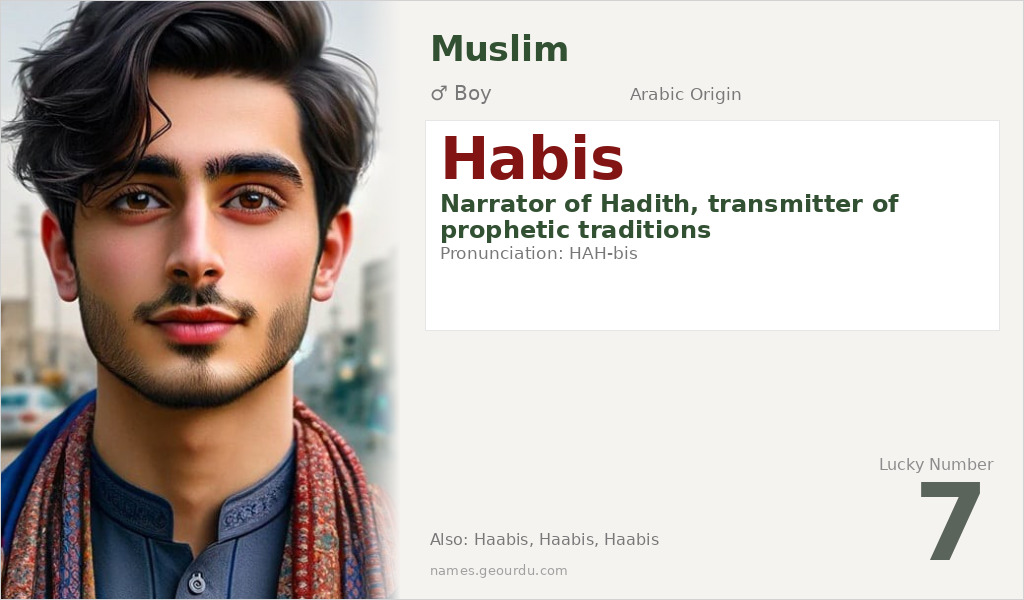
| 💎 Meaning | Narrator of Hadith, transmitter of prophetic traditions |
| 👤 Gender | Boy |
| 🕌 Religion | Muslim |
| 🌍 Origin | Arabic |
| 🗣 Pronunciation | HAH-bis |
| ✍️ Urdu | حابس |
| ✍️ Arabic | حابس |
| 🔢 Numerology | 7 |
| ✨ Spellings | Haabis, Haabis, Haabis |
Origin & Cultural Significance
Habis has exclusively Arabic origins and emerged within early Islamic society as an occupational name for Hadith transmitters. The name gained prominence during the formative centuries of Islam when preserving prophetic traditions was crucial for developing Islamic law and theology. It appears among early Muslim communities in the Arabian Peninsula and later spread throughout the Islamic world. While primarily used in Arabic-speaking regions, the name also appears in Muslim communities speaking Persian, Urdu, Turkish, and other languages due to Islamic cultural diffusion. Unlike some names that have pre-Islamic origins, Habis developed specifically within Islamic scholarly contexts, making it distinctly Muslim in character and association.
Personality Traits
Those named Habis are often associated with qualities of reliability, precision, and dedication to knowledge. The name’s connection to Hadith transmission suggests a personality that values authenticity, tradition, and careful preservation of important information. In social contexts, Habis might be perceived as thoughtful, disciplined, and respectful of established wisdom. These traits reflect the scholarly responsibility inherent in the name’s meaning and historical usage.
Similar Names
If you like Habis, consider: Hafiz, Hammad, Haris, Hasan, Habib
Famous People Named Habis
- Habis al-Majali — Jordanian military commander and politician
- Habis ibn Sa'd al-Tamimi — Early Islamic figure and companion of Prophet Muhammad
Frequently Asked Questions About Habis
What does Habis mean?
Habis means 'Narrator of Hadith' or 'transmitter of prophetic traditions' in Arabic. It comes from the root 'ḥ-b-s' meaning to restrain or preserve, specifically referring to preserving Islamic knowledge through authenticated chains of narration.
Is Habis a boy or girl name?
Habis is exclusively a boy's name in Arabic and Islamic naming traditions. There are no recorded instances of it being used for girls in historical or contemporary sources.
What is the origin of Habis?
Habis has Arabic origins and developed specifically within Islamic scholarly contexts as a name for Hadith narrators. It emerged in early Muslim society and spread throughout the Islamic world while maintaining its Arabic linguistic roots.





