
Table of Contents
Hadassa is a beautiful and historically rich name with deep roots in Hebrew tradition. Meaning ‘myrtle tree,’ this name carries botanical symbolism of love, peace, and resilience. Best known as the original Hebrew name of Queen Esther in the Biblical Book of Esther, Hadassa has been cherished for centuries in Jewish communities and adopted by Christians worldwide. Its elegant sound and meaningful origin make it a timeless choice for parents seeking a name with spiritual depth.
Meaning of Hadassa
Hadassa derives directly from the Hebrew word ‘hadas’ (הֲדַס), which specifically refers to the myrtle tree. This evergreen plant is native to the Mediterranean region and holds significant symbolic value in Jewish culture, representing beauty, fertility, and God’s blessings. In the Hebrew Bible, the myrtle is mentioned in contexts of restoration and peace, such as in Isaiah 55:13. The name’s botanical meaning connects it to nature and traditional symbolism, distinguishing it from many other Hebrew names that have more abstract meanings. As a name, Hadassa embodies these qualities of endurance, fragrance, and spiritual significance.
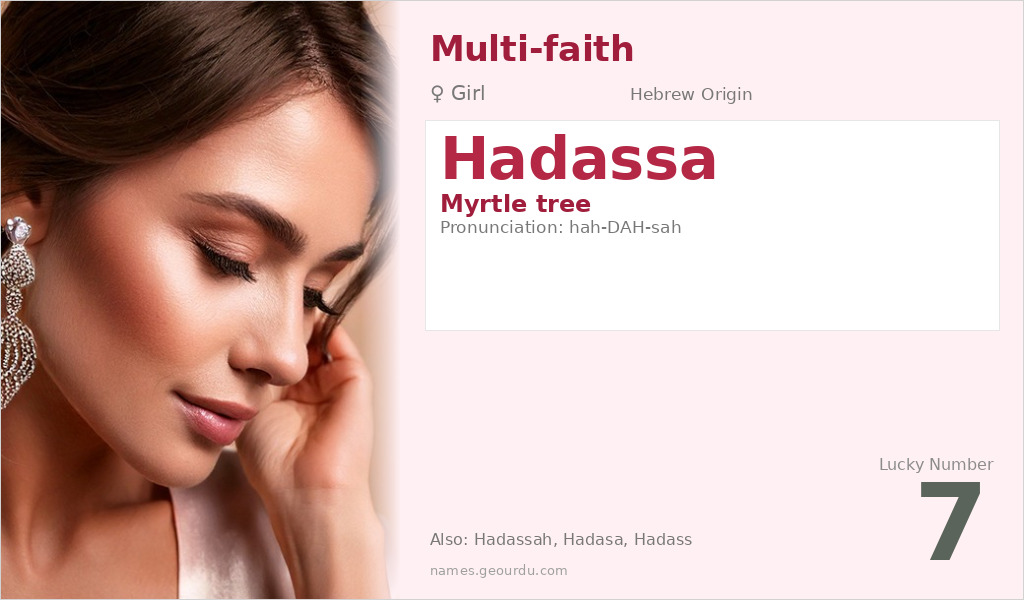
| 📛 Name | Hadassa |
| 💎 Meaning | Myrtle tree |
| 👤 Gender | Girl |
| 🕌 Religion | Multi-faith |
| 🌍 Origin | Hebrew |
| 🗣 Pronunciation | hah-DAH-sah |
| ✍️ Urdu | ہداسہ |
| ✍️ Arabic | هداسا |
| 🔢 Numerology | 7 |
| ✨ Spellings | Hadassah, Hadasa, Hadass |
Origin & Cultural Significance
Hadassa originates from ancient Hebrew and is most famously documented in the Biblical Book of Esther, where Hadassah is the Hebrew name of Queen Esther before she adopts her Persian name. This places the name’s usage in the 5th century BCE Persian Empire. While fundamentally a Jewish name from the Old Testament, it has been adopted by Christians who value Biblical names, particularly in Protestant and Catholic traditions. The name remains popular in Israel and among Jewish diaspora communities, with organizations like Hadassah (the Women’s Zionist Organization of America) helping to preserve its cultural relevance. Its cross-faith appeal demonstrates how Biblical names transcend religious boundaries while maintaining their historical roots.
Personality Traits
Those named Hadassa are often perceived as nurturing, intuitive, and deeply connected to their heritage or spiritual beliefs. Like the myrtle tree that symbolizes their name, they may exhibit qualities of resilience, evergreen vitality, and a calming presence. Many with this name are drawn to creative or healing professions where compassion and insight are valued. Their personality often reflects the name’s Biblical association with courage and transformation, as seen in Queen Esther’s story.
Similar Names
If you like Hadassa, consider: Esther, Hannah, Miriam, Ruth, Leah
Famous People Named Hadassa
- Hadassah Lieberman — American political figure and wife of former U.S. Senator Joe Lieberman
- Hadassah B. — Biblical figure, original Hebrew name of Queen Esther in the Book of Esther
Frequently Asked Questions About Hadassa
What does Hadassa mean?
Hadassa means 'myrtle tree' in Hebrew. It comes from the Hebrew word 'hadas' referring to the evergreen myrtle plant that symbolizes love, peace, and fertility in Jewish tradition.
Is Hadassa a boy or girl name?
Hadassa is exclusively a girl's name. It has always been feminine in its Hebrew origin and Biblical usage as Queen Esther's original name.
What is the origin of Hadassa?
Hadassa originates from ancient Hebrew and appears in the Hebrew Bible (Old Testament) as the original name of Queen Esther. It is fundamentally a Jewish name that has been adopted by Christians and others who appreciate Biblical names.





