Table of Contents
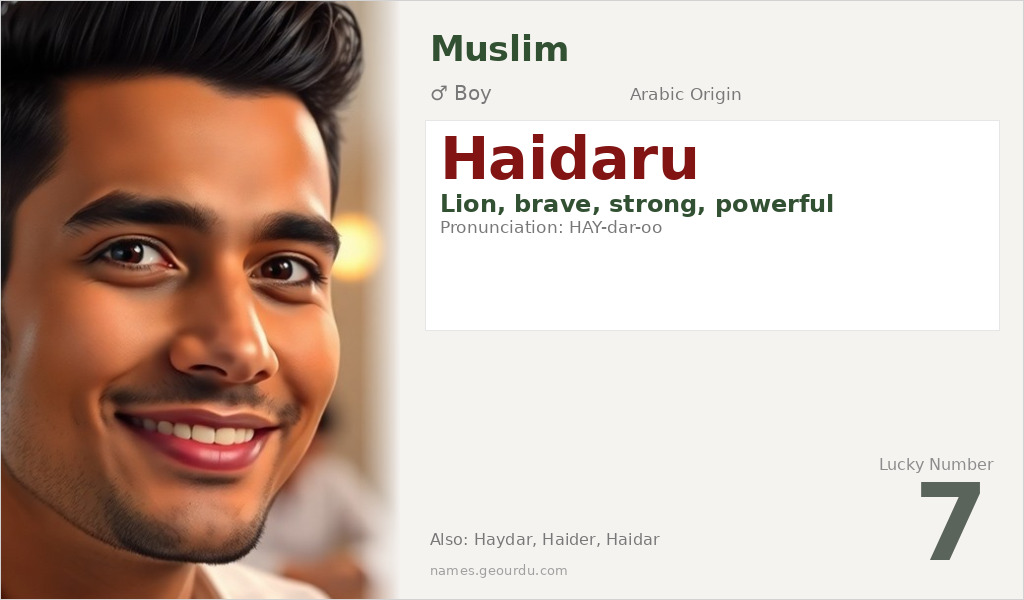
Haidaru is a powerful Arabic name that carries the majestic meaning of ‘lion,’ symbolizing strength, courage, and leadership. Deeply rooted in Islamic tradition, this name honors Ali ibn Abi Talib, known as ‘Haydar’ for his battlefield bravery. Popular across Muslim communities from South Asia to the Middle East, Haidaru represents both historical significance and contemporary appeal. Parents choosing this name often seek to instill qualities of protection, valor, and noble character in their sons.
Meaning of Haidaru
Haidaru derives directly from the Arabic name Haydar (حيدر), which unequivocally means ‘lion.’ This meaning originates from the Arabic root Ḥ-Y-D-R (ح-ي-د-ر), associated with strength, ferocity, and bravery. In Islamic history, the title ‘Haydar’ was famously bestowed upon Ali ibn Abi Talib, the fourth caliph and cousin of Prophet Muhammad, reflecting his lion-hearted courage in battles like Khaybar. The name spread through Persian literature and Urdu poetry, where it maintained its core leonine symbolism while acquiring cultural nuances in regions like South Asia. Linguistically, it’s distinct from similar lion-related names like Asad (another Arabic word for lion) through its specific historical and religious connotations.
| 📛 Name | Haidaru |
| 💎 Meaning | Lion, brave, strong, powerful |
| 👤 Gender | Boy |
| 🕌 Religion | Muslim |
| 🌍 Origin | Arabic |
| 🗣 Pronunciation | HAY-dar-oo |
| ✍️ Urdu | حیدر |
| ✍️ Arabic | حيدر |
| 🔢 Numerology | 7 |
| ✨ Spellings | Haydar, Haider, Haidar, Heidar, Haydaroo |
Origin & Cultural Significance
Haidaru originates from classical Arabic, specifically as an epithet for Ali ibn Abi Talib in early Islamic history. The name gained prominence through Shia Muslim traditions, where Ali is highly venerated, but it’s used across Sunni communities as well. It spread geographically through Arabic influence into Persian (as Haydar), Turkish (as Haydar), Urdu (as Haider/Haidar), and regional languages like Pashto and Sindhi. In South Asia, the name became particularly popular among Muslims following the Mughal era and through Sufi traditions. Historical figures like Haidar Ali of Mysore further cemented the name’s association with leadership and military prowess in the Indian subcontinent.
Personality Traits
Those named Haidaru are often associated with lion-like qualities: courage, strength, and protective instincts. They tend to be natural leaders who command respect through their determination rather than aggression. In social settings, they may display loyalty to family and friends reminiscent of a lion’s pride dynamics. While sometimes perceived as intense or formidable, they typically balance this with wisdom and strategic thinking.
Similar Names
If you like Haidaru, consider: Ali, Asad, Hamza, Haider, Sher, Arslan, Levon, Leon, Simba, Kesari
Famous People Named Haidaru
- Haidar Ali — 18th-century ruler of the Kingdom of Mysore in southern India, father of Tipu Sultan
- Haidar Abu Bakr al-Attas — former Prime Minister of Yemen (1990-1994)
Frequently Asked Questions About Haidaru
What does Haidaru mean?
Haidaru means 'lion' in Arabic. It specifically refers to bravery and strength, derived from the Arabic root Ḥ-Y-D-R, and is historically associated with Ali ibn Abi Talib's epithet 'Haydar.'
Is Haidaru a boy or girl name?
Haidaru is exclusively a boy's name in all cultural contexts where it's used, particularly in Muslim communities across Arabic, Persian, Urdu, and Turkish-speaking regions.
What is the origin of Haidaru?
Haidaru originates from Arabic, specifically as the name Haydar meaning 'lion.' It gained significance in Islamic tradition as an epithet for Ali ibn Abi Talib and spread through Persian, Turkish, and South Asian languages.