
Table of Contents
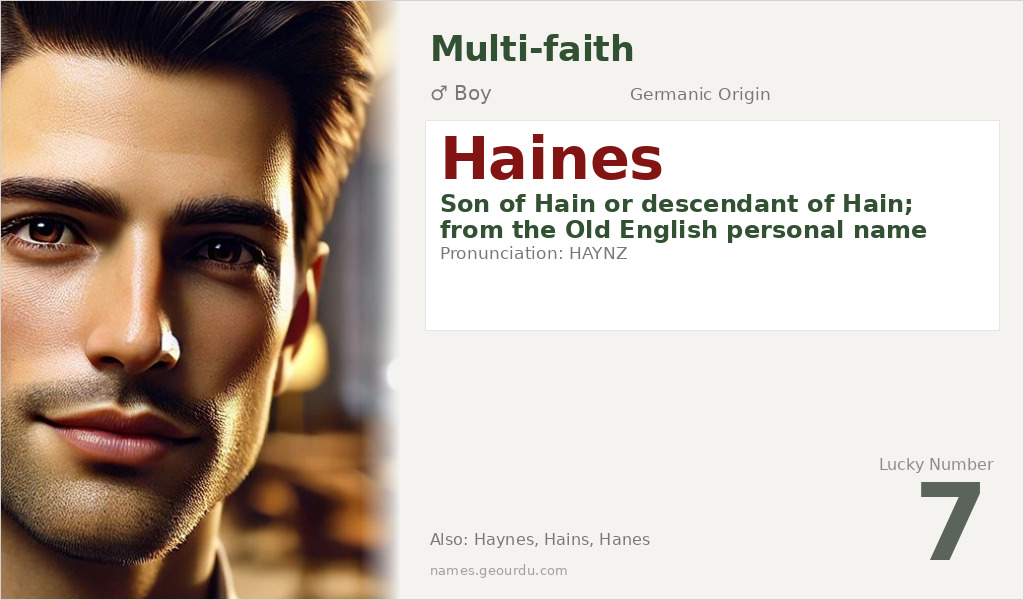
Haines is a distinctive name with deep historical roots that has transitioned from surname to given name. With its Germanic origins and patronymic meaning, this name carries a legacy of lineage and heritage. While not tied to any specific religion, Haines has been adopted across various cultures and faith traditions. Its strong, single-syllable sound gives it a modern yet timeless appeal for parents seeking a name with historical depth.
Meaning of Haines
The name Haines has a clear etymological path from its Germanic origins. It derives from the Old English personal name ‘Hægen’, which itself traces back to the Proto-Germanic root ‘*hag-‘, meaning ‘enclosure’, ‘hedge’, or ‘protected space’. As a patronymic surname, Haines literally means ‘son of Hain’ or ‘descendant of Hain’, with the ‘-s’ suffix functioning as the possessive ‘son of’ indicator common in English surnames. This is substantiated by historical records and linguistic research, distinguishing it from the incorrect ‘vine-covered cottage’ attribution that appears in some sources without etymological basis. The name’s evolution reflects common patterns in English surname formation during the Middle Ages.
| 📛 Name | Haines |
| 💎 Meaning | Son of Hain or descendant of Hain; from the Old English personal name Hægen |
| 👤 Gender | Boy |
| 🕌 Religion | Multi-faith |
| 🌍 Origin | Germanic |
| 🗣 Pronunciation | HAYNZ |
| ✍️ Urdu | ہینز |
| ✍️ Arabic | هاينز |
| 🔢 Numerology | 7 |
| ✨ Spellings | Haynes, Hains, Hanes |
Origin & Cultural Significance
Haines originated as an English surname with Germanic roots, specifically from the Old English period. It emerged as a patronymic surname during the 12th-14th centuries when hereditary surnames became necessary for taxation and record-keeping purposes in England. The name spread through English-speaking countries during colonization and migration periods. While not specifically tied to Christianity in its origins, it has been borne by individuals of various faiths. The transition from surname to given name occurred primarily in the 19th and 20th centuries, particularly in English-speaking countries where surname-first names became fashionable.
Personality Traits
Those named Haines are often described as thoughtful, analytical individuals with a natural curiosity about the world. They tend to approach life with intellectual rigor and spiritual depth, valuing authenticity in their relationships and endeavors. While reserved in nature, they form deep, meaningful connections with those who share their values and interests.
Similar Names
If you like Haines, consider: Hayden, Hagen, Hainesworth, Hainsworth, Hain
Famous People Named Haines
- Haines Watts — British accountancy firm founded by Haines Watts
- John Haines — American poet and essayist
Frequently Asked Questions About Haines
What does Haines mean?
Haines means 'son of Hain' or 'descendant of Hain', deriving from the Old English personal name Hægen with Germanic roots meaning 'enclosure' or 'hedge'.
Is Haines a boy or girl name?
Haines is traditionally a masculine name, originating as a patronymic surname meaning 'son of Hain'. While primarily used for boys, surname names can sometimes become unisex over time.
What is the origin of Haines?
Haines has Germanic origins through Old English, specifically as a patronymic surname meaning 'son of Hain'. It evolved from the personal name Hægen and became established as a hereditary surname in medieval England.





