
Table of Contents
Hajar is a name rich in historical and religious significance, tracing its roots to ancient Arabic language and Islamic tradition. Meaning ‘stone’ or ‘rock’, this name carries profound cultural weight across Muslim communities worldwide. From its appearance in Islamic narratives to its contemporary usage, Hajar represents strength, resilience, and faith. This comprehensive guide explores the true meaning, origin, and cultural context of this important name.
Meaning of Hajar
Hajar derives from the Arabic root ‘ḥ-j-r’ which fundamentally means ‘stone’ or ‘rock’. In classical Arabic, the term specifically refers to large stones or rock formations, not just small pebbles. The name gained particular significance through Hajar (known as Hagar in Biblical tradition), the wife of Prophet Ibrahim (Abraham) and mother of Prophet Ismail (Ishmael). Her story is central to Islamic tradition, particularly in the rituals of Hajj pilgrimage where pilgrims commemorate her search for water between the hills of Safa and Marwah. The name’s meaning reflects qualities of strength, endurance, and permanence associated with stone in Arabic culture and poetry.
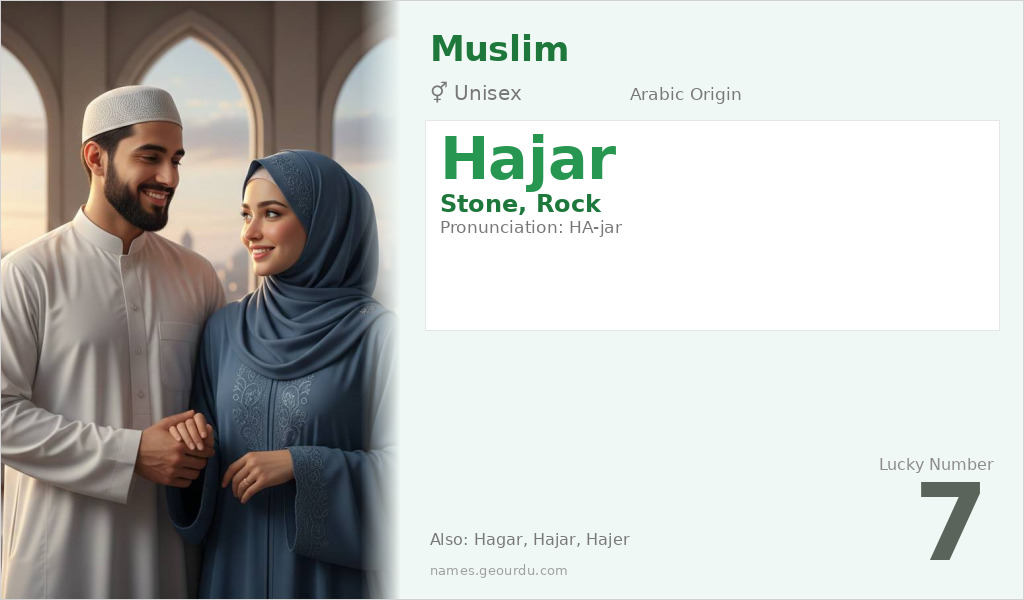
| 📛 Name | Hajar |
| 💎 Meaning | Stone, Rock |
| 👤 Gender | Unisex |
| 🕌 Religion | Muslim |
| 🌍 Origin | Arabic |
| 🗣 Pronunciation | HA-jar |
| ✍️ Urdu | ہاجر |
| ✍️ Arabic | هاجر |
| 🔢 Numerology | 7 |
| ✨ Spellings | Hagar, Hajar, Hajer, Hajara |
Origin & Cultural Significance
Hajar originates from the Arabic language and has been used for centuries across the Arabian Peninsula and Muslim world. The name’s prominence stems primarily from Islamic tradition, where Hajar plays a crucial role in the narrative of Prophet Ibrahim’s family. Her story is recounted in the Quran and Hadith literature, making the name particularly significant in Muslim communities. While the name appears in pre-Islamic Arabic poetry and records, its widespread adoption accelerated with the spread of Islam. Today, Hajar is used across diverse Muslim cultures from the Middle East to South Asia, Africa, and beyond, maintaining its connection to this important historical and religious figure.
Personality Traits
Those named Hajar are often associated with the steadfast qualities of their namesake stone. They tend to exhibit remarkable resilience in facing life’s challenges, much like the historical Hajar who demonstrated extraordinary endurance in the desert. Their practical nature and reliability make them valued friends and family members who provide stability during turbulent times. This grounding quality often translates into strong moral character and unwavering commitment to their principles and loved ones.
Similar Names
If you like Hajar, consider: Hajira, Hajrah, Hagar, Sakhr, Jabal, Khalil, Ibrahim, Ismail
Famous People Named Hajar
- Hajar (Biblical/Islamic figure) — Wife of Prophet Ibrahim (Abraham) and mother of Prophet Ismail (Ishmael), central figure in Islamic tradition and the Hajj pilgrimage rituals
- Hajar Al-Nassar — Contemporary Saudi Arabian poet and writer known for her literary contributions
Frequently Asked Questions About Hajar
What does Hajar mean?
Hajar means 'Stone' or 'Rock' in Arabic, derived from the root word 'ḥ-j-r'. The name specifically refers to large stones or rock formations and carries significant religious importance in Islamic tradition.
Is Hajar a boy or girl name?
Hajar is a unisex name in Arabic and Muslim cultures, though it is more commonly given to girls in many regions due to its association with the historical figure Hajar, wife of Prophet Ibrahim.
What is the origin of Hajar?
Hajar originates from the Arabic language and Islamic tradition. It gained prominence through Hajar (Hagar), the wife of Prophet Ibrahim and mother of Prophet Ismail, whose story is central to Islamic narratives and Hajj pilgrimage rituals.