
Table of Contents
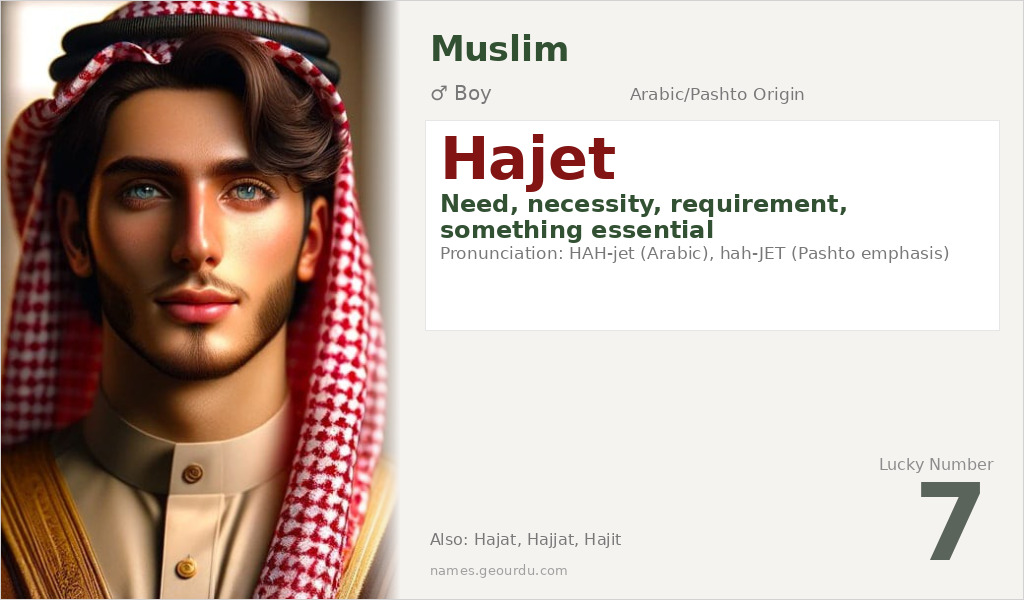
Hajet is a distinctive name with deep roots in both Arabic and Pashto linguistic traditions. Primarily used for boys in Muslim communities, particularly among Pashtun populations in Afghanistan and Pakistan, this name carries the profound meaning of ‘need’ or ‘necessity’. Unlike many names that reference positive attributes, Hajet acknowledges the fundamental human experience of requiring something essential. This exploration reveals how a simple concept becomes a powerful personal identifier across cultures.
Meaning of Hajet
The name Hajet originates from the Arabic word ‘ḥājah’ (حاجة), which translates directly to ‘need’, ‘necessity’, or ‘requirement’. Linguistically, it derives from the trilateral root ḥ-w-j (ح و ج), which encompasses concepts of needing, wanting, and requiring something essential. In Pashto, the name is spelled identically (حاجت) and carries the same core meaning, though with slightly different pronunciation emphasizing the second syllable. This semantic consistency across languages reflects the name’s straightforward yet profound significance. Unlike abstract virtues, Hajet represents tangible, practical necessity—making it a grounded, realistic choice for parents valuing substance over ornamentation in naming.
| 📛 Name | Hajet |
| 💎 Meaning | Need, necessity, requirement, something essential |
| 👤 Gender | Boy |
| 🕌 Religion | Muslim |
| 🌍 Origin | Arabic/Pashto |
| 🗣 Pronunciation | HAH-jet (Arabic), hah-JET (Pashto emphasis) |
| ✍️ Urdu | حاجت |
| ✍️ Arabic | حاجة |
| 🔢 Numerology | 7 |
| ✨ Spellings | Hajat, Hajjat, Hajit, Hajeth |
Origin & Cultural Significance
Hajet has dual origins in both Arabic and Pashto linguistic traditions. While the word originates from Classical Arabic, its adoption as a personal name is particularly prominent among Pashtun communities in Afghanistan and northwestern Pakistan. In these regions, it functions not only as a given name but also as a common noun in daily speech. The name’s popularity in Pashto-speaking areas reflects cultural values that appreciate practical, meaningful names over purely decorative ones. Historically, names referencing basic human conditions (like need, hope, or patience) have been common in Islamic naming traditions, with Hajet representing this pragmatic approach to nomenclature.
Personality Traits
Those named Hajet often embody qualities of practicality and essentiality. They’re frequently seen as indispensable members of their social circles—people who address fundamental needs and provide necessary solutions. This doesn’t necessarily mean they’re always in need themselves, but rather that they understand and respond to necessities effectively. Their grounded nature makes them reliable and realistic in both personal and professional contexts.
Similar Names
If you like Hajet, consider: Hajira, Hajji, Hajdar, Hakim, Hasan
Famous People Named Hajet
- Hajet Khan — 19th century Pashtun tribal leader from the Khattak tribe
- Hajet Gul — Contemporary Afghan poet and writer from Kandahar
Frequently Asked Questions About Hajet
What does Hajet mean?
Hajet means 'need', 'necessity', or 'requirement' in both Arabic and Pashto languages. It comes from the Arabic root ḥ-w-j relating to needing something essential.
Is Hajet a boy or girl name?
Hajet is primarily a masculine name used for boys in Muslim communities, especially among Pashtun populations in Afghanistan and Pakistan. There are no documented feminine uses of this name.
What is the origin of Hajet?
Hajet has dual origins: it comes from the Arabic word 'ḥājah' but is particularly common as a personal name in Pashto-speaking regions of Afghanistan and Pakistan, where it maintains the same meaning.





