Table of Contents
The name Haman carries one of the most complex and controversial histories in naming traditions. While known to many as the villainous minister of Pharaoh in Islamic and Biblical narratives, the name also appears in Persian and regional contexts with entirely different connotations. This duality makes Haman a fascinating case study in how names evolve across cultures and religious traditions.
Meaning of Haman
The meaning of Haman is subject to significant debate among etymologists. In Hebrew and Aramaic sources, the name likely derives from roots meaning ‘noise’ or ‘tumult,’ which aligns with the chaotic character in religious texts. However, Persian linguistics offers ‘haman’ as meaning ‘companion’ or ‘friend,’ from the Persian word for ‘same’ or ‘together.’ This creates a striking contrast: a name representing either discord or companionship depending on cultural context. Regional languages like Pashto and Balochi show Persian influence in their interpretation, while Arabic maintains the Quranic association. The linguistic journey of this name demonstrates how meanings transform across geographical and religious boundaries.
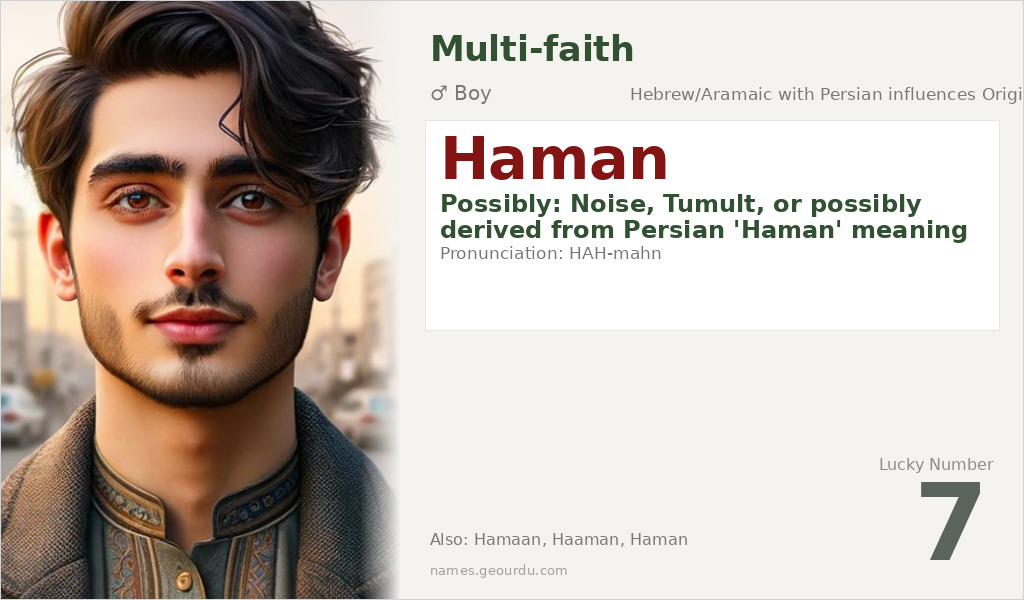
| 📛 Name | Haman |
| 💎 Meaning | Possibly: Noise, Tumult, or possibly derived from Persian 'Haman' meaning 'companion' or 'friend' |
| 👤 Gender | Boy |
| 🕌 Religion | Multi-faith |
| 🌍 Origin | Hebrew/Aramaic with Persian influences |
| 🗣 Pronunciation | HAH-mahn |
| ✍️ Urdu | ہامان |
| ✍️ Arabic | هامان |
| 🔢 Numerology | 7 |
| ✨ Spellings | Hamaan, Haaman, Haman |
Origin & Cultural Significance
Haman originates from ancient Semitic languages, most prominently appearing in the Hebrew Bible and subsequently in the Quran as Pharaoh’s chief minister who opposed Moses. This religious association has made the name controversial in Muslim naming traditions, though it persists in some communities. Simultaneously, the name appears in Persian history and literature with positive connotations, and has spread to neighboring regions including Afghanistan and Pakistan through Pashto and Balochi influences. The dual origin story—both as a Biblical/Quranic figure and as a Persian name—creates unique cultural tensions that continue to influence how the name is perceived and used today across different communities.
Personality Traits
Given the name’s complex heritage, individuals named Haman often navigate unique social perceptions. The name’s strong historical associations, both negative and positive, may influence how bearers develop resilience and self-awareness. Many named Haman learn to articulate their own identity beyond the name’s loaded history, often developing strong communication skills and cultural sensitivity as they explain their name’s origins to others.
Similar Names
If you like Haman, consider: Hamza, Hasan, Husain, Haroon, Hameed
Famous People Named Haman
- Haman (Biblical/Quranic figure) — Minister of Pharaoh who opposed Moses
- Haman (Persian name bearer) — Various historical figures in Persian and regional contexts
Frequently Asked Questions About Haman
What does Haman mean?
Haman has multiple possible meanings: from Hebrew/Aramaic origins meaning 'noise' or 'tumult' (associated with the Quranic/Biblical villain), and from Persian meaning 'companion' or 'friend.' The meaning depends on cultural and linguistic context.
Is Haman a boy or girl name?
Haman is exclusively a masculine name across all cultural contexts where it appears, from Semitic traditions to Persian and regional naming practices.
What is the origin of Haman?
Haman has dual origins: primarily from Hebrew/Aramaic as the name of Pharaoh's minister in religious texts, and secondarily from Persian where it means 'companion.' The name appears in Quranic, Biblical, Persian, and regional traditions across the Middle East and South Asia.