Table of Contents
Hamziyyah is a beautiful and powerful Arabic name for girls that carries centuries of cultural significance. Derived from the masculine name Hamzah, meaning ‘lion,’ this feminine form symbolizes strength, courage, and steadfastness. Particularly cherished in Muslim communities, the name connects to important historical figures in early Islam while embodying qualities of protection and resilience. Understanding Hamziyyah’s rich etymology reveals why it remains a meaningful choice for parents seeking a name with both historical depth and contemporary relevance.
Meaning of Hamziyyah
Hamziyyah originates from classical Arabic, specifically as the feminine form of Hamzah (حمزة). The root ḥ-m-z (ح-م-ز) carries connotations of strength, sharpness, and steadfastness. Historically, ‘hamzah’ referred to a sharp-pointed tool or weapon, but its metaphorical extension to mean ‘lion’ became predominant due to the lion’s symbolic association with strength and courage in Arabic poetry and culture. The feminine suffix ‘-iyyah’ is a common Arabic morphological pattern for creating feminine forms from masculine nouns and adjectives. Thus, Hamziyyah literally translates to ‘lioness’ or ‘strong, steadfast woman.’ This naming pattern follows traditional Arabic linguistics where feminine derivatives maintain the core meaning while specifying gender through grammatical construction.
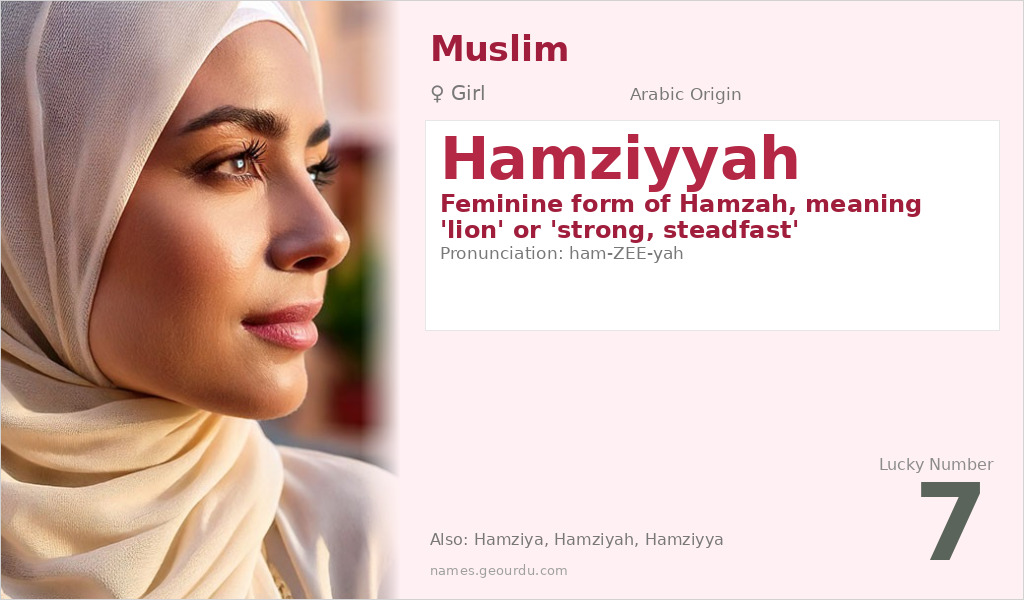
| 📛 Name | Hamziyyah |
| 💎 Meaning | Feminine form of Hamzah, meaning 'lion' or 'strong, steadfast' |
| 👤 Gender | Girl |
| 🕌 Religion | Muslim |
| 🌍 Origin | Arabic |
| 🗣 Pronunciation | ham-ZEE-yah |
| ✍️ Urdu | حمزیہ |
| ✍️ Arabic | حمزية |
| 🔢 Numerology | 7 |
| ✨ Spellings | Hamziya, Hamziyah, Hamziyya, Hamzia |
Origin & Cultural Significance
The name Hamziyyah has its origins in pre-Islamic and early Islamic Arabia. Its masculine counterpart, Hamzah, gained immense significance through Hamzah ibn Abdul-Muttalib, the beloved uncle of Prophet Muhammad who was martyred in the Battle of Uhud. Known as ‘Asadullah’ (Lion of God), his bravery made the name Hamzah highly respected in Muslim communities. The feminine form Hamziyyah emerged naturally within Arabic naming conventions to honor similar qualities in girls. While used across the Arab world, the name is particularly popular in regions with strong Islamic heritage, including the Middle East, North Africa, South Asia, and among Muslim diaspora communities worldwide. It represents both linguistic tradition and cultural values of strength and protection.
Personality Traits
Those named Hamziyyah are often associated with traits of courage, determination, and protective instincts. Like the lioness that inspires their name, they may demonstrate natural leadership abilities combined with nurturing qualities. Historically and culturally, the name suggests someone who stands firm in their convictions while caring deeply for their community and family. These associations stem from both the literal meaning and the historical figure of Hamzah ibn Abdul-Muttalib, whose legacy continues to influence how the name is perceived in Muslim societies today.
Similar Names
If you like Hamziyyah, consider: Hamzah, Asad, Layth, Haytham, Saba
Famous People Named Hamziyyah
- Hamzah ibn Abdul-Muttalib — Uncle of Prophet Muhammad, known as 'Asadullah' (Lion of God) for his bravery in early Islamic battles
- Hamziyyah bint Abdullah — Historical figure mentioned in some Islamic texts as a pious woman known for her strength of character
Frequently Asked Questions About Hamziyyah
What does Hamziyyah mean?
Hamziyyah means 'lioness' or 'strong woman' in Arabic. It is the feminine form of Hamzah, derived from the Arabic root ḥ-m-z meaning 'to be strong, steadfast, or lion-like.'
Is Hamziyyah a boy or girl name?
Hamziyyah is exclusively a girl's name. It is specifically constructed as the feminine form of the masculine name Hamzah through the Arabic feminine suffix '-iyyah.'
What is the origin of Hamziyyah?
Hamziyyah originates from classical Arabic language and Islamic culture. It evolved as the feminine derivative of Hamzah, a name made famous by Hamzah ibn Abdul-Muttalib, the courageous uncle of Prophet Muhammad in 7th century Arabia.